Before-After Ads on TikTok: What Works, What Doesn't, and How to Test Without Wasting Budget
A cleaning cloth sold $430k in one month on TikTok using before-after creative. Before you copy the format, understand what's observable versus inferred—and how to test systematically without blowing budget.
A cleaning cloth that sold $430,000 in one month on TikTok didn't win because of celebrity endorsements or massive ad spend. It won because the first three seconds showed juice being absorbed into a stained surface—and then wiped away clean.
Before you copy the "before-after" format and assume it will work for your product, understand what's actually observable versus what's inferred. The Crasea microfiber cloth case shows that problem-solution ads succeed when they match the right pain point to a visible payoff within the hook window. But not every transformation fits this format, and forcing it can backfire.
The core question isn't whether before-after ads work—they do, frequently. It's whether your product has a genuine transformation moment that can be demonstrated authentically in 15-30 seconds, and whether you're testing enough variations to find which specific pains resonate.
What Actually Works in Before-After Ads
Shopify's 2026 TikTok marketing guide identifies three formats that consistently perform: problem-solution, before-after, and transformation. These aren't arbitrary categories; they map to how viewers process information on the platform.
Problem-solution starts with a recognizable frustration ("My countertops are always stained") and delivers relief ("This cloth wipes it clean in one pass"). The key is that the problem must feel immediate and solvable, not abstract or permanent.
Before-after shows the same surface or situation at two points in time, with the product as the pivot point. This works best when the visual difference is dramatic enough to register without explanation.
Transformation goes beyond surface-level change to show a shift in state or outcome. A cleaning product transforming dirty to clean is surface-level; a skincare product transforming irritated to calm skin involves both visual and emotional layers.
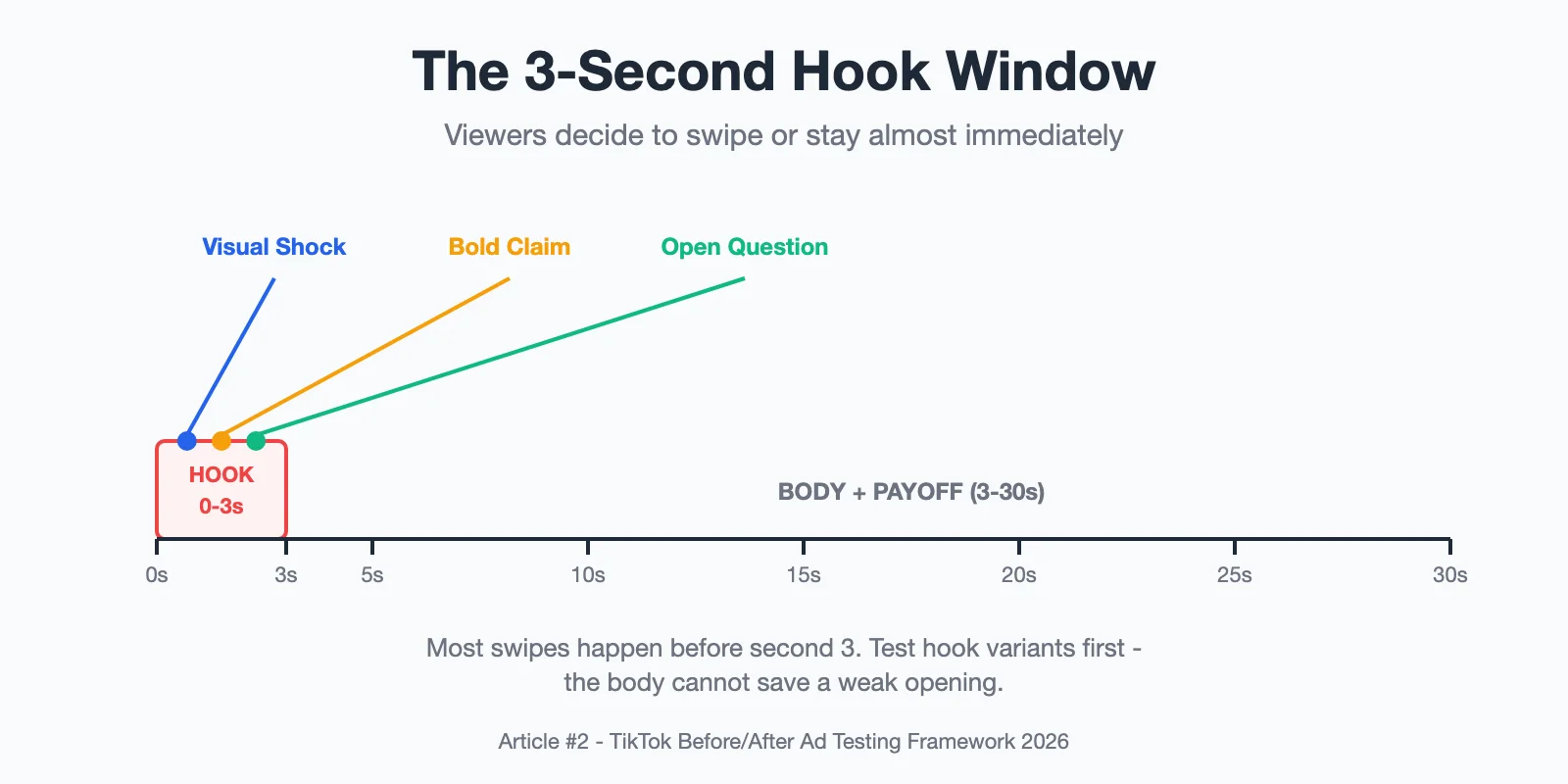
HeroPost's 2026 TikTok for Business guide emphasizes hooks within 3 seconds: questions, visual payoffs, or pattern breaks. The Crasea case study confirms this—the juice absorption demo happened immediately, not after a brand intro or product unboxing.
The Crasea Case: What We Can Verify
Available sources document several facts about the microfiber cloth that hit $430k monthly sales:
Observable:
- Product: Tight microfiber cloth marketed as "one cloth for all" cleaning tasks
- Sales velocity: ~$430,000 in approximately one month on TikTok US
- Distribution channel: 63% of sales came from product cards using search keywords like "magic cleaning"
- Creative approach: "Pain + solution" videos showing absorption and quick-rinse demonstrations
- Viral elements: Juice absorption hook, softness claims, visible transformation
Unverifiable from public sources:
- Exact media spend vs. organic reach breakdown
- ROAS or profit margins (only revenue is reported)
- Specific video timestamps or creator details
- Whether paid amplification was needed to reach scale
What this means for your testing: You can replicate the creative framework without copying the exact asset. But you need access to your own performance data to know what's working, not just industry anecdotes.
Three Critical Design Decisions
1. Hook Selection: Which Pain Point Gets First Frame?
The Crasea videos led with juice absorption—a visceral, immediately understandable problem. But your product might have multiple pain points to choose from:
Kitchen cleaning products:
- Grease buildup on stovetops (visual, messy)
- Water stains on glass (subtle, requires close-up)
- Food residue on counters (relatable, everyday)
- Odor removal (invisible, harder to demonstrate)
Personal care products:
- Acne marks (emotional, high-stakes)
- Dry skin texture (tactile, requires detail shots)
- Hair damage split ends (visible, before-after friendly)
- Scalp oiliness (less visually dramatic)
Home organization:
- Cluttered surfaces (relatable, transformation-friendly)
- Difficult-to-clean storage (process-oriented)
- Space optimization (requires measurement context)
Decision rule: Choose the pain point that is most visible in 3 seconds without explanation. If you need text overlay or narration to make it clear, it's probably too subtle for top-of-funnel TikTok.
2. Payoff Timing: When Does the Transformation Happen?
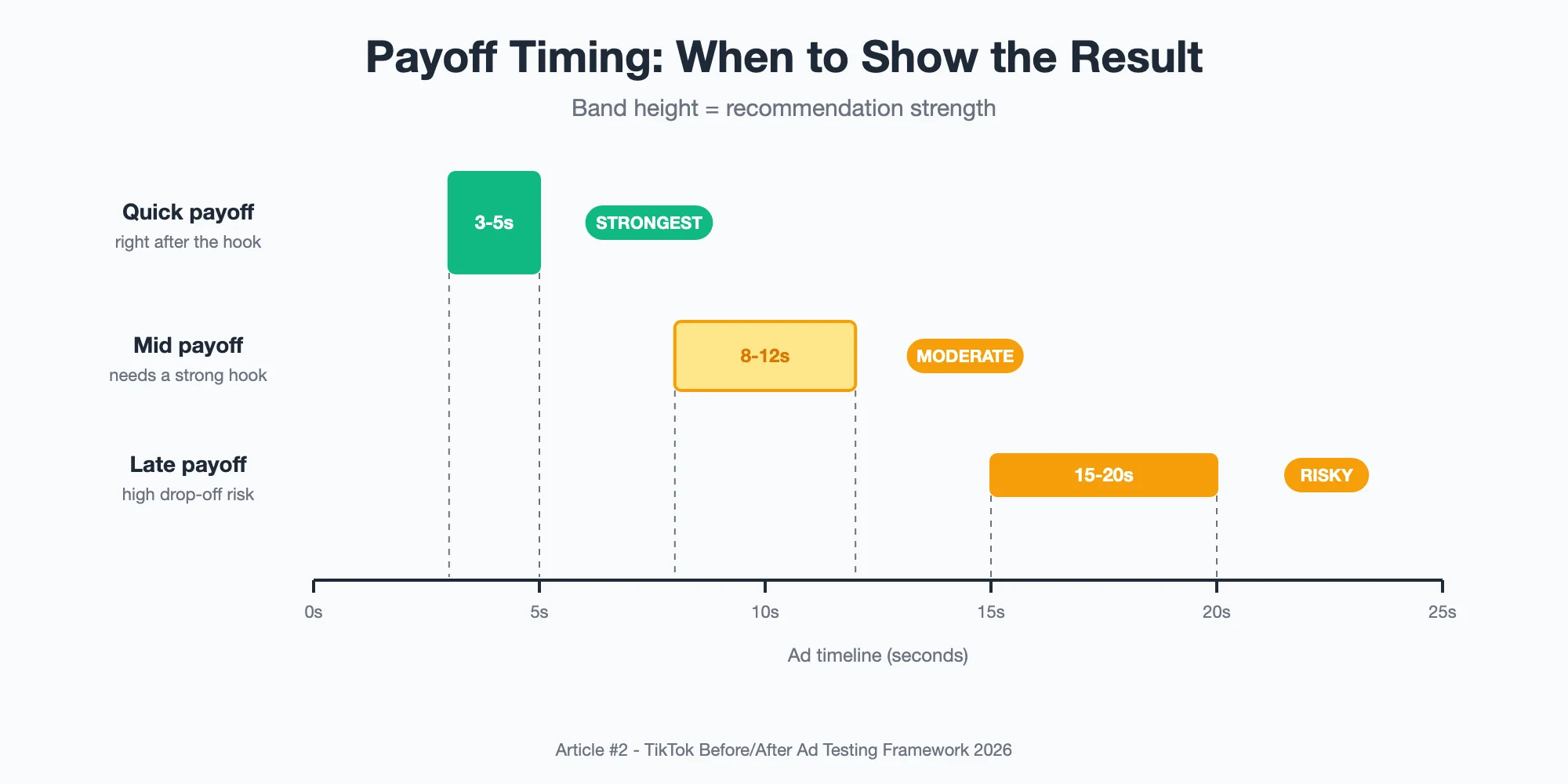
TikTok's attention economy rewards immediacy. The Crasea videos delivered the wipe-away payoff within 5-8 seconds of the hook. This timing matters for three reasons:
Retention: Viewers decide whether to keep watching in the first few seconds. Delaying the payoff increases drop-off.
Algorithm signal: Completion rate and rewatch rate feed TikTok's distribution logic. Fast payoffs encourage both.
Platform norms: Organic TikTok content rarely builds slowly. Ads that feel native to the platform perform better than polished production pieces.
But speed isn't the only consideration. Some transformations require setup time to feel authentic:
- Instant transformations (cleaning products, makeup removal): Deliver payoff quickly, no apology needed
- Process transformations (organization systems, deep-cleaning routines): Show key steps but compress timeline
- Results transformations (skincare outcomes, fitness changes): Be honest about timeframes, don't fake instant results
For cleaning products specifically, the sweet spot is 5-15 seconds from hook to payoff. Anything longer risks feeling like a commercial rather than useful content.
3. Proof Elements: What Makes the Claim Credible?
Crasea's success included "softness claims" alongside visual proof. This combination matters because:
Visual proof shows the transformation is real, not staged Feature claims explain why it works, building rational justification Social proof (reviews, user-generated content) validates beyond the brand's word
Your before-after ads should include at least one credible proof element per variation:
- Texture demonstration: Show the microfiber weave up-close to justify "tight microfiber" claims
- Chemistry explanation: Briefly explain why something works (enzyme action, abrasion level)
- Comparison shots: Side-by-side with competing methods (hand-washing vs. cloth wiping)
- Usage context: Show the product being used in realistic scenarios, not just studio lighting
- Result metrics: "Wipes clean in 3 passes" is more concrete than "wipes clean easily"
Avoid proof elements that feel defensive or over-explained. TikTok audiences respond to confidence, not caveats.
What Before-After Ads Cannot Prove
Here's where most merchants go wrong: They treat viral before-after ads as universal winners and assume their product should follow the same pattern.
Before-after ads cannot prove:
- Long-term customer satisfaction (only initial reaction)
- Repeat purchase likelihood (one-time novelty vs. ongoing utility)
- Profitability at scale (viral ≠ profitable)
- Transferability to other channels (TikTok behavior ≠ Instagram or Meta)
- Performance for different price points ($20 impulse buy ≠ $200 consideration purchase)
The Crasea cloth worked at its price point and category. A $430k monthly seller doesn't mean every cleaning product will replicate that result. Your job is to test whether your specific offering fits the format, not assume it does based on one case.
A Testing Framework for Before-After Variations
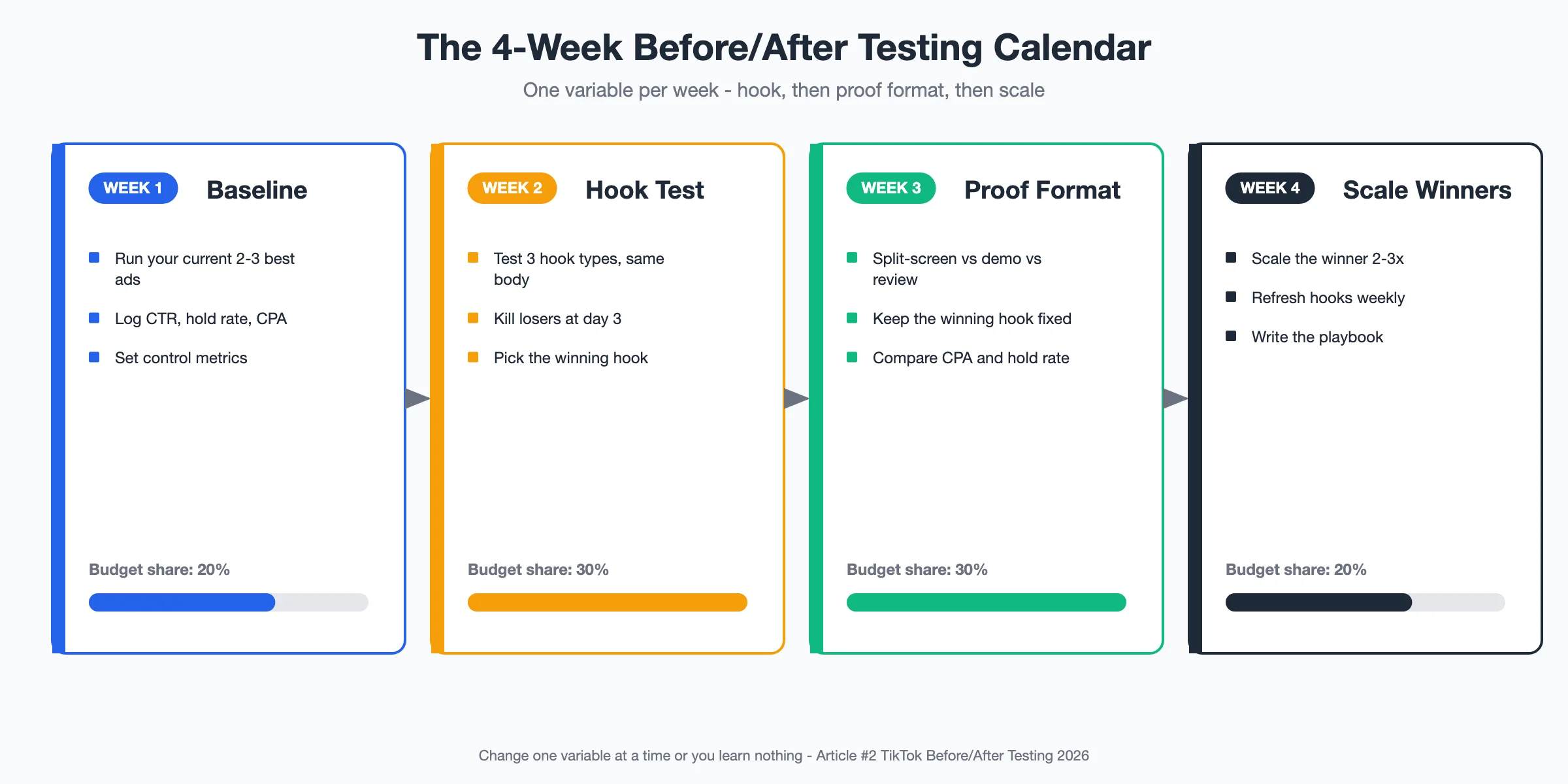
Instead of betting everything on one creative approach, run structured tests:
Week 1: Hook Validation
Create 5-10 variations with different opening hooks:
- Problem-first: "Tired of stubborn stains?" → show stain → show solution
- Payoff-first: Show clean surface immediately → cut to "how we got here"
- Question-first: "Ever wonder how restaurants keep tables this clean?" → reveal product
- Pattern-break: Unusual angle or perspective → normalize into product demo
- User-generated style: Phone-quality footage → less polished, more authentic
Measure completion rate and click-through separately. High completion with low CTR suggests entertaining but weak offer. Low completion suggests the hook itself needs work.
Week 2: Payoff Timing Tests
Take the winning hooks and test payoff windows:
- Instant (3-5 seconds): Immediate transformation, minimal setup
- Standard (8-12 seconds): Brief setup, clear payoff
- Extended (15-20 seconds): More context, still compressed
Don't spread budget evenly. Allocate 60% to standard timing, 30% to instant, 10% to extended. Kill underperformers quickly, double down on what moves the needle.
Week 3: Proof Element Combinations
Test different proof types alongside winning hook-payoff pairs:
- Texture close-ups: Justify material claims
- Side-by-side comparisons: Show superiority over alternatives
- Real-world usage: Contextualize the transformation
- Result metrics: Add specificity ("3 passes," "10 seconds")
- No proof: Baseline control, pure transformation focus
The baseline often outperforms expectations. Sometimes the transformation speaks for itself without added justification.
Week 4: Scale and Refine
Take the top 2-3 performers and:
- Increase budget incrementally (20% at a time)
- Test against different audience segments
- Create derivative variations (same concept, new execution)
- Document learnings for future creative development
When Before-After Isn't The Right Format
Not every product belongs in before-after territory. Consider alternative approaches when:
Your transformation is invisible: Skincare improvements, supplement effects, software productivity gains—these don't have obvious visual before-after moments. Use educational content, user testimonials, or feature-benefit framing instead.
Your price point requires consideration: $150+ purchases need more than visual proof. Build trust through detailed explanations, comparison guides, or founder stories before expecting conversion.
Your category is saturated: Cleaning products, beauty tools, kitchen gadgets—all crowded with before-after ads. Differentiate through unique angles (reverse demos, failure cases, expert validation) or skip the format entirely.
Your supply chain can't handle demand spikes: Viral before-after ads create sudden traffic surges. If you can't fulfill orders reliably, you'll damage brand reputation faster than you build it.
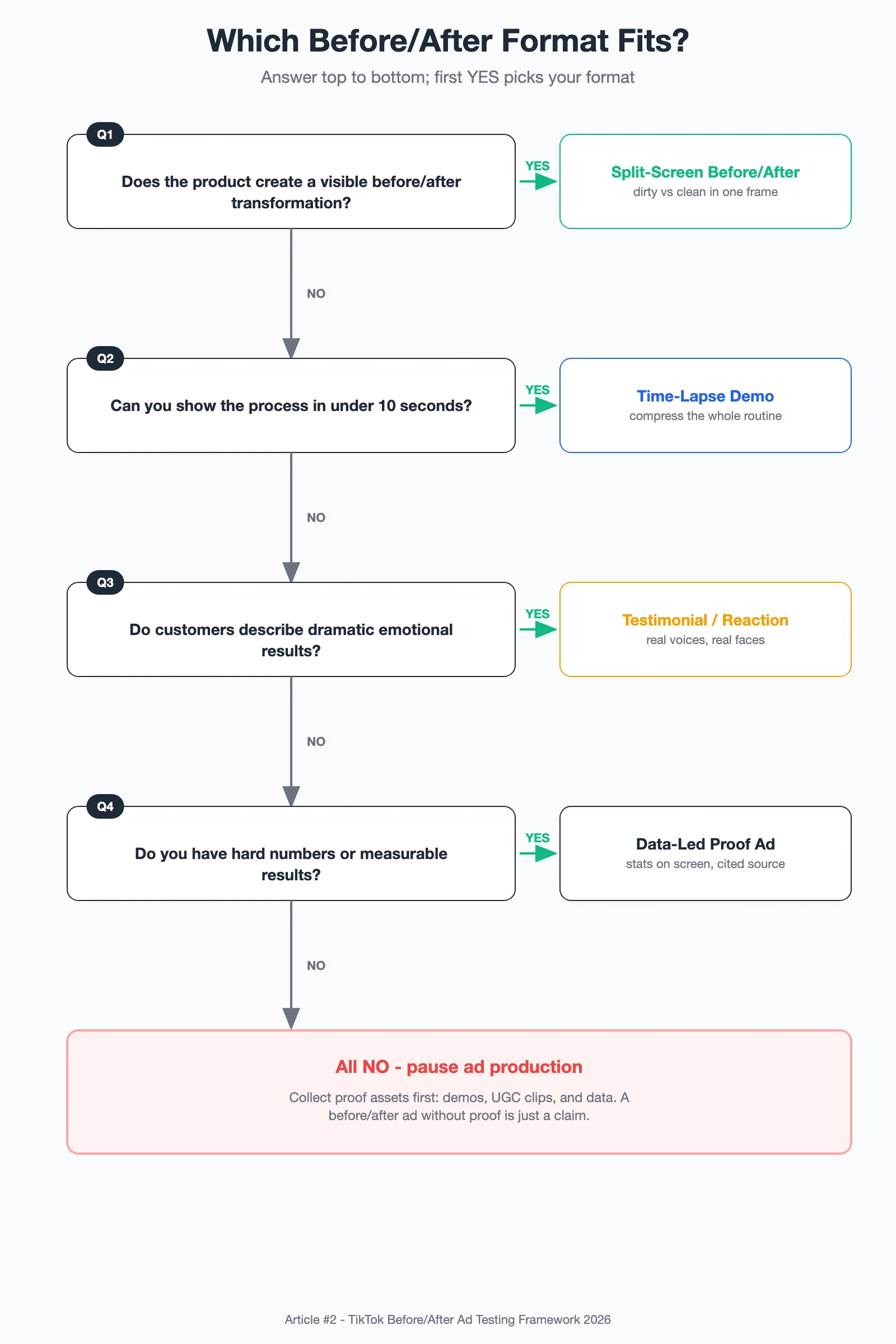
The Real Question: Is Your Product Testable in This Format?
Before investing heavily in before-after creative, ask:
- Does my product have a visible transformation? If not, don't force it.
- Can I demonstrate that transformation in under 15 seconds? If it requires 2 minutes of explanation, reconsider.
- Do I have multiple pain points to test? One hook limits your learning velocity.
- Can I produce 20+ variations monthly? TikTok's algorithm rewards volume and iteration.
- Am I prepared to kill underperformers quickly? Attachment to creative kills testing.
If you answer yes to most of these, before-after ads deserve serious testing. If not, there are other paths to TikTok success that fit your product better.
Sources:
- Shopify TikTok Marketing Guide 2026 – Hook strategies and format recommendations
- HeroPost TikTok for Business 2026 – Platform best practices and native advertising guidance
- TKFFF Crasea Case Study – Microfiber cloth $1.2M weekly sales via pain-solution format
- Sohu Cleaning Cloth Analysis – $430k monthly sales breakdown and keyword strategy