How I Keep AI Video Ads Compliant: My Pre-Launch Checklist
One undisclosed AI presenter cost me a rejected campaign. Now every AI video ad I ship passes the same pre-launch review — claims, disclosure, rights, platform rules.
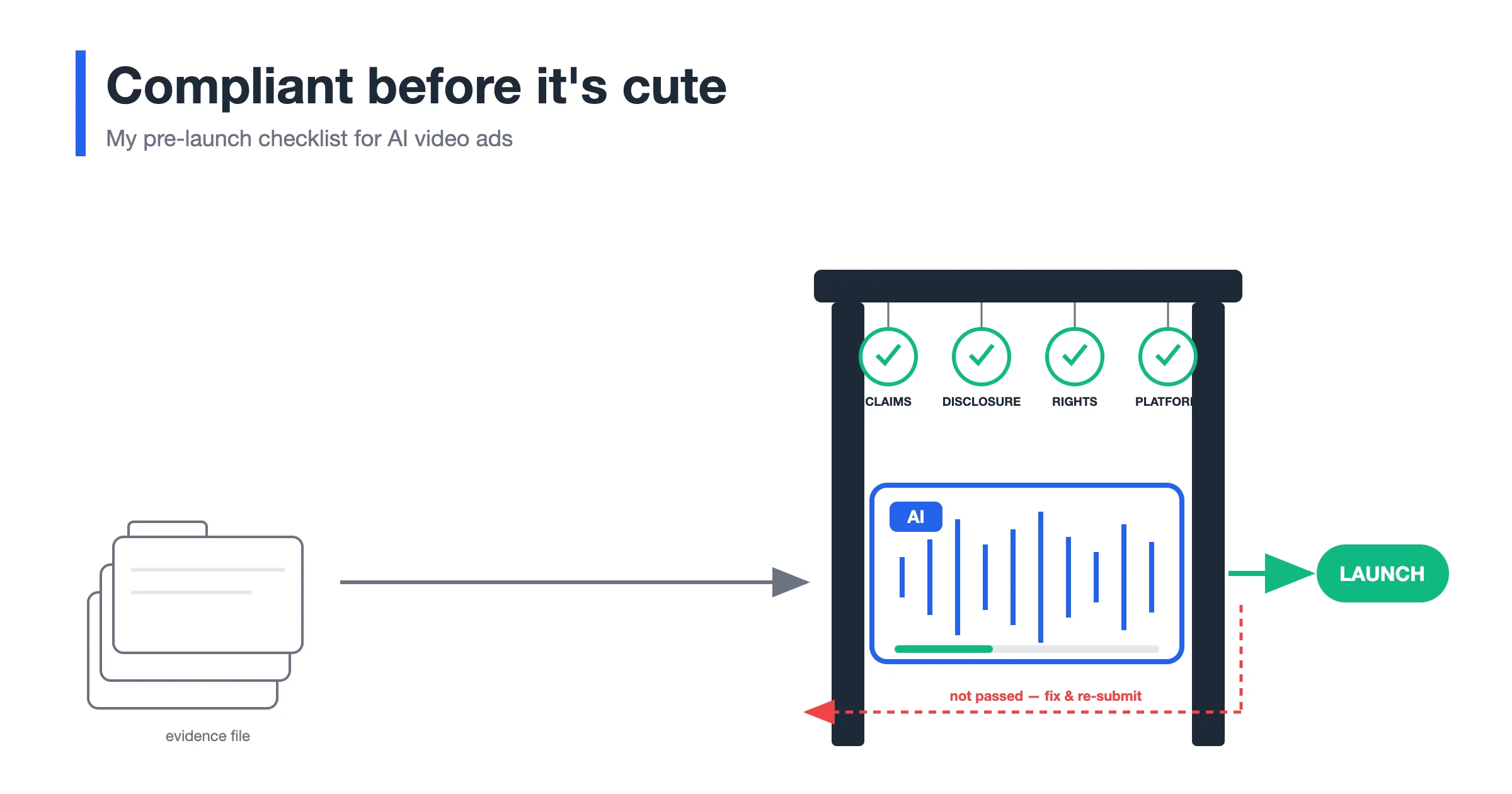
Practitioner playbook — a composite field guide written from the perspective of a brand operations lead. Figures are illustrative, not verified client results.
I run brand operations for a consumer products company, which among other things means I own the pre-launch review for every ad we ship — including the AI-generated video ads our team now produces by the batch. I did not start out careful. Early on, we ran a campaign with a hyper-realistic AI presenter who was, in fact, not a real person, and nothing in the ad or the setup said so. Platform review bounced it, the reship lost us a week of flight time, and the most uncomfortable part was that nobody had decided to be misleading. Nobody had even thought about it. That's the actual failure mode of AI ad compliance: not malice, but speed outrunning process.
So I built a process. It's a checklist, a disclosure matrix, a claim-rewrite table, and a sign-off flow, and it catches roughly everything now. Two disclaimers before I walk you through it. First, this is an operating method, not legal advice — rules for advertising and AI disclosure vary by jurisdiction and platform and change constantly, so anything below marked "my rule" is a house standard, and when real stakes are involved my rule is to escalate to qualified counsel. Second, my thresholds and counts are illustrative; they describe how I work, not what any regulator or platform requires.
Here's the system, in the order I apply it.
I Map the Risks Before I Read a Single Rule
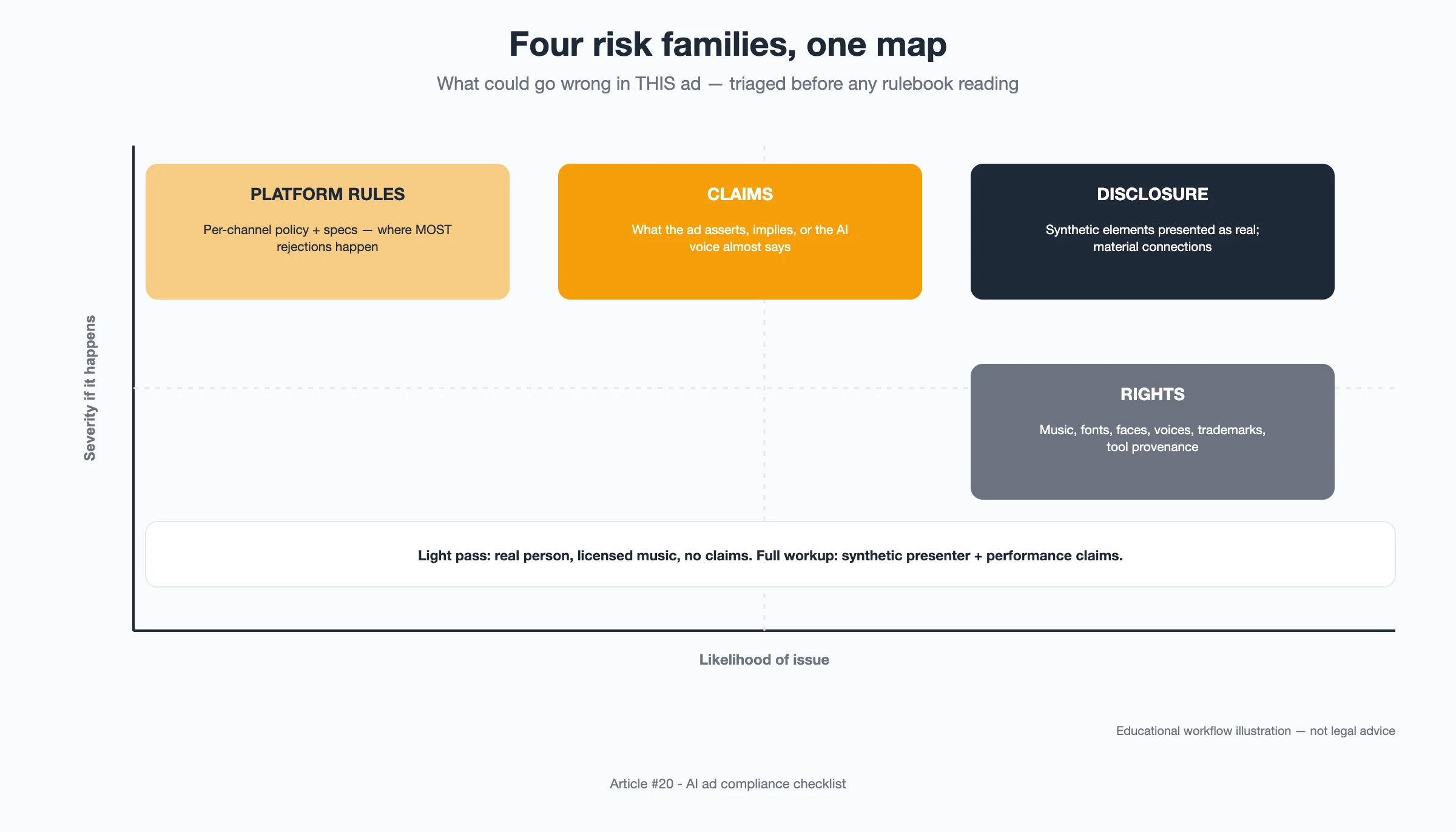
Rulebooks are organized by authority; ads are not. So my first pass on any creative is a risk map with four families, and I ask one question of each: what could actually go wrong in this specific ad?
- Claims. Everything the ad asserts, implies, or visually suggests — including what the AI voiceover doesn't quite say but the viewer will hear.
- Disclosure. Synthetic elements presented as real, material connections (affiliates, sponsorships, paid reviews), and before-and-after framing.
- Rights. Music, fonts, stock assets, any real face or voice, product likenesses, trademarks visible in frame, and the provenance of the generation tools themselves.
- Platform rules. Each network's ad policy and creative specs; an ad that's fine on one channel can be a violation on another, and this is where most of my rejections happen — policy mismatches, not legal problems.
Mapping risk family-by-family instead of ad-by-ad means I know which sections of the review need depth. A talking-head video of a real employee with licensed music gets a light pass. A synthetic presenter making product performance claims gets the full workup. Triage is the whole efficiency of the system.
The Disclosure Matrix: Which AI Elements Need Labels
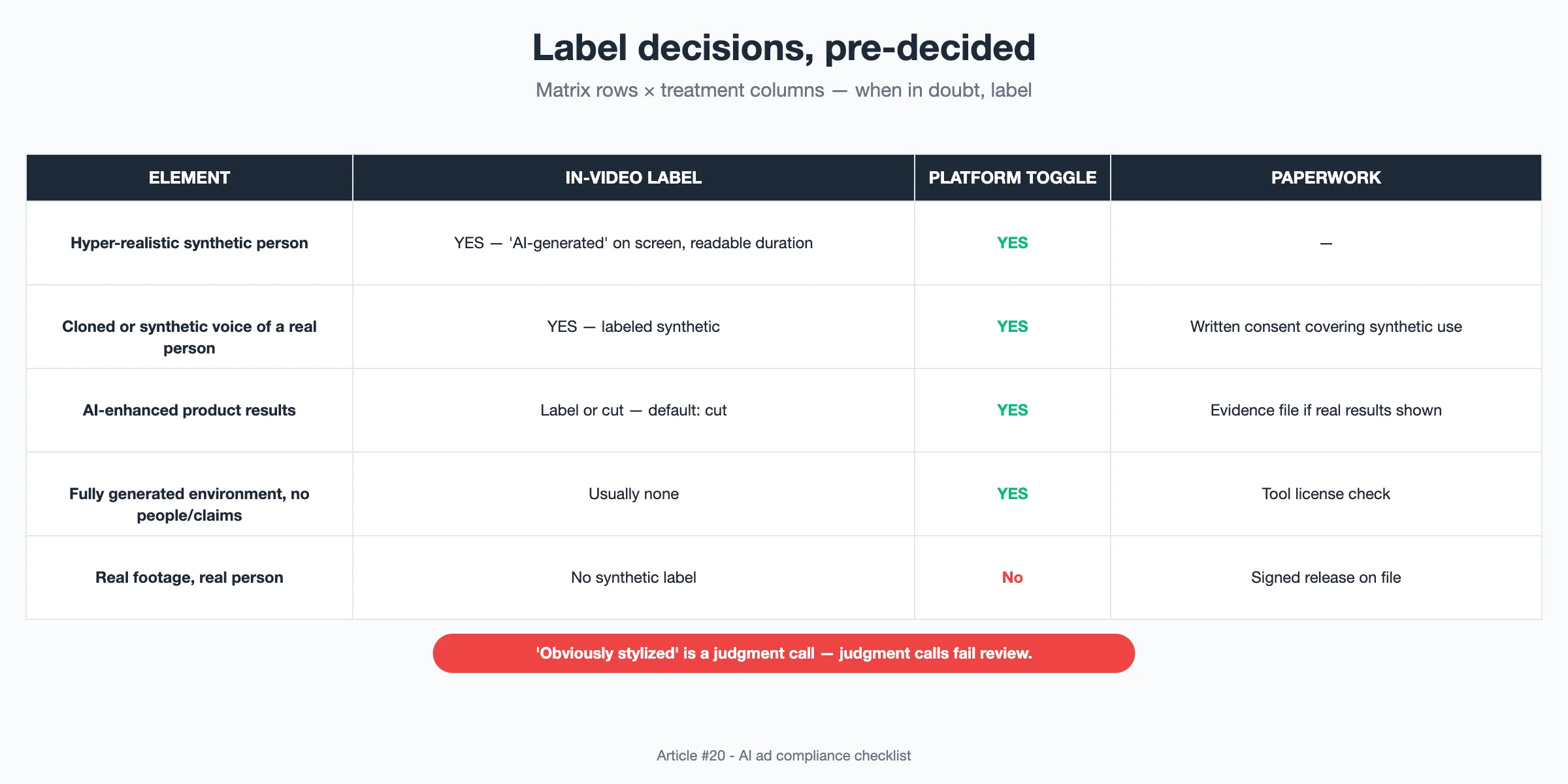
This is the single sheet that prevented the next version of my bad-idea campaign. For every AI element in a cut, my rule is a fixed disclosure treatment — in-video, not buried in a caption.
- Hyper-realistic synthetic person (any AI human that could pass as a real individual): visible "AI-generated" label on screen for a meaningful duration, plus the platform's native AI-disclosure toggle at the campaign level where one exists. No exceptions for "it's obviously stylized" — obviously is a judgment call, and judgment calls fail review.
- Cloned or synthetic voice of a real person: label it as synthetic, and never run a recognizable voice — even a team member's — without written consent covering synthetic use.
- AI-enhanced product results (skin, cleaning, food styling, anything "after"): if the enhancement goes beyond what the real product does, it's either labeled or cut. My default is cut.
- Fully generated environments with no people or claims: lighter treatment — usually just the campaign-level toggle.
- Real footage, real person, signed release: no synthetic label, but the release is the paperwork that proves it.
The matrix rows are element types and the columns are treatment levels, and every cell is pre-decided. The producer doesn't ask me "does this need a label?" because the answer already lives in the grid. When in doubt — and platforms' own definitions of "realistic" keep shifting — I label. Labels are cheap; rejections, relaunch delays, and lost trust are not.
Claim Language: What I Strike and What I Swap
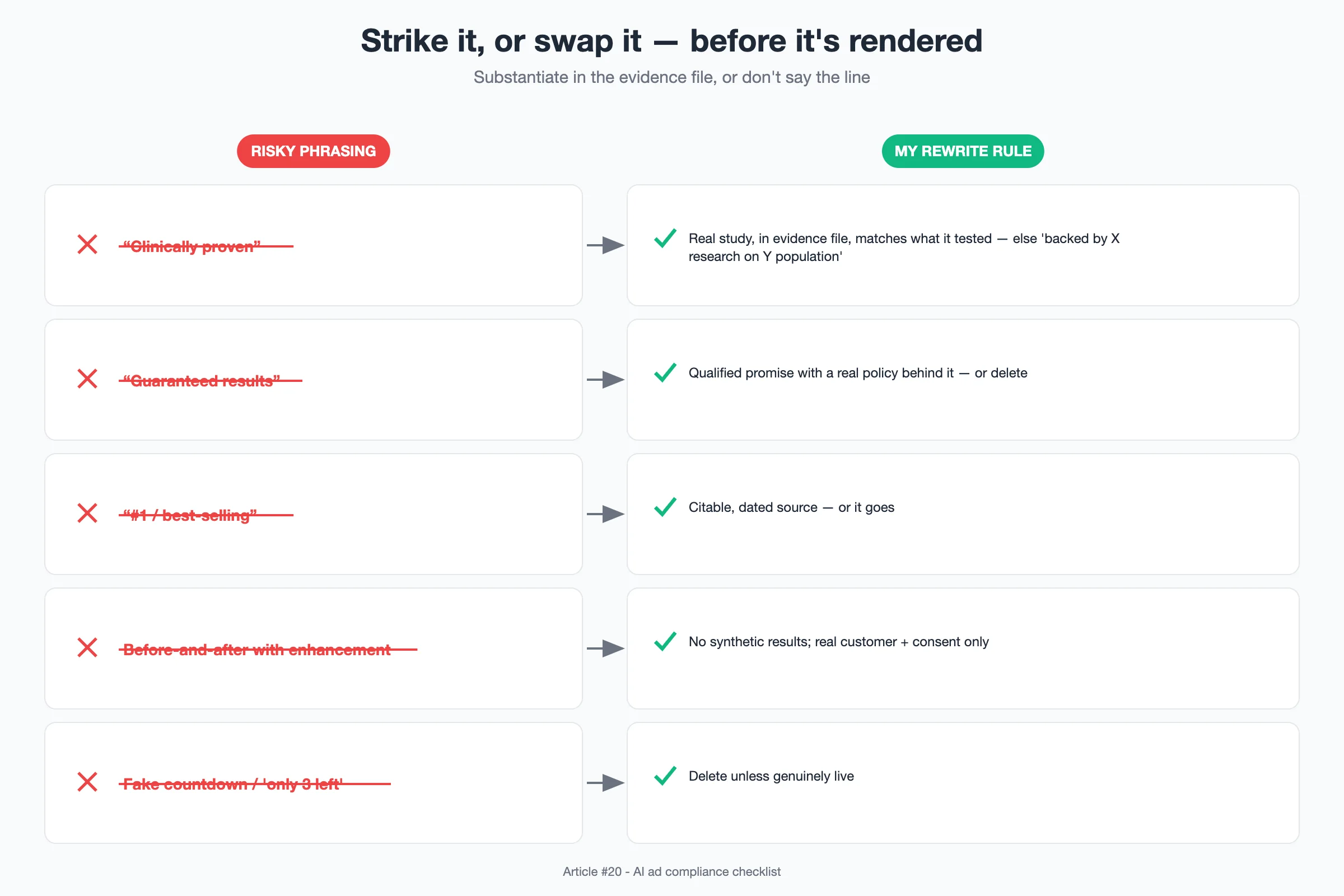
AI video makes claims easy to produce — a confident synthetic voice will say anything you type. So every spoken or on-screen claim passes through my strike-and-swap table before it's rendered, not after:
- "Clinically proven" → struck unless a real study exists, is documented in our evidence file, and the claim matches what it actually tested. "Backed by X research on Y population" instead of a universal "proven."
- "Guaranteed results" → swapped for a qualified promise with a real policy behind it, or deleted. Guarantee language is a magnet for both review bots and complaints.
- "#1" / "best-selling" → needs a citable source, dated, or it goes. AI narration says superlatives with such warmth that they feel earned. They still need receipts.
- Before-and-after visuals → no synthetic enhancement of results (see the matrix), and any real testimonial footage must be an actual customer with consent, not a generated person acting grateful.
- Countdown timers and "only 3 left" → deleted unless the scarcity is genuinely live. Fake urgency is the kind of thing that turns a rejected ad into a flagged account.
The underlying rule is one sentence: substantiate in the evidence file before launch, or don't render the line. It's much cheaper to rewrite a script than to withdraw a media buy.
The Pre-Launch Checklist: Every Ad, Every Time
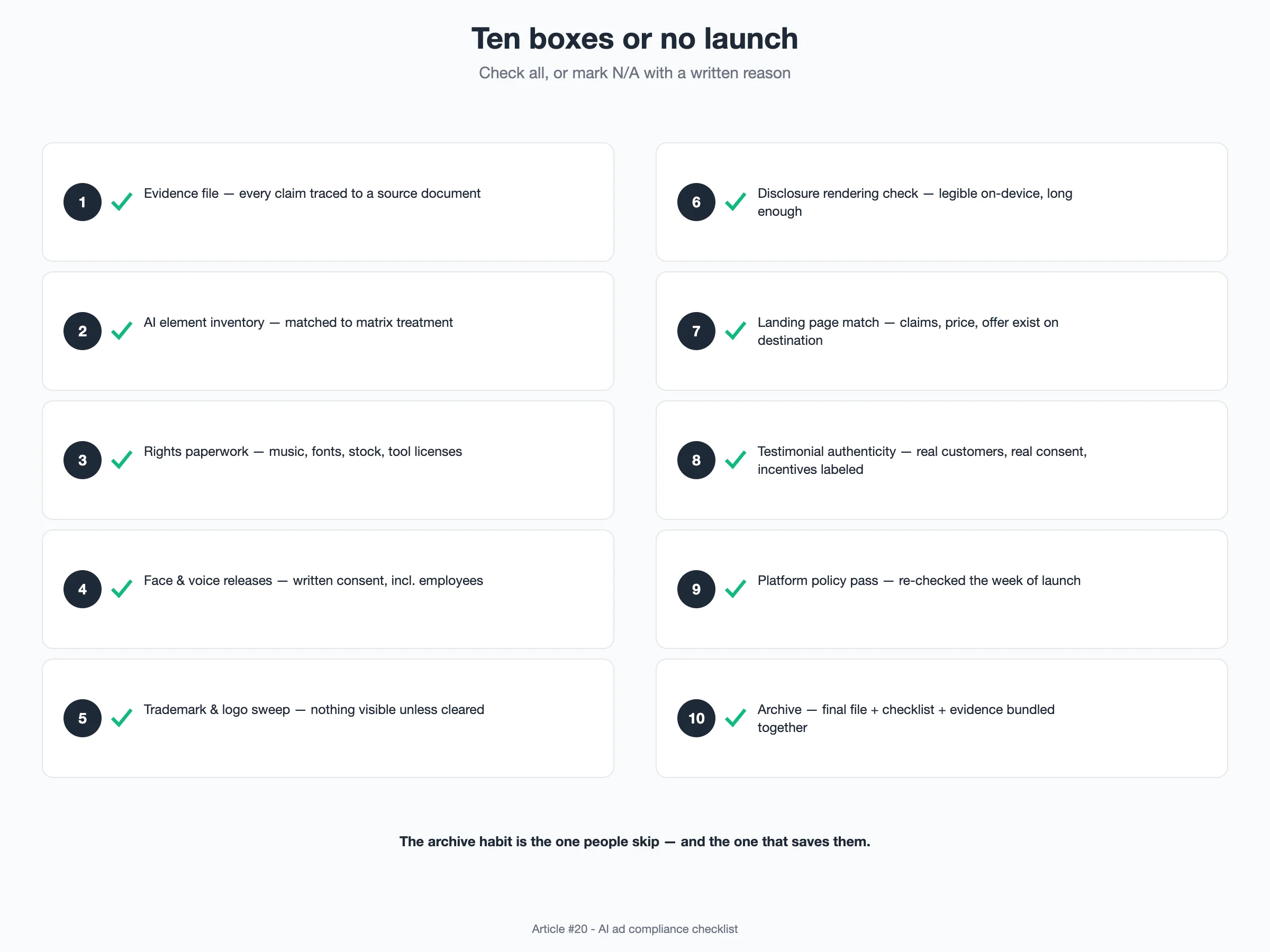
Ten boxes, no sign-off until all ten are checked or explicitly marked not-applicable with a reason:
- Evidence file — every claim in the ad traced to a source document.
- AI element inventory — every synthetic element listed and matched to its matrix treatment.
- Rights paperwork — music, fonts, stock, tool licenses confirmed for commercial ad use.
- Face and voice releases — written consent for any real person, including employees.
- Trademark and logo sweep — nothing recognizable visible in generated frames unless cleared.
- Disclosure rendering check — labels legible at feed size and on-device, on screen long enough to read.
- Landing page match — the ad's claims, price, and offer all actually appear on the destination.
- Testimonial authenticity — real customers, real consent, labeled if incentivized.
- Platform policy pass — re-checked against each channel's current rules the week of launch, because they change quietly.
- Archive — final file, checklist, and evidence bundled in one folder so that if a question arrives in month three, the answer takes minutes.
The archive habit is the one people skip and the one that saves them.
Sign-Off Is a Flow, Not a Feeling
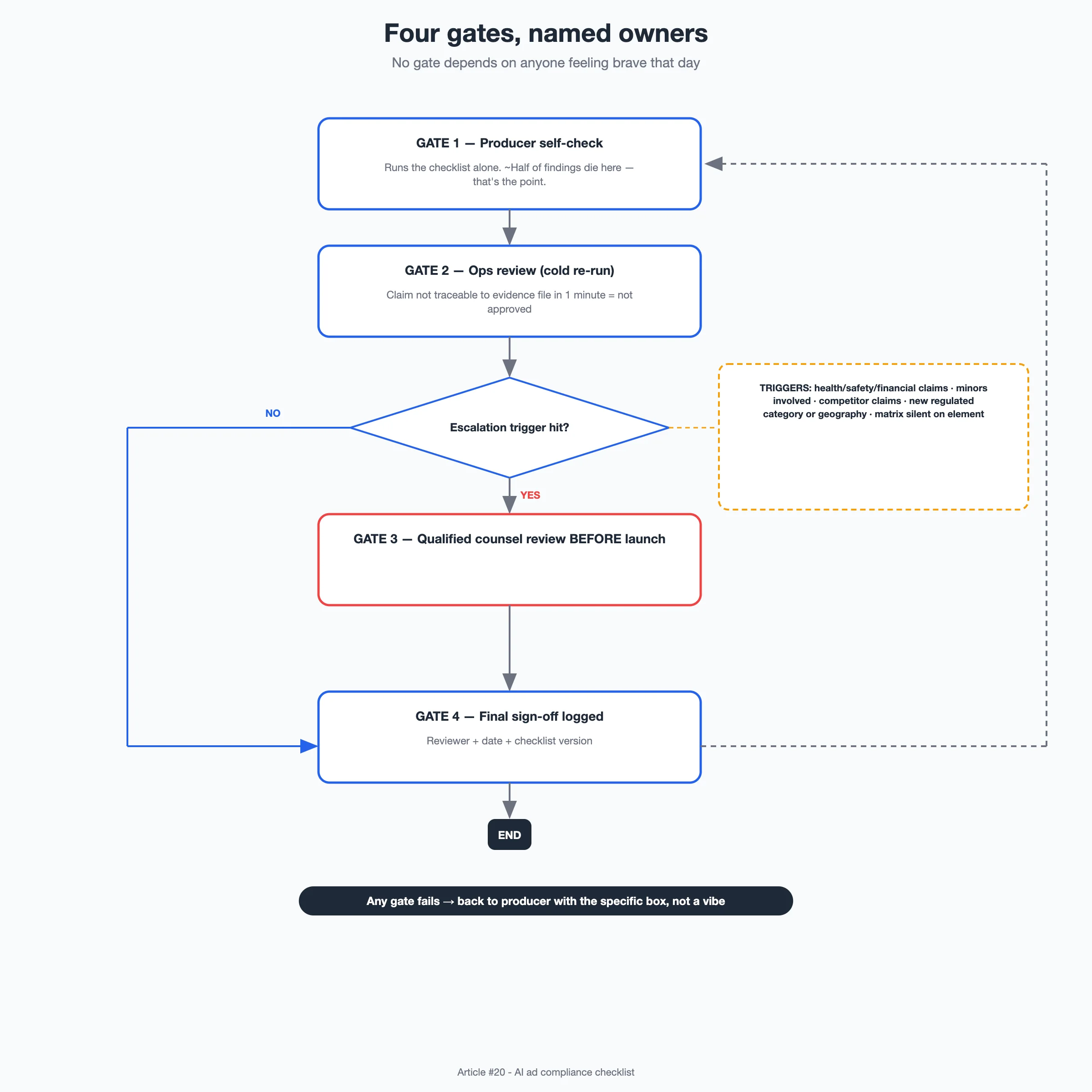
My final structural rule is that approval has named owners and forced handoffs:
- Producer self-check first. The person who made the ad runs the checklist alone. Roughly half my findings die here, which is the point.
- Ops review second — me. I re-run the checklist cold. If I can't trace a claim to the evidence file in under a minute, it's not approved; untraceable confidence is just risk with good posture.
- Legal escalation has pre-agreed triggers, not vibes. Health, safety, or financial product claims; advertising to or featuring minors; claims about competitors; new regulated categories or new market geographies; anything the matrix doesn't cover. If an ad touches a trigger, it goes to qualified counsel before launch — I never "basically" interpret a regulation.
- Final approval is logged with the reviewer, date, and checklist version.
One flow, four gates, and no gate depends on anyone feeling brave that day.
The Boring Habits That Keep the Checklist Alive
Checklists rot. Mine has three maintenance habits: a monthly policy sweep where I re-read each platform's ad rules and diff them against the checklist (it's been updated a handful of times a year, always by something small — a new disclosure toggle, a reworded category rule); a rejection log where every bounced or flagged ad gets a line, and the quarterly theme of that log becomes next quarter's checklist edit; and a deletion pass, because a checklist nobody trusts becomes a checklist nobody follows. When in doubt I add, but twice a year I subtract.
The Real Question: Would This Ad Still Pass With My Confidence Out of the Room?
The seductive failure in AI video is that everything looks finished. The synthetic presenter looks real, the claim sounds researched, the scene looks rights-cleared because nothing looks stolen. Confidence is exactly what I removed from the process — the checklist passes an ad on documents, not on impressions. So the question I ask before every launch isn't "does this look compliant?" It's "would this survive a reviewer who has never seen this ad, works from no memory of our last argument, and can't be charmed by how good the render looks?" If the answer is no, the ad isn't ready. Fix the paperwork before you praise the pixels.
Sources:
- U.S. FTC endorsement and advertising guides – general expectations on disclosures and material connections
- Major platforms' advertising policy and AI-disclosure help centers – channel-level rules that change quarter to quarter
- Licensing terms of common stock, music, and AI generation tools – commercial-use rights verification
- Marketing industry self-regulation publications on advertising claims – substantiation norms across categories
Disclosure: This piece is written from a practitioner's perspective to share a working method. It is not a customer testimonial, and any numbers are illustrative examples, not guaranteed outcomes.