Retargeting Without Annoying: The Frequency Rules I Follow
My best-performing retargeting audiences slowly rot when I let frequency drift. Here are the tiering, capping, and suppression rules I actually run in 2026.
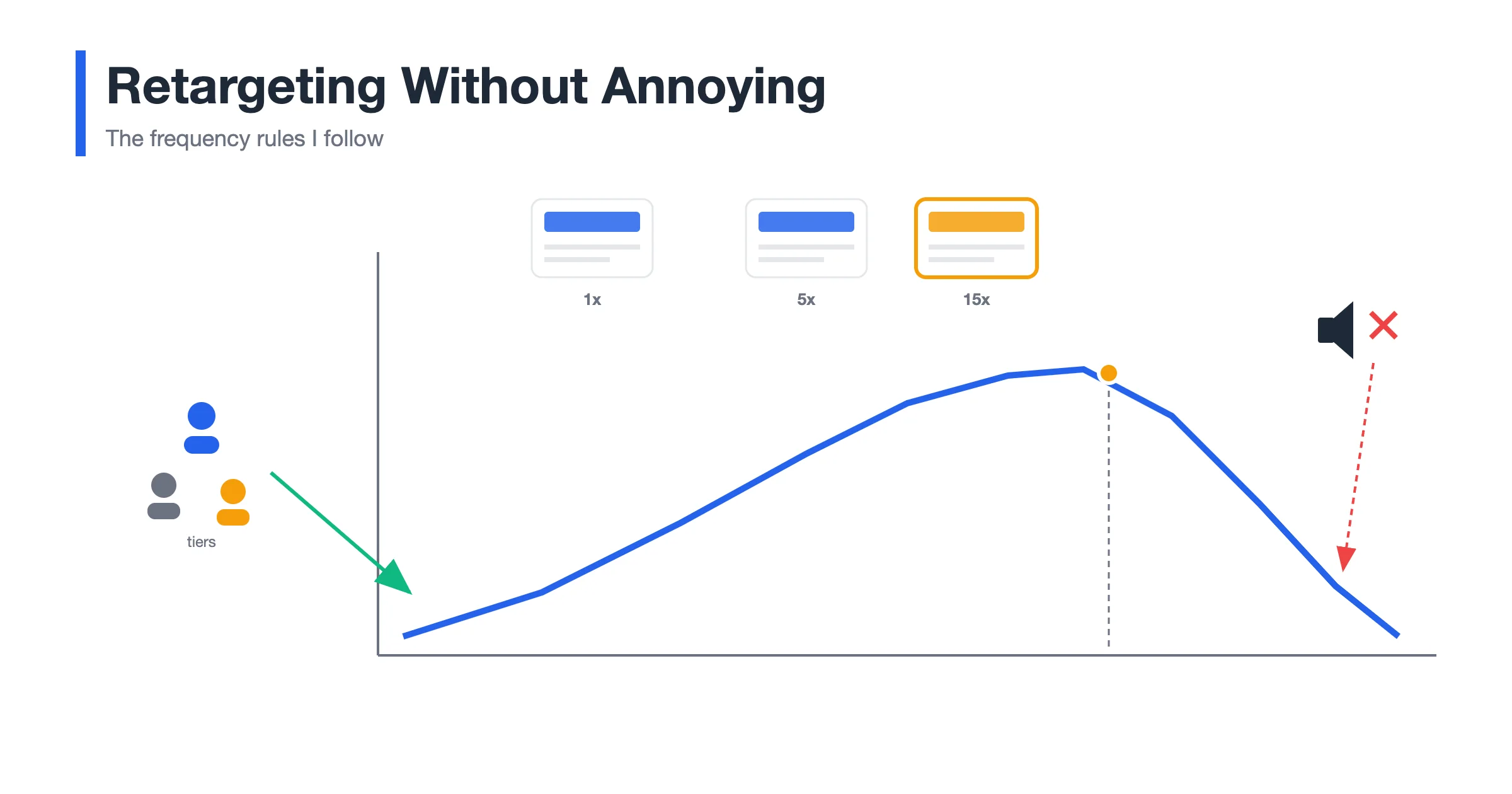
Practitioner playbook — a composite field guide written from the perspective of an affiliate program owner. Figures are illustrative, not verified client results.
I run the affiliate and partner program for a consumer products line, which means most of my retargeting budget follows people who arrived through someone else's content: a review site, a newsletter, a comparison page. These visitors already trusted a third party enough to click. That should make retargeting easy. For a long time it wasn't. One of my partner-sourced audiences kept buying the same ad for two straight weeks, click-through slowed to a crawl, and I initially read that as "the audience is low quality." It wasn't low quality. It was exhausted, and I was the one exhausting it.
The turning point was pulling frequency data by cohort instead of by campaign. Once I could see how many times the same person had seen the same message, the pattern was ugly and obvious: response climbed for the first couple of exposures, flattened, then fell off a cliff — while I kept pushing budget into the falling part of the curve. Retargeting frequency isn't a platform setting you configure once. It's a relationship you either respect or burn down.
This piece is the working method I settled on after that: how I tier audiences before I cap anything, how I read fatigue instead of guessing at it, how I escalate messages instead of repetition, and which exclusions quietly do half the work. Every number below is my own illustrative rule of thumb, not an industry promise.
I Tier Audiences Before I Touch a Frequency Cap
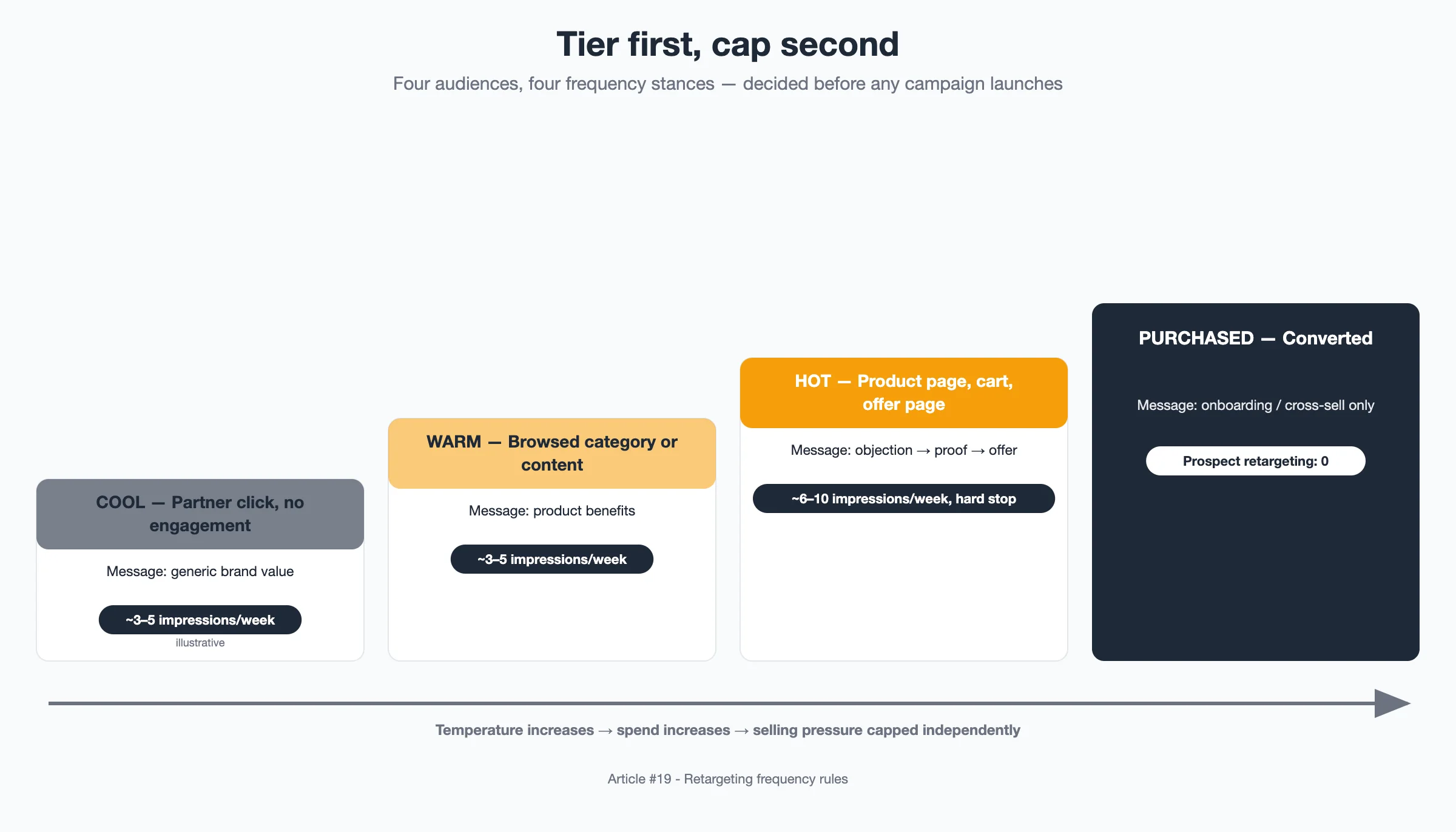
The single biggest mistake I made was treating "visited site" as one audience. A person who bounced off my homepage in four seconds and a person who abandoned a cart after reading three reviews are not the same human, and a shared frequency cap insults both of them.
My tiers, in order of temperature:
- Cool — partner click, no engagement. They came from an affiliate link and left fast. My stance: low priority, generic brand-value message, and a light cap. I'd rather find out they're interested cheaply than smother them early.
- Warm — browsed category or content pages. They read something. They get product-benefit creative and a slightly higher allowance.
- Hot — viewed product page, added to cart, or used a partner's offer page. This is where I spend real money, with the highest cap and the most specific message.
- Purchased — converted. They exit prospecting retargeting entirely and enter post-purchase sequences with a completely different job: onboarding, cross-sell, and eventually the affiliate loop (recurring commissions, if the product supports it).
Each tier gets its own frequency stance — for me that looks like roughly 3–5 impressions per week for Warm, maybe double that for Hot with a hard stop, and near-zero selling pressure for Purchased. The exact figures matter far less than the principle: decide the ceiling per tier before you need it, because you will never raise it voluntarily in the middle of a bad week.
I Read the Frequency–Fatigue Curve, Not a Magic Number
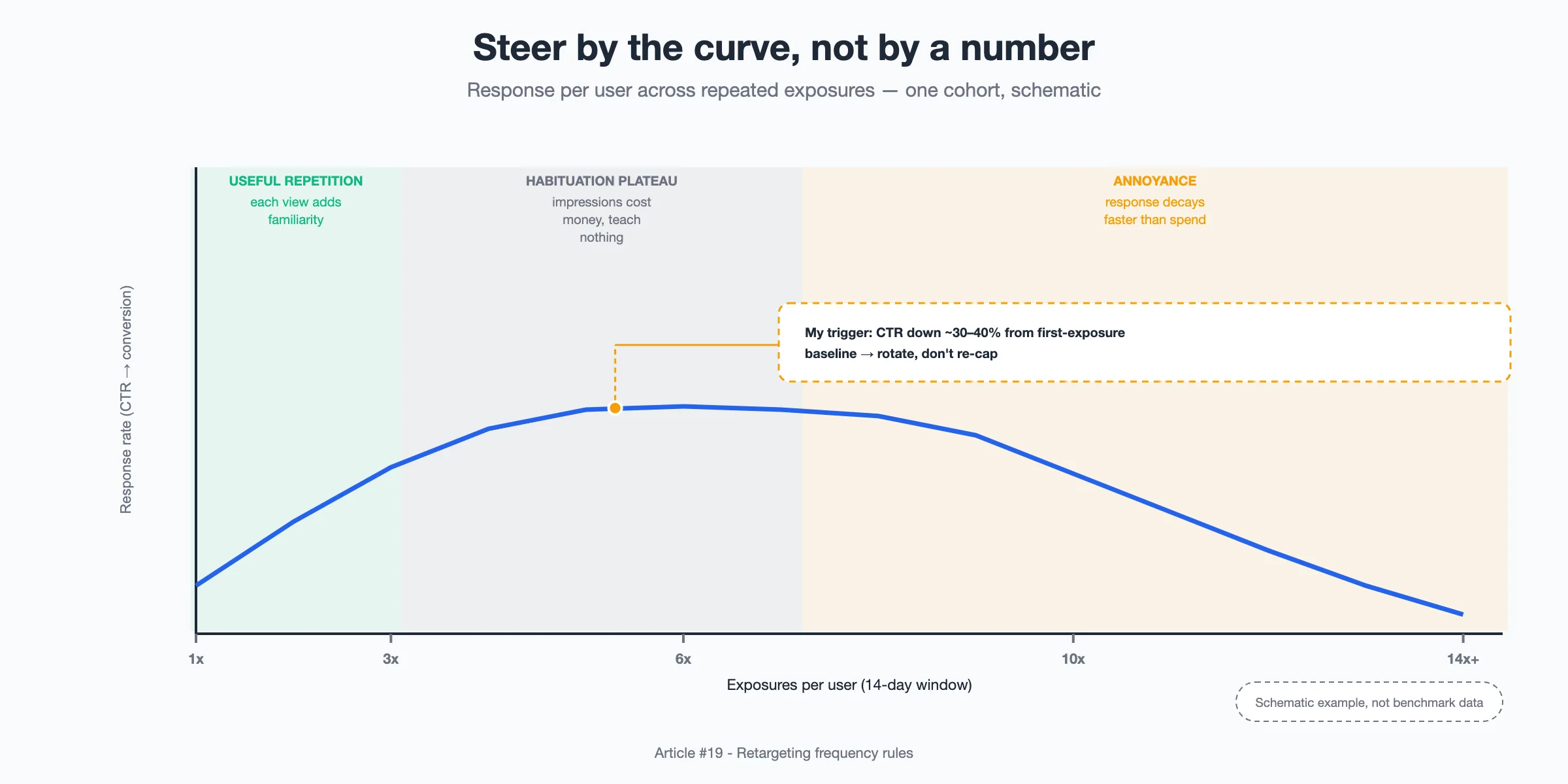
People ask "what frequency is too high?" as if there's a universal answer. There isn't. There's only your curve, and you can measure it.
I chart response rate (click-through to offer, ultimately conversion) against exposure count within a window, per cohort. The shape is stubbornly consistent: a useful-repetition zone where each exposure adds familiarity and response holds or climbs; a habituation plateau where extra impressions cost money and teach nothing; and an annoyance zone where response decays faster than spend, and — the part nobody budgets for — where you also feed negative brand sentiment into a user who will remember the ad, not the product.
My working rule, entirely illustrative: when a cohort's click-through on its most recent creative drops roughly 30–40% from its first-exposure baseline, I treat the audience as fatigued regardless of what the absolute frequency number says. Frequency is inputs; fatigue is outputs. I cap the inputs, but I steer by the outputs.
One habit that saves me: I review the whole curve weekly by cohort age (7-day, 14-day, 28-day windows) instead of staring at yesterday's frequency average. Averages hide the tails, and the tail — the people at twelve-plus exposures — is where the annoyance lives.
I Change the Message Before I Change the Cap
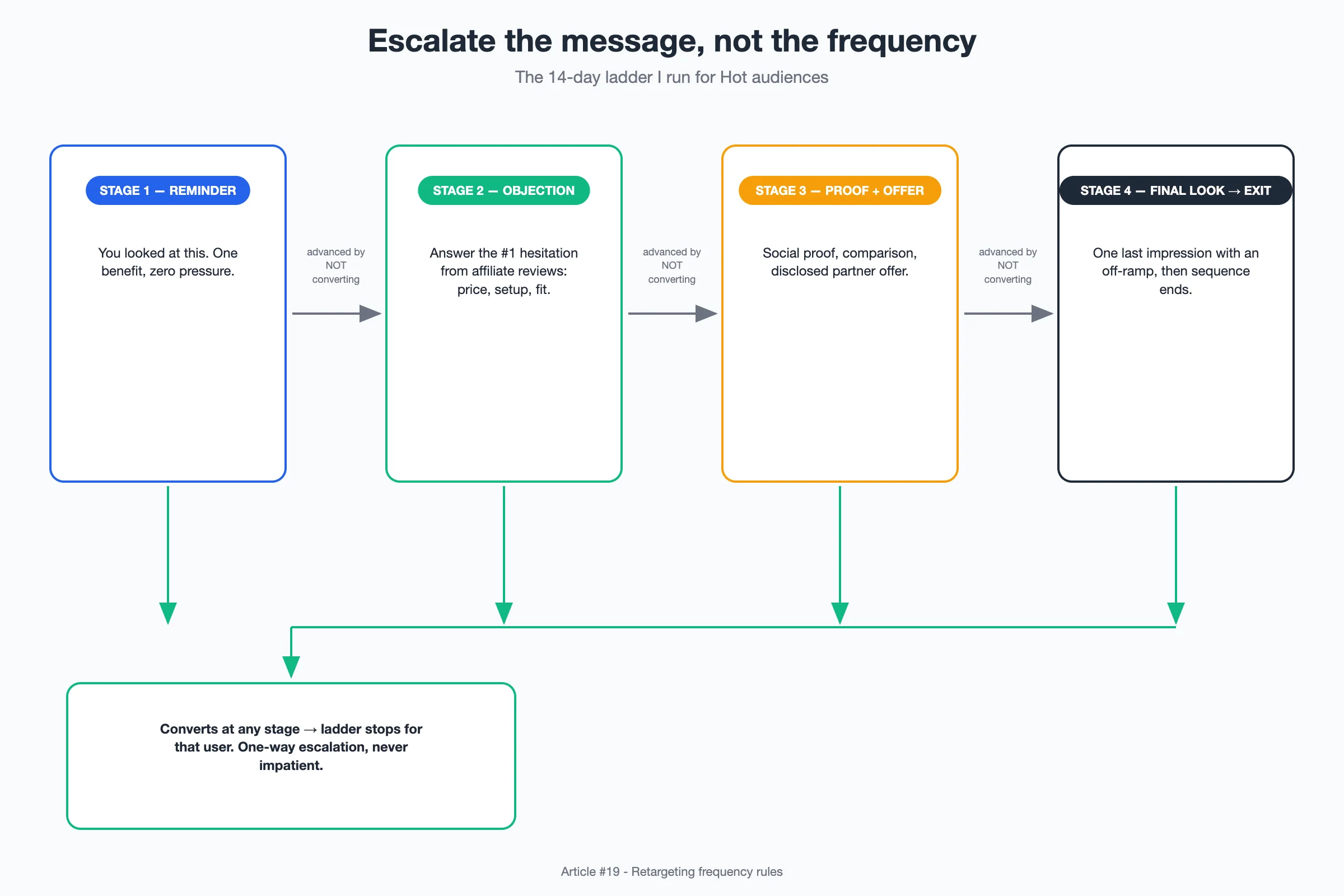
When performance softens, my first move is never "cap down." It's "say something new." Repetition of the same argument is what annoys people; repetition of the same opportunity with a progressing argument just reads as helpful — at least up to a point.
My ladder has four stages, and a user walks it over a defined window (I typically keep the full ladder inside 14 days for Hot audiences):
- Reminder. "You looked at this." Neutral, single benefit, zero pressure.
- Objection. The most common hesitation the affiliate audience would have — price, setup time, "does it work for my case" — answered directly. My top-converting affiliate partners are goldmines here: their review content tells me exactly which objections real buyers raise.
- Proof and offer. Social proof, comparison framing, and if the program allows it, an actual incentive or partner-exclusive angle. This is where a disclosed affiliate relationship belongs, not hidden in a footer.
- Final look, then exit. One last impression with an explicit off-ramp ("we'll stop showing you this"), then the user leaves the sequence entirely until a genuinely new event re-triggers them.
Escalation is one-way: a user advances by not converting, never by me getting impatient. If someone converts at stage two, stages three and four simply don't exist for them. If they exhaust stage four, the next impression I serve should carry a new promise, not an echo.
My Exclusion and Suppression Rules Do the Quiet Work
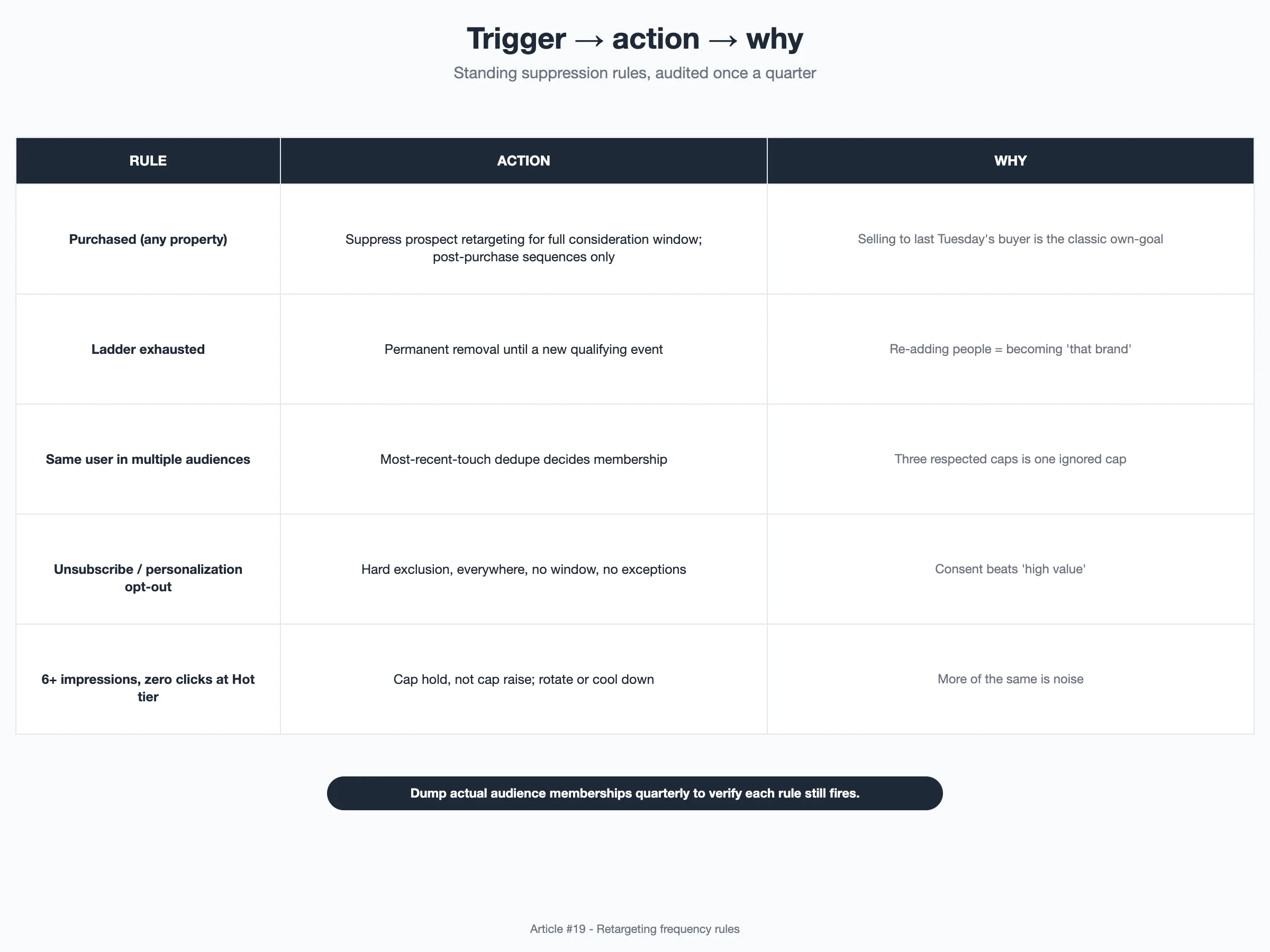
Half of "not annoying" is plumbing. These are the standing rules in my account, formatted as trigger → action:
- Purchased → suppress all prospect retargeting for the full consideration window, then switch to post-purchase only. The classic own-goal is selling a product to someone who bought it last Tuesday.
- Sequence exhausted → permanent removal until a new qualifying event. A finished ladder is finished. Re-adding people to "try again later" is how you get remembered as that brand.
- Duplicate signals across properties → most-recent-touch attribution decides the audience. Affiliate visitors often hit my site from multiple partners; without dedupe, one human lives in three audiences and each one gets its own cap. Three "respected" caps is one ignored cap.
- Newsletter unsubscribe or opt-out of personalization → hard exclusion from every tailored audience, everywhere. Non-negotiable, no window, no exception for "high value."
- Deep engagement without conversion at the Hot tier → cap hold, not cap raise. If someone has seen six impressions and never clicked once, more of the same is noise. That's my signal to rotate creative or let them cool down.
The table format matters because it makes every rule auditable. Once a quarter I dump my actual audience memberships and verify each rule fires — suppression lists have a way of silently breaking after platform updates.
One Flowchart Decides Who Sees What
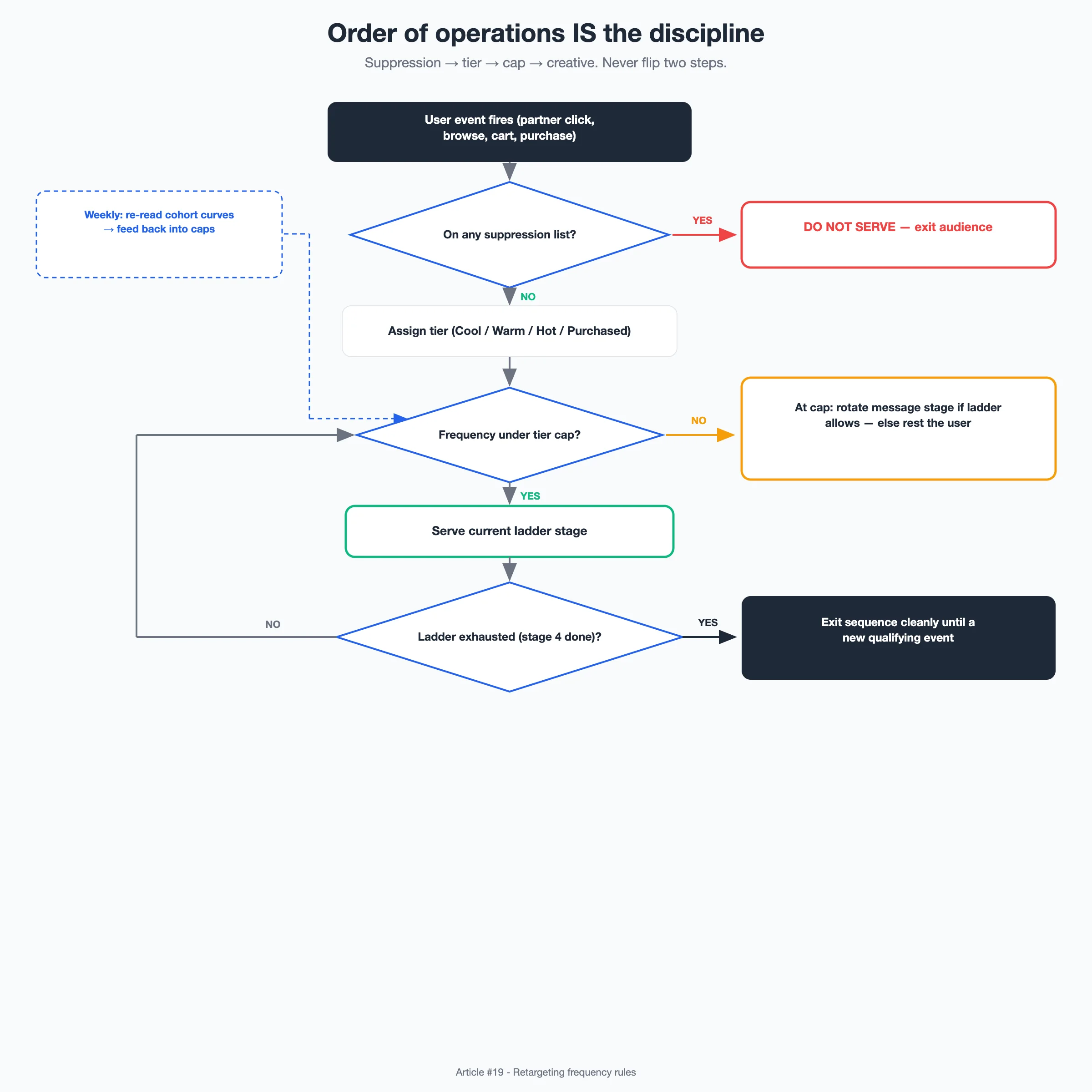
I keep every branch of this logic in one diagram pinned to my workspace: event fires → check suppression lists first → assign tier → check cohort frequency against the tier cap → under cap: serve current message stage; at cap: rotate stage if the ladder allows, otherwise rest the user → out of ladder: exit cleanly.
The order of operations is the whole discipline. Suppression before tiering, tiering before cap checks, cap checks before creative decisions. Flip any two and you get the failure mode where a purchased customer is "correctly" frequency-capped in an audience they should never have been in at all.
Having the flowchart also ends budget arguments. When performance dips, I'm not guessing whether to cut spend — I follow the branch: if fatigue signals are green and volume is fine, hold; if a cohort is deep in the annoyance zone, the flowchart sends it to rest or rotate, and the money follows automatically.
What I Review Weekly (and What I Deliberately Ignore)
My Monday review is short: frequency distribution histograms per tier (I care most about the right tail), click-through-by-exposure curves per creative, ladder stage progression rates (what share of users who reach stage three ever convert?), and a spot check that suppression lists are alive.
What I ignore: single-day frequency spikes, one partner's complaint that "your ads are everywhere" without a cohort behind it, and the seductive idea that a big promo period suspends the rules. Promo weeks are precisely when fatigued audiences punish you, because everyone else is bidding into the same impressions and your share of voice doubles by accident.
The Real Question: Are They Ignoring My Ads, or Have I Run Out of Things to Say?
When a retargeting cohort decays, the easy story is "ad blindness" — the audience has simply learned to ignore banners, so the fix is more volume or new placements. I no longer buy that story. The uncomfortable version of my data says people stopped responding when I stopped informing them: same face, same promise, same offer, seventh sighting. Frequency rules and message ladders are just the operational way of admitting that retargeting is a conversation, and conversations end when one side is repeating themselves. So before I touch a cap, I ask the annoying question: what would this ad tell someone who has already seen the last three? If the honest answer is "the same thing, louder," the audience isn't ignoring my ads. I've run out of things to say — and the fix is a new sentence, not a new impression.
Sources:
- Platform advertising documentation on frequency and impression counting – how each network meters impressions per user
- Independent benchmark reports from major ad networks – typical click-through decay across exposure counts
- Data-privacy guidance for marketing personalization and opt-outs – suppression and consent handling norms
- Affiliate industry disclosure guidelines – representing partner relationships inside retargeting creative
Disclosure: This piece is written from a practitioner's perspective to share a working method. It is not a customer testimonial, and any numbers are illustrative examples, not guaranteed outcomes.