Selling Into Southeast Asia: What TikTok Shop Needs Beyond Translated Creatives
Translation doesn't equal localization. A video that works in Los Angeles may fail in Jakarta if it ignores payment preferences, holiday calendars, and cultural humor.
Translation doesn't equal localization. A video that works in Los Angeles may fail in Jakarta if it ignores payment preferences, holiday calendars, and cultural humor.
Merchants expanding into Southeast Asia through TikTok Shop in 2026 face genuine complexity beyond simply translating creatives. Singapore offers mature infrastructure and English-speaking audiences as entry point. Indonesia requires Halal certification and Islamic holiday awareness. Vietnam demands mobile-first design and social proof emphasis. Thailand needs Line integration and influencer partnerships.
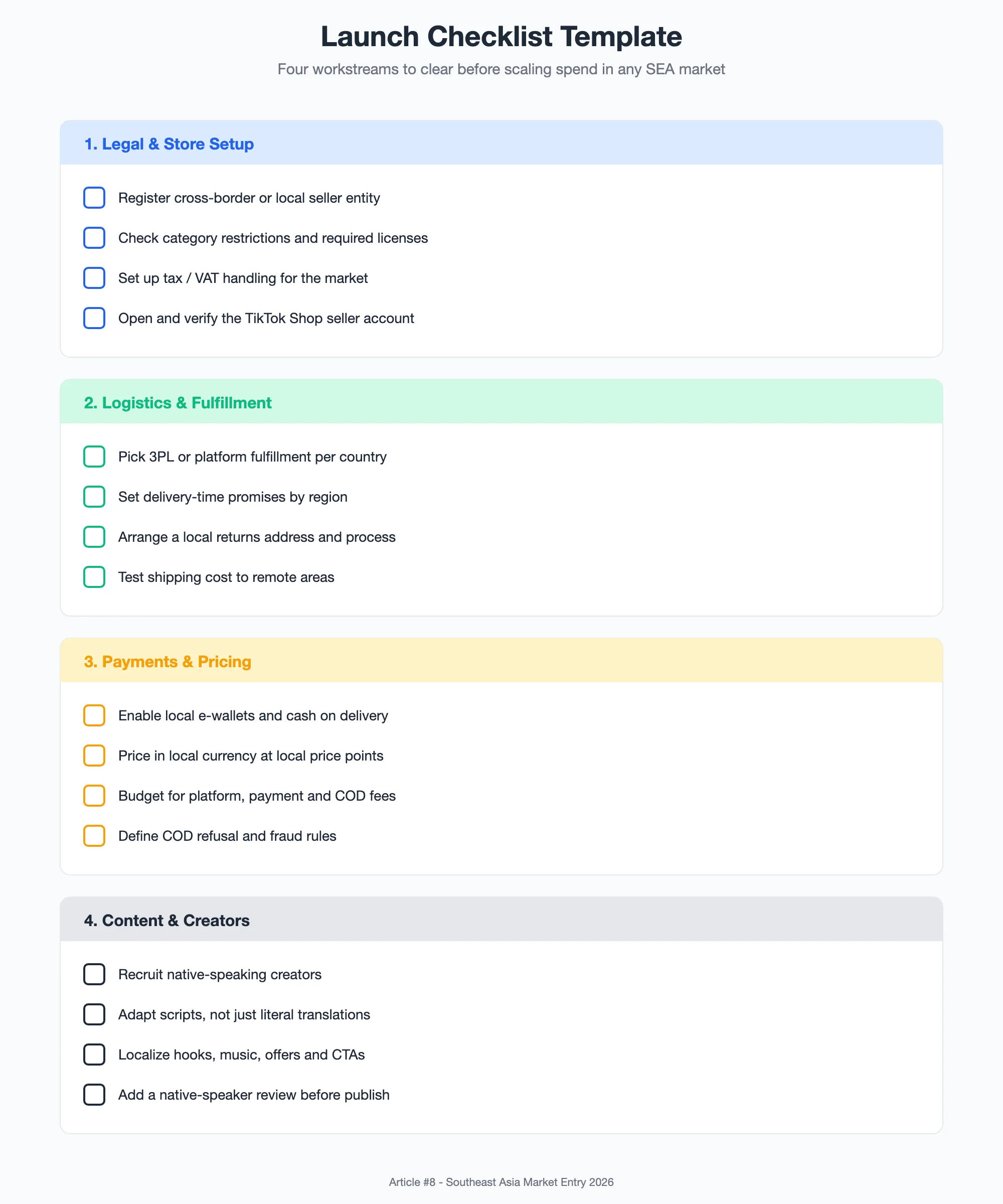
This article provides country-specific launch checklists covering payments, logistics, regulatory requirements, and creative localization principles for each major SEA market.
Why Southeast Asia Isn't a Monolith
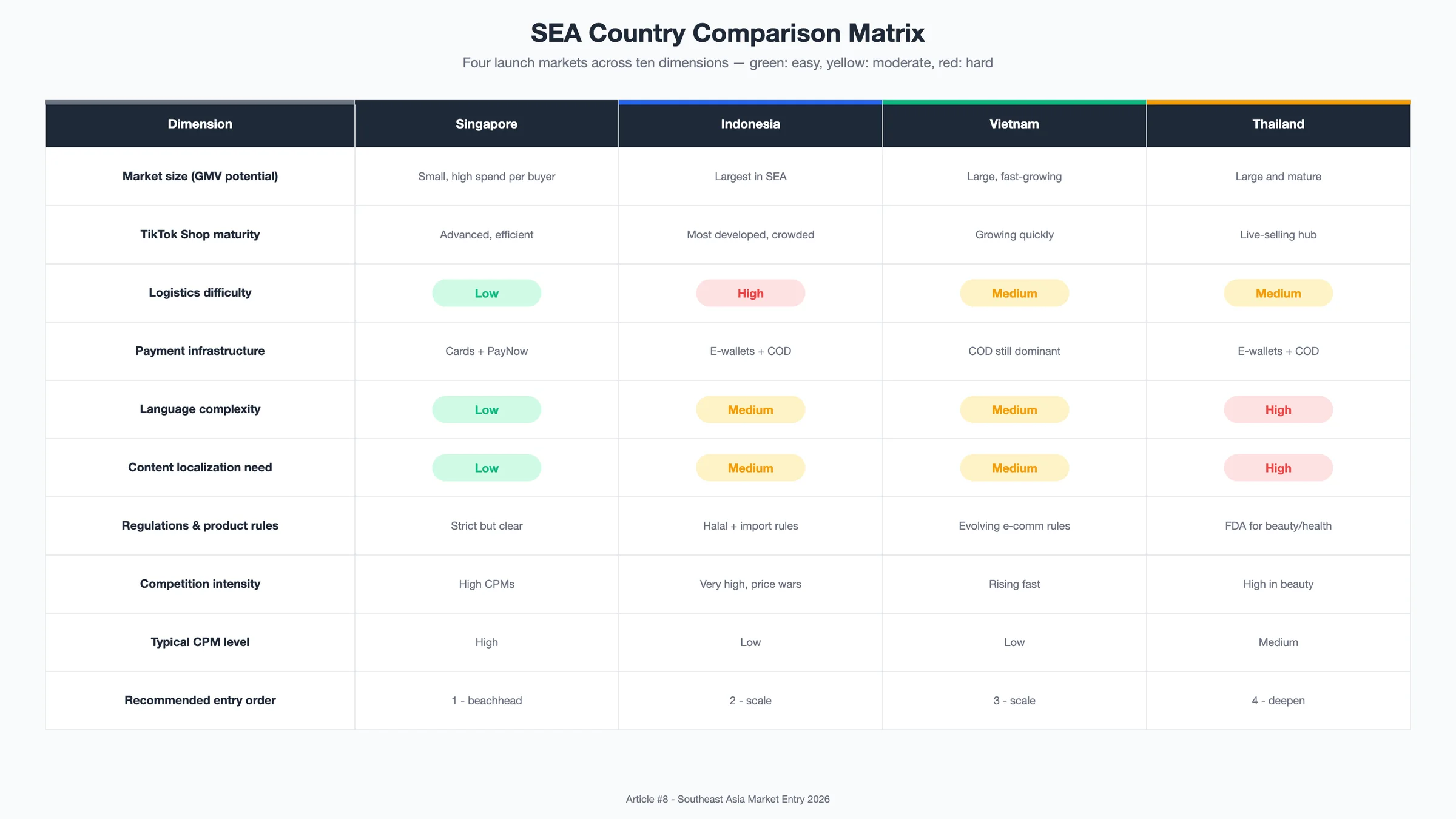
Southeast Asia comprises 10 countries with GDP per capita ranging from $4,000 (Vietnam) to $72,000 (Singapore). Language diversity exceeds 1,000 languages across the region. Payment preferences vary dramatically: cash-on-delivery dominates in Indonesia, while digital wallets lead in Singapore.
Treating Southeast Asia as single market guarantees failure. Your Singapore strategy should not automatically apply to Manila or Bangkok. Each country requires tailored approach based on local infrastructure, consumer behavior, and regulatory environment.
That said, successful patterns emerge across markets. Mobile-first design is universal. Social proof matters everywhere. Price sensitivity varies but exists in all markets. Understanding these commonalities while respecting differences creates scalable yet localized expansion strategy.
Singapore: The Entry Point
Singapore makes ideal first market for several reasons:
High spending power: GDP per capita $72,000 means consumers can afford premium pricing. Average order values 2-3x higher than regional peers.
Mature infrastructure: Reliable logistics (2-3 day delivery standard), high credit card penetration (85%+), sophisticated fulfillment networks.
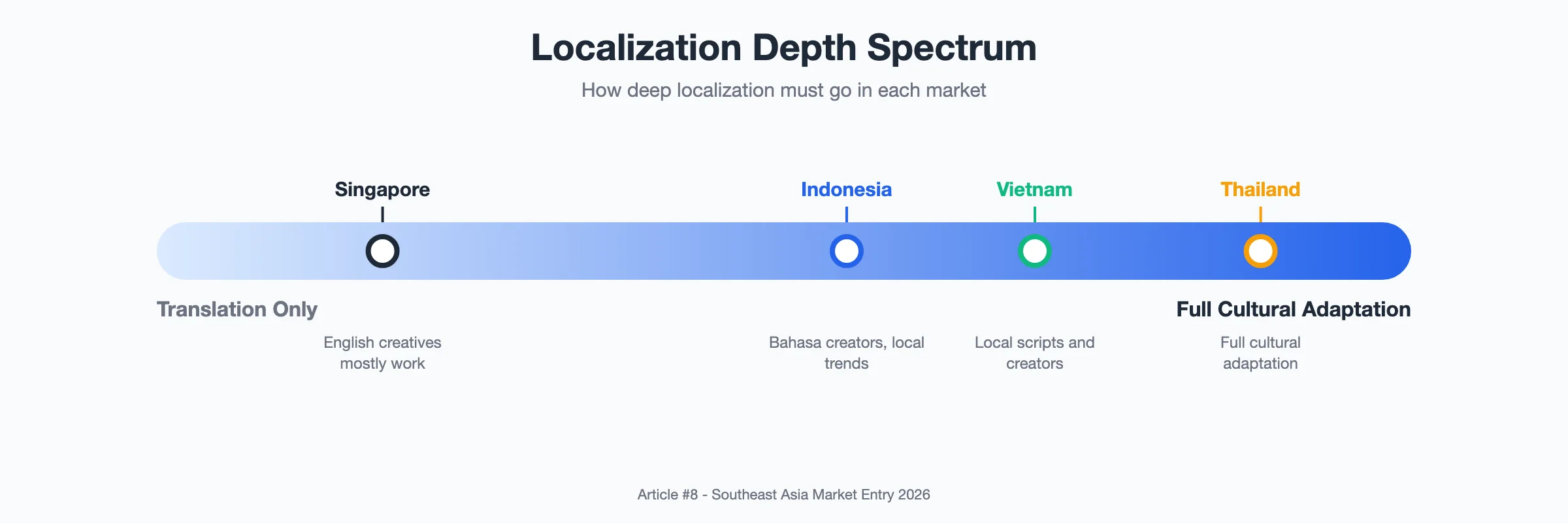
English-speaking majority: 75% of population speaks English fluently. Creative translation minimal; focus on cultural nuance rather than language adaptation.
Regulatory clarity: Clear e-commerce regulations, straightforward business registration, predictable tax environment.
TikTok penetration: High smartphone adoption (95%+) with strong TikTok usage among millennials and Gen Z.
Launch checklist:
- Business registration: Easy online process, ~2 weeks turnaround
- Payment methods: Credit cards (Visa/Mastercard), PayNow (instant transfer), GrabPay
- Logistics partners: NinjaVan, J&T Express, SingPost
- Creative approach: Premium positioning, English copy, quality-focused messaging
- Regulatory: Consumer protection laws apply; product safety standards align with international norms
- Budget recommendation: Start with $5,000-$10,000 monthly ad spend to test concepts
Singapore's maturity means higher CPMs ($15-25 vs $8-12 regionally) but also higher conversion rates and customer lifetime value. Use it as benchmark market before expanding to price-sensitive regions.
Indonesia: Volume with Complexity
Indonesia represents Southeast Asia's largest opportunity: 275M population, 73% internet penetration, growing middle class. But complexity demands careful preparation.
Halal certification critical: 87% Muslim population means Halal-certified products enjoy significant advantage. Even non-food items (cosmetics, apparel) benefit from Halal perception. Certification process takes 3-6 months; start early.
Islamic calendar alignment: Ramadan, Eid al-Fitr, Eid al-Adhit create massive shopping spikes. Plan inventory and marketing campaigns around these dates 3-6 months in advance. During Ramadan, daily spending increases 30-50%.
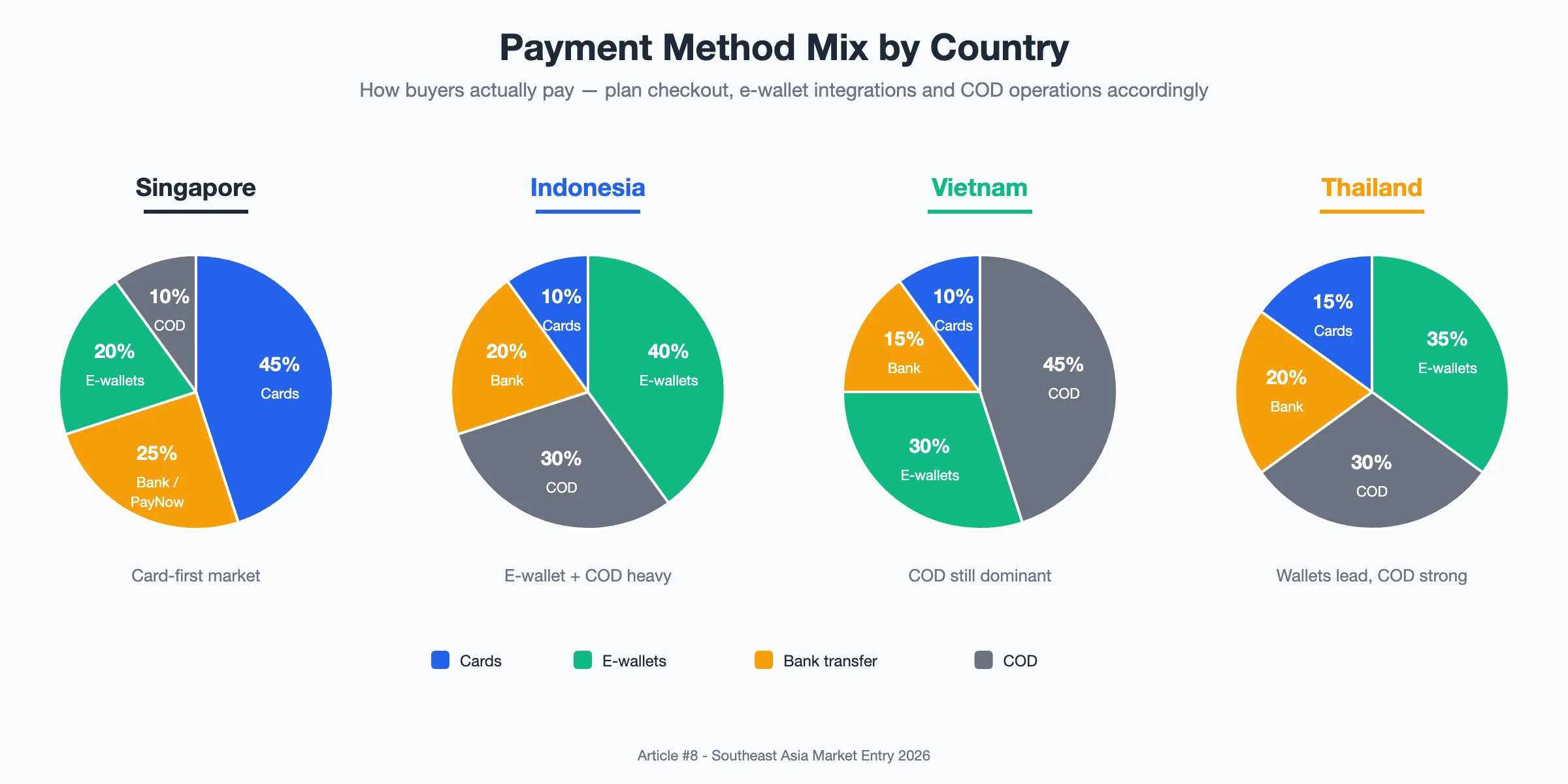
Cash-on-delivery preference: 60-70% of transactions use COD. This creates return risk (20-30% COD rejection rate) and cash flow challenges. Mitigate with deposit requirements or incentives for prepayment.
Price sensitivity: Highest in region. Consumers compare prices aggressively across platforms. Compete on value bundles rather than premium positioning.
WhatsApp dominance: 96% smartphone users rely on WhatsApp for communication. Customer service via WhatsApp essential; expect response times under 2 hours during business hours.
Launch checklist:
- Business registration: Local entity required or partner with Indonesian distributor
- Halal certification: BPOM (food/cosmetics) + MUI Halal certification
- Payment methods: Bank transfer (60%), COD (30%), E-wallets (10%)
- Logistics partners: JNE, SiCepat, J&T Express
- Creative approach: Value messaging, family-oriented themes, Indonesian language (Bahasa), religious sensitivity
- Regulatory: Product labeling in Bahasa, import duties vary by category
- Budget recommendation: Start with $10,000-$20,000 monthly; scale during Ramadan
Creative localization tips:
- Use family imagery (multi-generational households common)
- Reference Islamic holidays appropriately
- Avoid pork-related content or imagery
- Emphasize value bundles ("buy 3 get 1 free" performs better than premium pricing)
- Test Bahasa Indonesia copy vs regional dialects (Javanese speakers prefer local dialects)
Vietnam: Mobile-First Growth Market
Vietnam combines young demographics (median age 32) with rapid smartphone adoption (75% penetration) and growing e-commerce confidence.
Mobile-only shoppers: 85% of traffic comes from mobile devices. Desktop optimization unnecessary; invest exclusively in mobile experience.
Social proof critical: Vietnamese consumers heavily influenced by reviews, user-generated content, and influencer endorsements. Display review counts prominently; encourage customer photos.
Price promotion driven: Consumers wait for sales events (9.9, 10.10, 11.11 festivals). Plan inventory and cash flow around these peaks; off-season performance naturally weaker.
MoMo and Zalo dominance: MoMo e-wallet leads digital payments (40% share). Zalo (local messaging app) used for customer service; integrate Zalo chat into checkout flow.
Fast-growing TikTok adoption: 55M TikTok users (60% of population); highest engagement rates globally. Ideal for brand awareness and top-of-funnel acquisition.
Launch checklist:
- Business registration: Foreign ownership restrictions in some categories; consider local partnership
- Payment methods: Bank transfer (40%), MoMo (30%), COD (20%), Credit cards (10%)
- Logistics partners: GHTK, Viettel Post, NinjaVan
- Creative approach: Youth-oriented, trend-focused, Vietnamese language, mobile-optimized vertical videos
- Regulatory: Product labeling in Vietnamese, import duties apply
- Budget recommendation: Start with $8,000-$15,000 monthly; increase during sale festivals
Creative localization tips:
- Feature young professionals and students (largest demographic)
- Reference Vietnamese festivals (Tet Lunar New Year = biggest shopping event)
- Use trending sounds and formats from Vietnamese TikTok creators
- Emphasize limited-time promotions and flash sales
- Include customer testimonials with photos
Thailand: Entertainment-First Market
Thailand combines tourism-driven sophistication with strong local culture. Consumers expect entertainment value even from shopping experiences.
Line integration essential: 98% smartphone penetration with 57M Line users (80%+ penetration). Line OA (Official Account) for customer service mandatory; expect high message volumes.
Influencer culture mature: Thai consumers trust influencers more than traditional advertising. Micro-influencers (10k-100k followers) often outperform celebrities on ROI. Budget 20-30% of media spend for influencer partnerships.
Entertainment expectation: Shopping should be fun. Live streaming commerce popular; consider hosting weekly live sessions demonstrating products and answering questions in real-time.
Buddhist calendar awareness: Songkran (Thai New Year, April), Loy Krathong (November) create shopping opportunities. Avoid launching negative or controversial campaigns during royal mourning periods.
Payment diversity: Credit cards (45%), bank transfer (30%), convenience store payment (20%), e-wallets (5%). Convenience store payment (7-Eleven, Lotus's) enables cash-based shoppers to pay online orders.
Launch checklist:
- Business registration: Local entity preferred but not always required; consider third-party marketplace partner
- Payment methods: Credit cards, bank transfer, convenience store payment, Line Pay
- Logistics partners: Kerry Express, Flash Express, J&T Express
- Creative approach: Entertaining, colorful, Thai language, influencer collaborations, live streaming integration
- Regulatory: Product labeling in Thai, FDA approval for cosmetics/health products
- Budget recommendation: Start with $10,000-$18,000 monthly; allocate 20-30% for influencer partnerships
Creative localization tips:
- Collaborate with Thai micro-influencers in your category
- Create entertaining live streaming content (product demos + Q&A)
- Reference Thai holidays and cultural moments
- Use bright colors and playful aesthetics
- Include convenience store payment option prominently
Multi-Market Operation Model
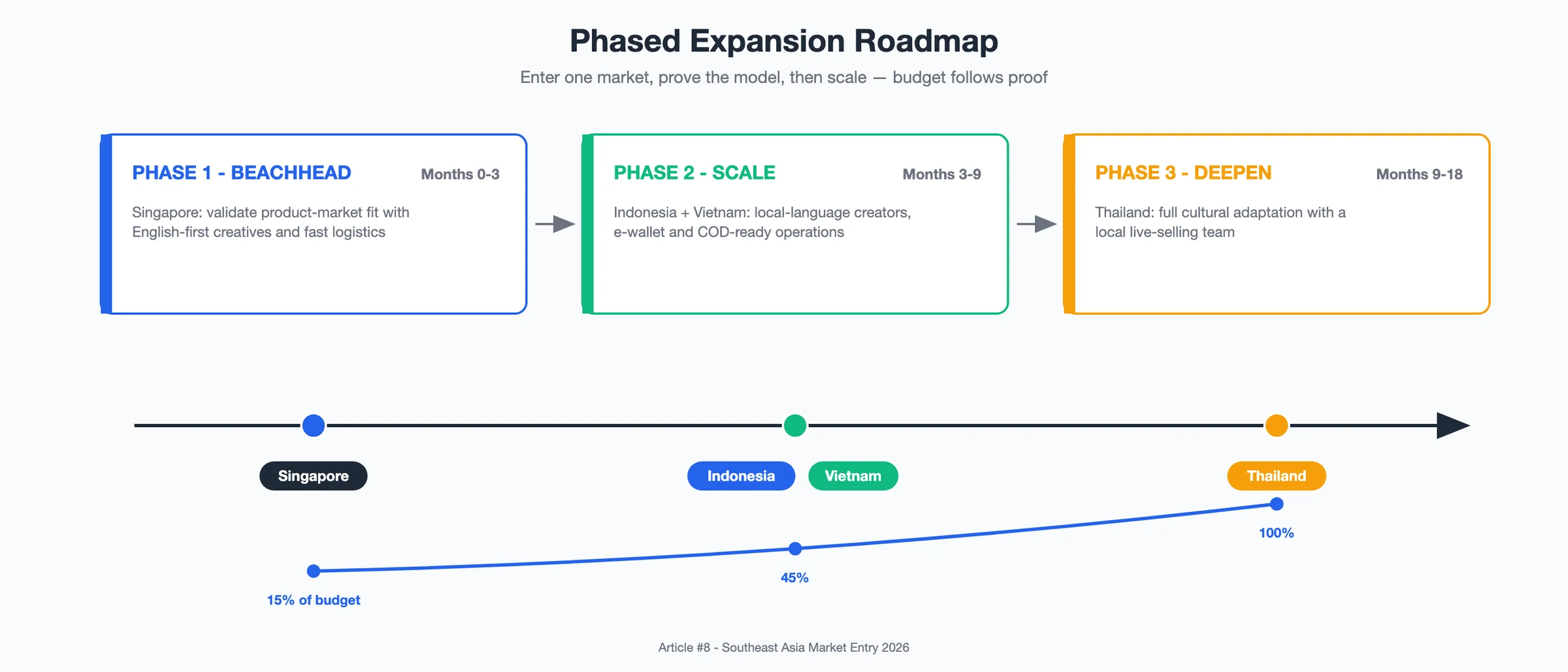
Once you've validated in one market, expand using this framework:
Phase 1: Singapore validation (Months 1-3)
- Test product-market fit with high-spending, low-complexity market
- Refine creative concepts and offer structure
- Build operational playbooks for fulfillment and customer service
- Target: $10k/month spend, 3.0x+ ROAS
Phase 2: Indonesia/Vietnam parallel launch (Months 4-6)
- Apply learnings from Singapore with local adaptations
- Hire local contractors or agencies for customer service
- Establish local logistics partnerships
- Target: $20k-$30k/month combined spend, 2.5x+ ROAS
Phase 3: Thailand expansion (Months 7-9)
- Add influencer marketing layer
- Implement live streaming commerce
- Integrate Line customer service
- Target: $15k-$25k/month spend, 2.5x+ ROAS
Phase 4: Regional scaling (Months 10+)
- Optimize budget allocation based on performance data
- Centralize creative production with local adaptation layers
- Negotiate volume discounts with logistics partners
- Target: $50k+/month regional spend, 2.5x+ blended ROAS
The Real Question: Are You Prepared for Localization Depth?
Before expanding to Southeast Asia, ask:
-
Can you commit 6-12 month runway? Each market requires 3-6 months to reach profitability as you build awareness and optimize operations.
-
Do you have local customer service capability? Expect 50-100 customer messages daily per market during peak periods. Native language support essential.
-
Can you handle regulatory complexity? Halal certification, product labeling laws, import duties vary significantly. Legal counsel recommended.
-
Is your supply chain flexible? Different markets require different inventory allocations. Overstock in one market, stockouts in another common pitfall.
-
Are you prepared for payment diversity? Managing COD, multiple e-wallets, bank transfers, and convenience store payments requires operational sophistication.
If you answer yes to most of these, Southeast Asia deserves serious consideration. If not, consider starting with Singapore only or partnering with established regional players.
Sources:
- ebrun TikTok Shop Singapore GMV Growth – Singapore market data and growth metrics
- Sohu Cross-Border Seller Guides – Country-specific requirements and best practices
- TikTok Shop Official Merchant Resources – Platform documentation and merchant guidelines
- MBBrowser SEA Operations Guide – Regional operational frameworks