Meta Advantage+ Shopping Campaigns: What Merchants Can Actually Control in 2026
Meta's Advantage+ Shopping Campaigns automate targeting, creative, and budget pacing, but that automation hides what is actually working. Here is what merchants can control, what they cannot, and a practical framework for making informed ASC decisions in 2026.
Before you move more budget into Advantage+ Shopping Campaigns, check what the algorithm is actually testing—and what it's hiding from you.
Meta's ASC has become the default shopping ad format for merchants with 50+ weekly conversions, but many are discovering that "set it and forget it" works well until it doesn't. The Andromeda delivery system automates targeting, creative combinations, and budget pacing across placements. That automation solves real problems: creative fatigue, audience overlap, and manual bid adjustments. It also creates blind spots where budget leaks into low-intent placements or creative variations that look good but don't drive purchases.
The core issue isn't whether ASC performs—it often does when you have strong first-party data and patient learning periods. The issue is whether you're making informed decisions about what's working, or just trusting a black box that reports ROAS without explaining why.
What ASC Actually Automates (And What It Doesn't)
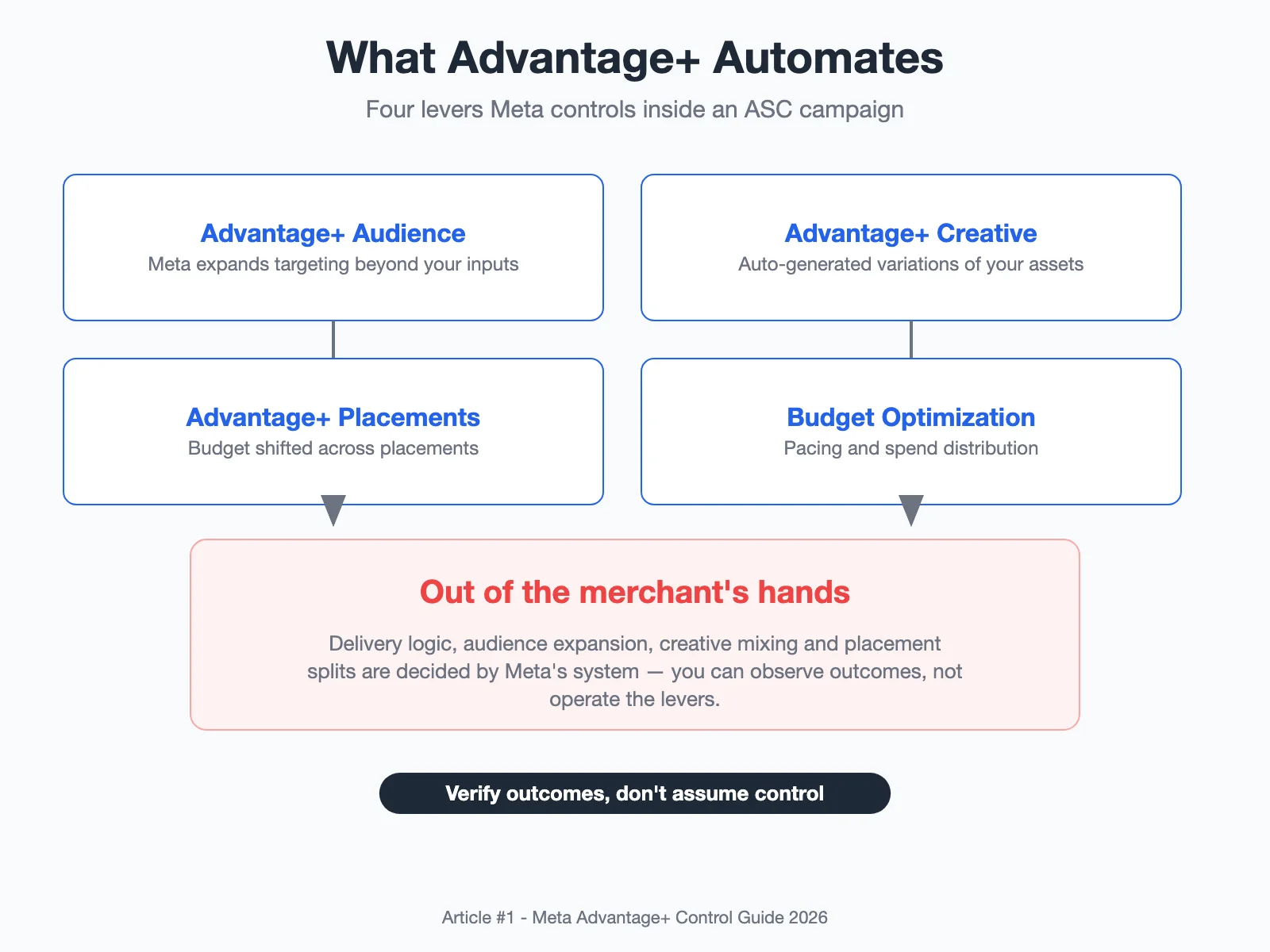
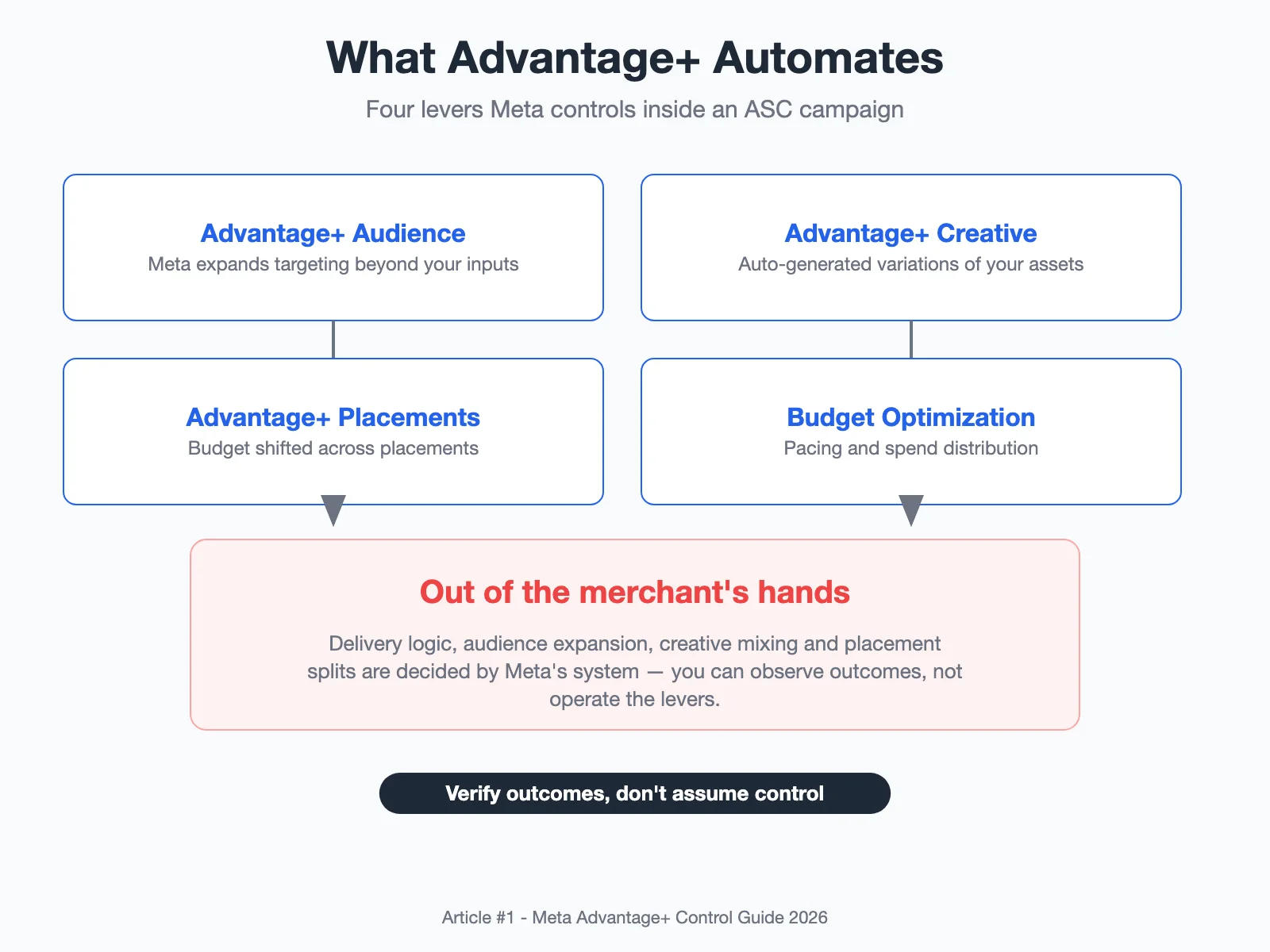
Meta's documentation lists several Advantage+ features as enabled by default:
- Advantage+ audience: Automatic audience expansion beyond your specified targets
- Advantage+ creative: Automatic creative optimization and combination testing
- Placement automation: Cross-placement delivery across Facebook, Instagram, and Audience Network
- Budget optimization: Campaign-level budget allocation across ad sets
What merchants typically cannot control without disabling these features:
- Which specific audiences receive which creative variations
- Placement-level performance visibility in standard reporting
- Budget pacing between new customer acquisition vs. retargeting
- Creative testing frequency and variation limits
A Stackmatix analysis from 2026 notes that successful ASC requires "quality data and patience"—specifically strong first-party data inputs plus respect for the learning phase. Avoid frequent edits; let algorithms learn. This advice sounds reasonable until you need to diagnose why a campaign underperformed last week.
The Control Problem: Three Real Scenarios
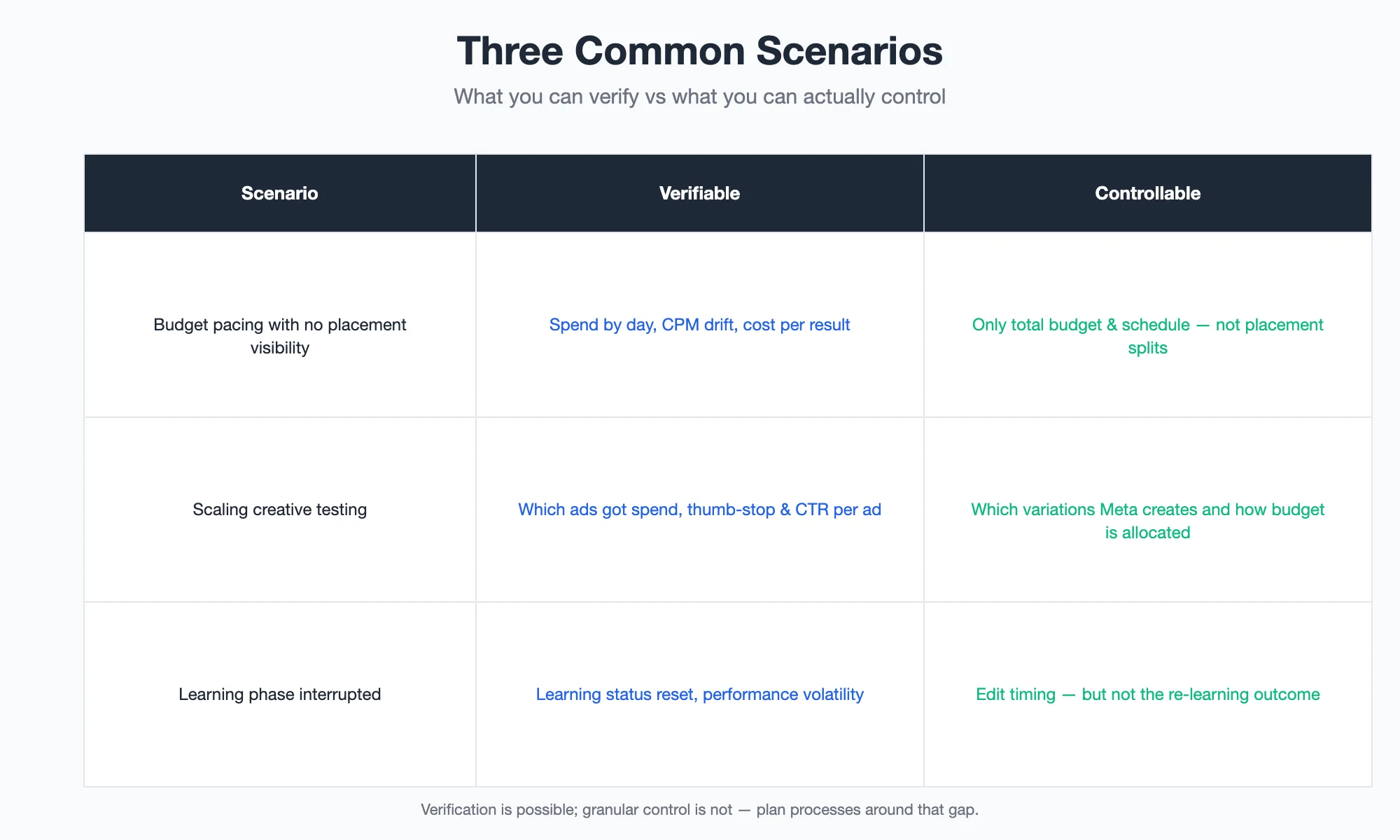
Scenario 1: Budget Pacing Without Placement Visibility
You set a $500/day campaign budget. The platform optimizes across placements, but standard reports show blended metrics. After two weeks, ROAS looks acceptable at 2.8x. Then you request placement-level breakdowns and discover 40% of spend went to Audience Network—placements you never explicitly approved for this product category.
What you can verify: Meta's help documentation confirms that Advantage+ includes automatic placement optimization. You can exclude specific placements manually, but doing so may reduce overall campaign efficiency according to Meta's own testing.
What you can control: Campaign-level budget caps, daily vs. lifetime budget choices, and explicit placement exclusions. Nothing about which placements get prioritized when the algorithm decides.
Scenario 2: Creative Testing at Scale
Meta recommends launching 20-50 creative variations monthly for ASC. The theory is that more inputs give the algorithm better optimization signals. The reality: you're now managing a content production pipeline you didn't sign up for, and you still don't know which creative elements actually drove conversions versus which ones got lucky early impressions.
What you can verify: CustomerLabs' 2026 best practices guide explicitly states "Launch 20-50 creative variations monthly" as an ASC success factor. This comes from documented merchant experience, not speculation.
What you can control: Creative upload volume, asset combinations through ad creation tools, and performance-based pruning after statistical significance. Nothing about how the algorithm combines assets internally or which combinations get priority during learning phases.
Scenario 3: Learning Phase Disruptions
You launch a fresh ASC with optimized budget settings. Week one shows promising CTR but unclear conversion quality. Week two, you notice performance dips and make "optimizations": adjusting target audiences, pausing underperforming creatives, shifting budget allocations. Performance degrades further because each change resets the learning phase.
What you can verify: Multiple 2026 sources emphasize avoiding manual tweaks during learning phases. The algorithm needs consistent data collection before it can optimize effectively.
What you can control: Initial setup quality (audience definitions, creative variety, budget sizing), patience during learning periods, and post-learning evaluation frameworks. Nothing about intervening mid-cycle without understanding reset costs.
A Practical Framework for ASC Control
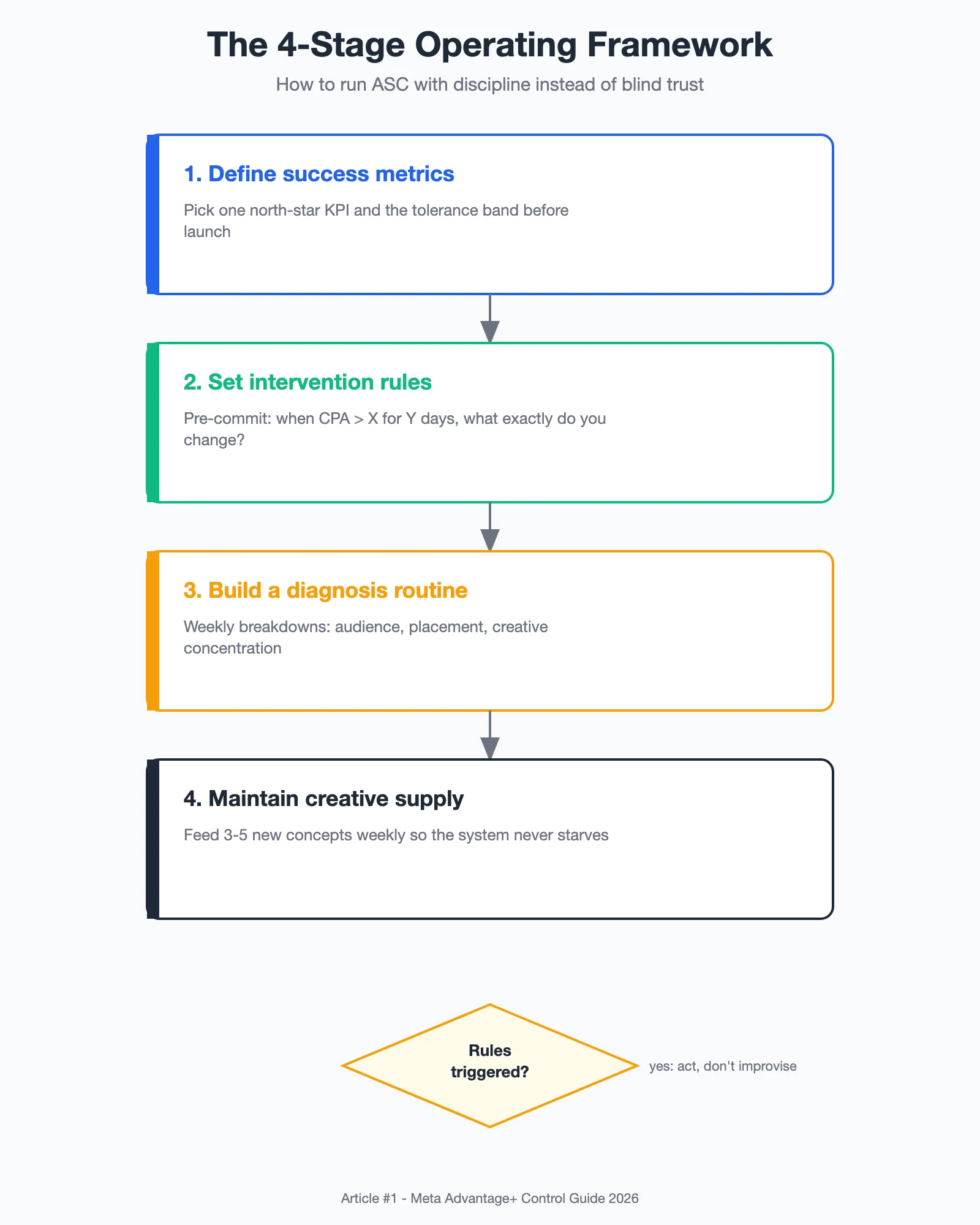
Instead of fighting automation or surrendering to it, try this approach:
1. Define Success Metrics Before Launch
ROAS alone won't tell you what changed. Track:
- Blended ROAS (overall campaign efficiency)
- Placement-tier ROAS (request breakdowns weekly even if not shown by default)
- Creative tier performance (which asset types outperform)
- Audience composition shifts (are you reaching new customers or recycling existing ones?)
2. Establish Intervention Rules
Don't tweak based on weekly fluctuations. Precommit to rules like:
- No changes during the first 14 days unless spend exceeds 2x expected CPA without conversions
- Weekly placement reviews only; adjust exclusions based on patterns, not single-day anomalies
- Creative refresh every 30 days minimum, evaluated against the previous month's winners
- Budget increases only after 7 consecutive days meeting target ROAS thresholds
3. Build Diagnostic Routines
When performance shifts, investigate systematically:
Day 1-2: Confirm the signal isn't noise. Check sample sizes, attribution windows, and holiday effects.
Day 3-5: Request detailed reports. Look for placement migration, creative fatigue markers, audience saturation.
Day 6-7: Test hypotheses with small budgets before scaling interventions.
4. Maintain Creative Supply Chains
If you're running ASC seriously, treat creative production as infrastructure:
- Monthly cadence: 20-50 new variations as recommended
- Asset library: Organize by format, message type, and proof element
- Testing workflow: Document which combinations outperform and why
- Production buffer: Always have 2-3 weeks of inventory ready
When ASC Isn't The Right Default
Advantage+ Shopping Campaigns work best when:
- You have 50+ weekly conversions for reliable signal collection
- Your creative team can sustain 20-50 monthly variations
- You accept automated optimization as the primary strategy
- You have infrastructure for diagnostic monitoring
Consider manual campaigns instead when:
- You need precise audience segmentation for different product categories
- Your creative production capacity is limited to <10 variations monthly
- You're testing new markets with unknown audience behaviors
- You need granular placement control for brand safety reasons
The Real Question: Are You Ready for Automated Scaling?
ASC isn't fundamentally harder than manual campaigns. It's differently demanding. Instead of spending time on bid adjustments and audience tweaking, you invest in creative production, diagnostic infrastructure, and intervention discipline.
Merchants who struggle with ASC typically underestimated one of three things: creative supply requirements, diagnostic complexity, or patience for learning phases. Those who succeed treat automation as a force multiplier rather than a replacement for strategy.
Before you migrate budget into Advantage+, ask whether your team can sustain the actual workload—not the theoretical one. The algorithm will handle optimization. Your job is ensuring it's optimizing toward the right outcomes.
Sources:
- 12 Best Practices for Meta ASC – Data quality and patience requirements
- Meta Advantage+ Campaigns Guide – Creative volume recommendations and Andromeda automation details
- Meta Ads Automation 2026 – Practical implementation guidance
- Overseas CMCM Meta Guide – Budget optimization defaults and manual adjustment warnings