The Creative Scorecard I Use Before I Spend a Dollar
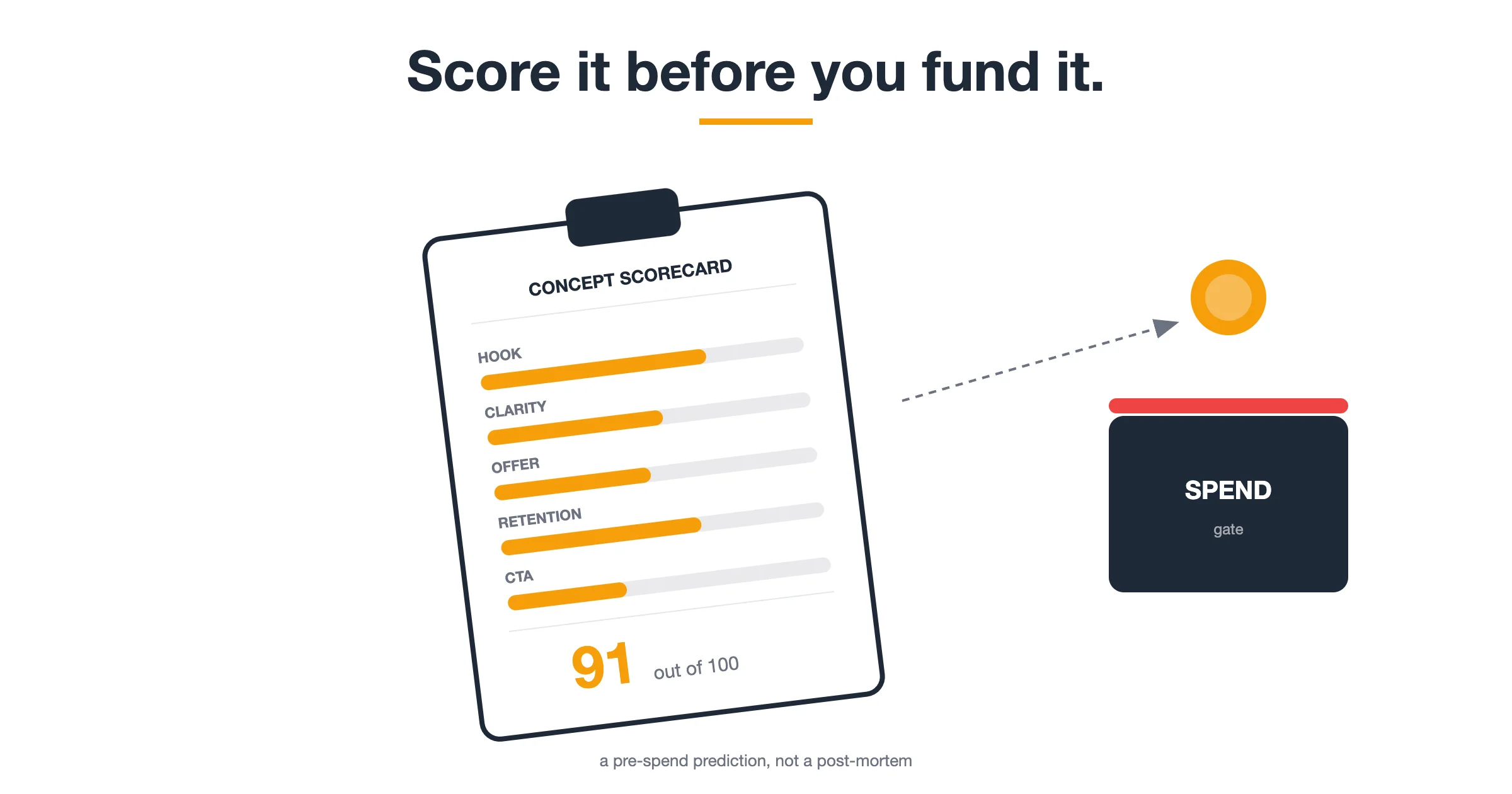
Before budget goes out, every concept runs through a weighted scorecard of leading indicators. Here is how I build it, score it, and where it fails me.
Practitioner playbook — a composite field guide written from the perspective of a Creative Strategist. Figures are illustrative, not verified client results.
My job is to decide which creative deserves to spend money before it has spent any. That is a prediction problem dressed up as a taste problem, and for a long time I made it with taste. I'd watch a cut, feel a jolt of excitement, and greenlight a budget. Some of those calls were great. A lot were expensive gut feelings that the market quietly overruled.
The fix wasn't less intuition; it was a place to put the intuition so it had to compete with evidence. Before a dollar goes out, every concept runs through a scorecard: a small sheet of weighted leading indicators that forces me to state, in writing, why I think something will work and where I expect it to fail. This is how I built it, how I score it, and the honest limits of trusting a number before the market has had its say.
What The Scorecard Is (And What It Deliberately Isn't)
The scorecard is a pre-spend prediction, nothing more. It is not a performance report and not a verdict on whether a piece of creative is "good." It answers exactly one question: given what I can see right now, does this concept have a real chance, and what do I expect it to cost me to find out?
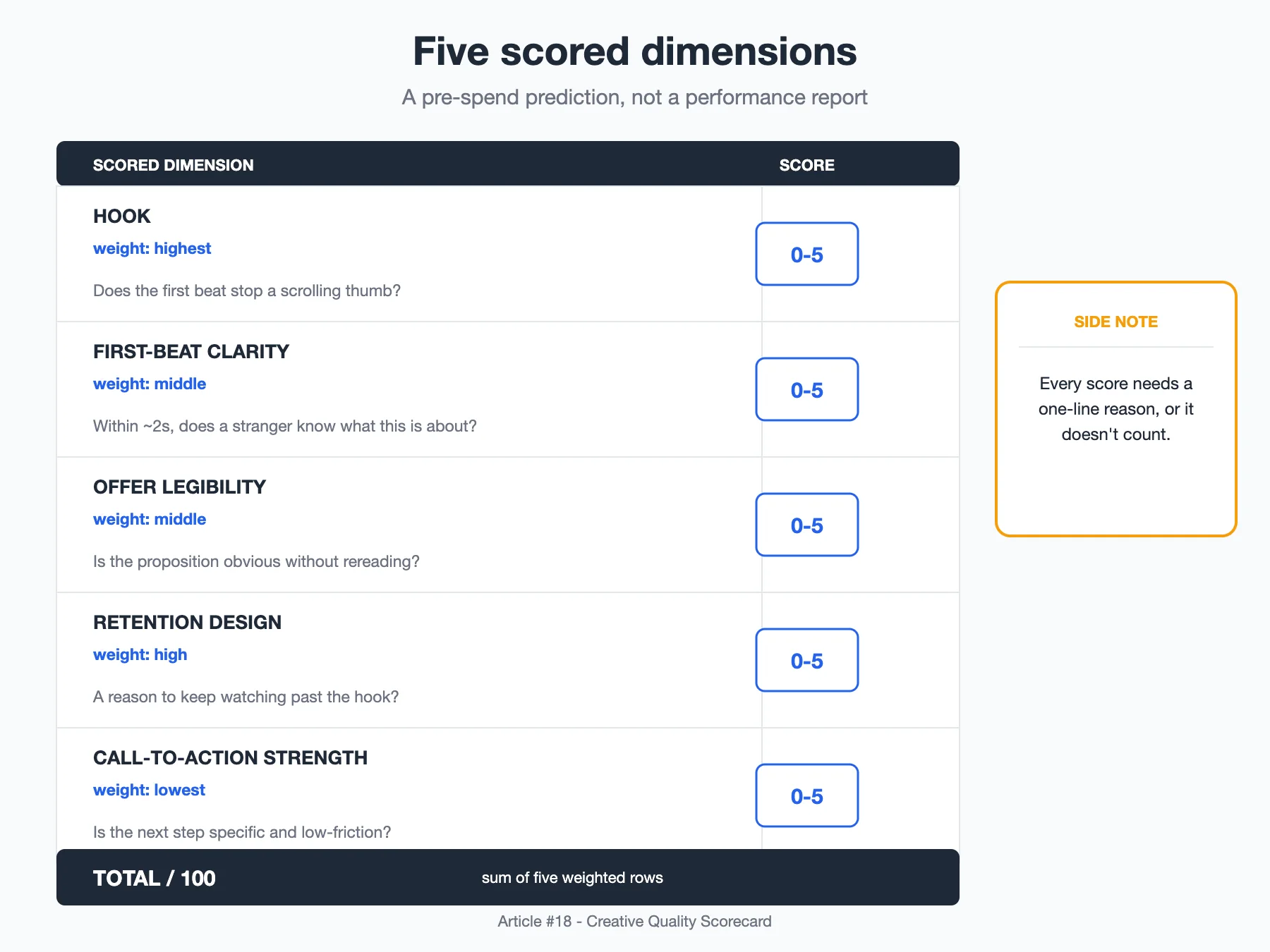
Mine has five scored dimensions, each rated 0 to 5 and then weighted into a total out of 100:
- Hook — does the first beat stop a thumb that was already scrolling?
- First-beat clarity — within about two seconds, does a stranger know what this is about?
- Offer legibility — is the actual proposition or benefit obvious without rereading?
- Retention design — is there a reason to keep watching past the hook, not just to start?
- Call-to-action strength — is the next step specific and low-friction?
The discipline is that each score needs a one-line reason attached to it. A blank score box doesn't count. If I can't articulate why a hook earns a 4 versus a 2, that's me hiding, and the whole sheet is worthless.
The Four Leading Indicators I Actually Watch
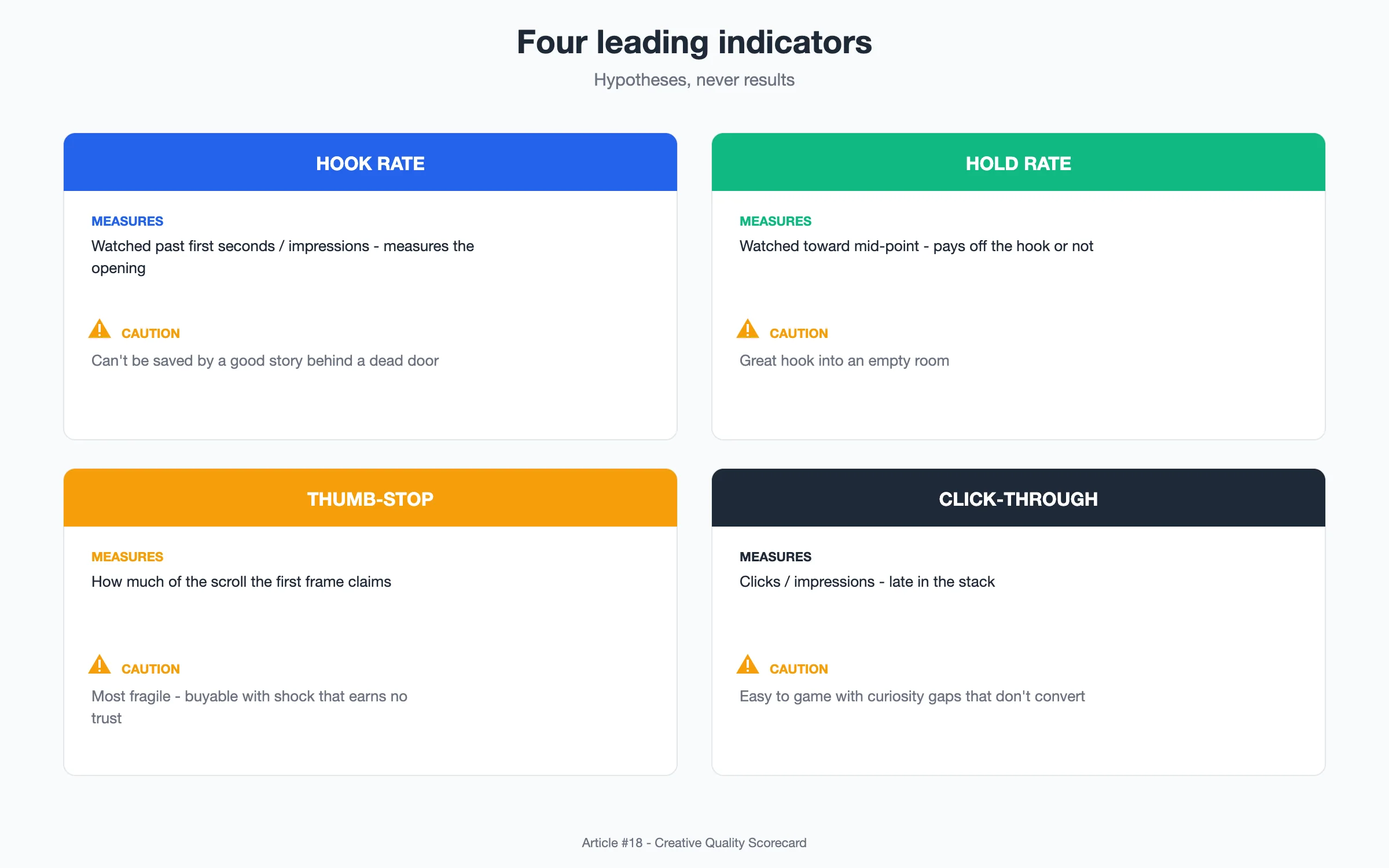
The five dimensions above are qualitative. To keep myself honest I anchor them to leading indicators, the early signals that predict downstream performance before it shows up in revenue. I don't chase vanity numbers, but I do score against how these usually behave. All figures below are illustrative ranges I keep in my head as reference points, not guarantees for any specific account.
- Hook rate — people who watched past the first few seconds, divided by impressions. It measures the opening, full stop. A concept that can't stop a thumb has no amount of story that will save it.
- Hold rate — the share that keeps watching toward the mid-point. It tells me whether the promise of the hook gets paid off or whether I built a great door into an empty room.
- Thumb-stop — a rough sense of how much of the scroll the first frame claims. It's the most fragile of the four, because it can be bought with shock that earns no trust.
- Click-through — clicks divided by impressions. Late in the stack, and easy to game with curiosity gaps that don't convert.
The caution I attach to every card: a leading indicator is a hypothesis, never a result. If I score a concept on thumb-stop alone I will systematically reward loud, empty creative, because the loudest first frame is the cheapest thing to fake.
Weighting The Signals So The Total Means Something
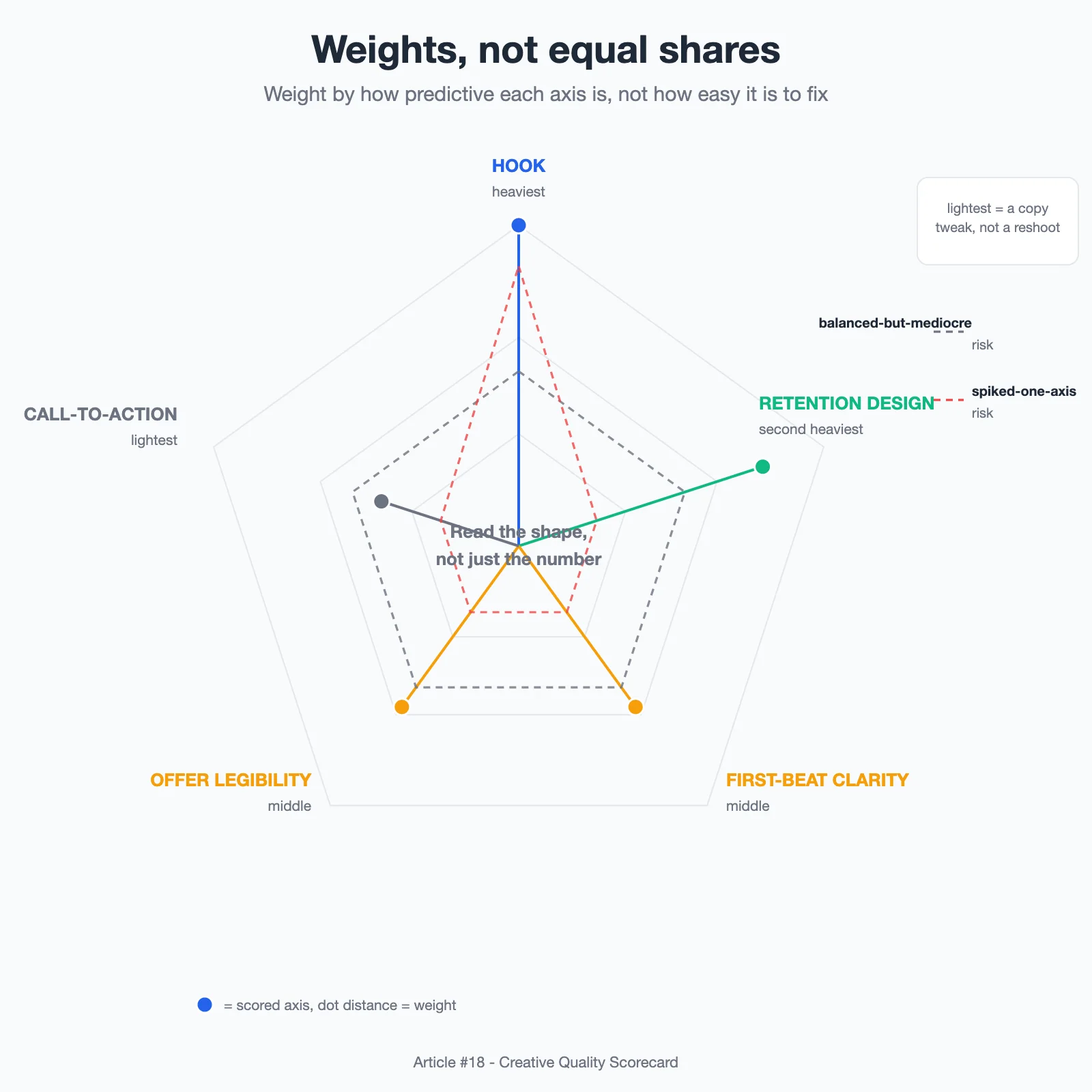
An unweighted scorecard is a lie with five decimals. If every dimension counts equally, a concept with a dead hook and a pretty call-to-action still scores respectable, and respectable gets budgets spent on it. So I weight the axes by how predictive each one actually is, not by how easy it is to fix later.
My rough weight distribution, again illustrative and tuned over time:
- Hook: the heaviest slice. Nothing downstream happens if the opening fails, so it earns the most influence.
- Retention design: second heaviest, because it separates a good first two seconds from an ad that can actually carry a message.
- First-beat clarity and offer legibility: middle weight. These are cheaper to repair, so they don't get to veto a concept on their own.
- Call-to-action strength: the lightest slice. A weak CTA is a copy tweak; a weak hook is a reshoot. I refuse to let the cheapest fix swing the score.
I look at the filled radar shape more than the total. A balanced pentagon with mediocre scores and a spiked wheel with one huge axis are different risks, and they should not share the same total. The weight system is how I make the total respect that difference.
Thresholds: The Numbers That Decide Kill, Iterate, Or Scale
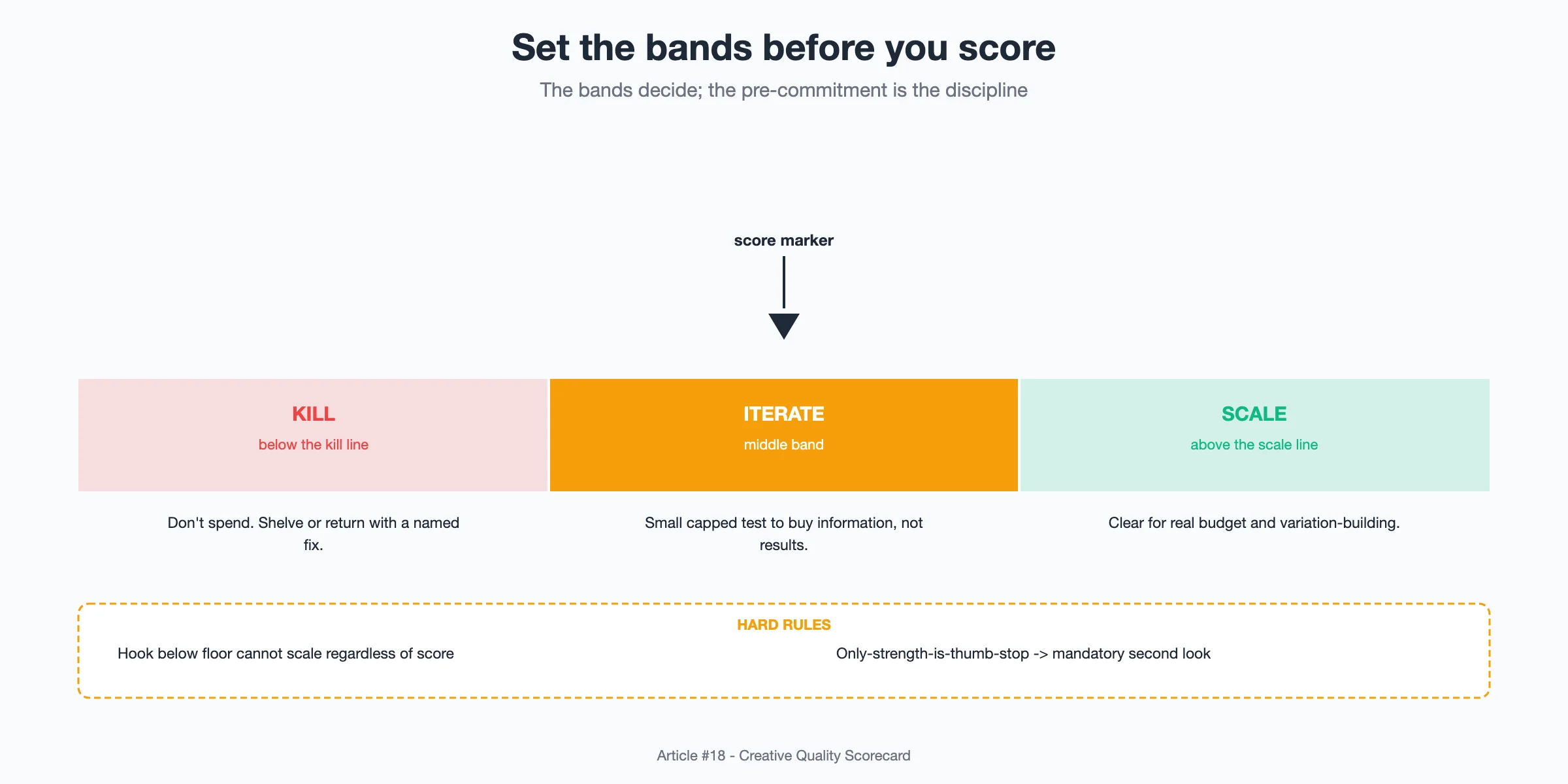
A score without thresholds is decoration. The point of the exercise is to pre-commit to actions so I stop renegotiating with my feelings at the last minute. I set the bands before I score the batch, and I don't move them to rescue a favorite concept.
My structure, with example numbers:
- Below the kill line — don't spend. The concept is either shelved or sent back for a specific, named fix. Being at peace with that is most of the value of the tool.
- The iterate band — a small test budget, deliberately capped, spent to buy information rather than results. Enough to see whether the leading indicators hold up against real delivery, not enough to hurt if they don't.
- Above the scale line — clears for real budget and variation-building, because the prediction is strong enough to bet on.
Two thresholds I set in stone regardless of score: any concept with a hook below a floor weight-adjusted score cannot scale no matter how pretty the rest is, and any concept whose only strength is thumb-stop gets a mandatory second look for whether the shock will survive contact with trust. The bands are the decision; the pre-commitment is the discipline.
From Score To Decision Without Second-Guessing
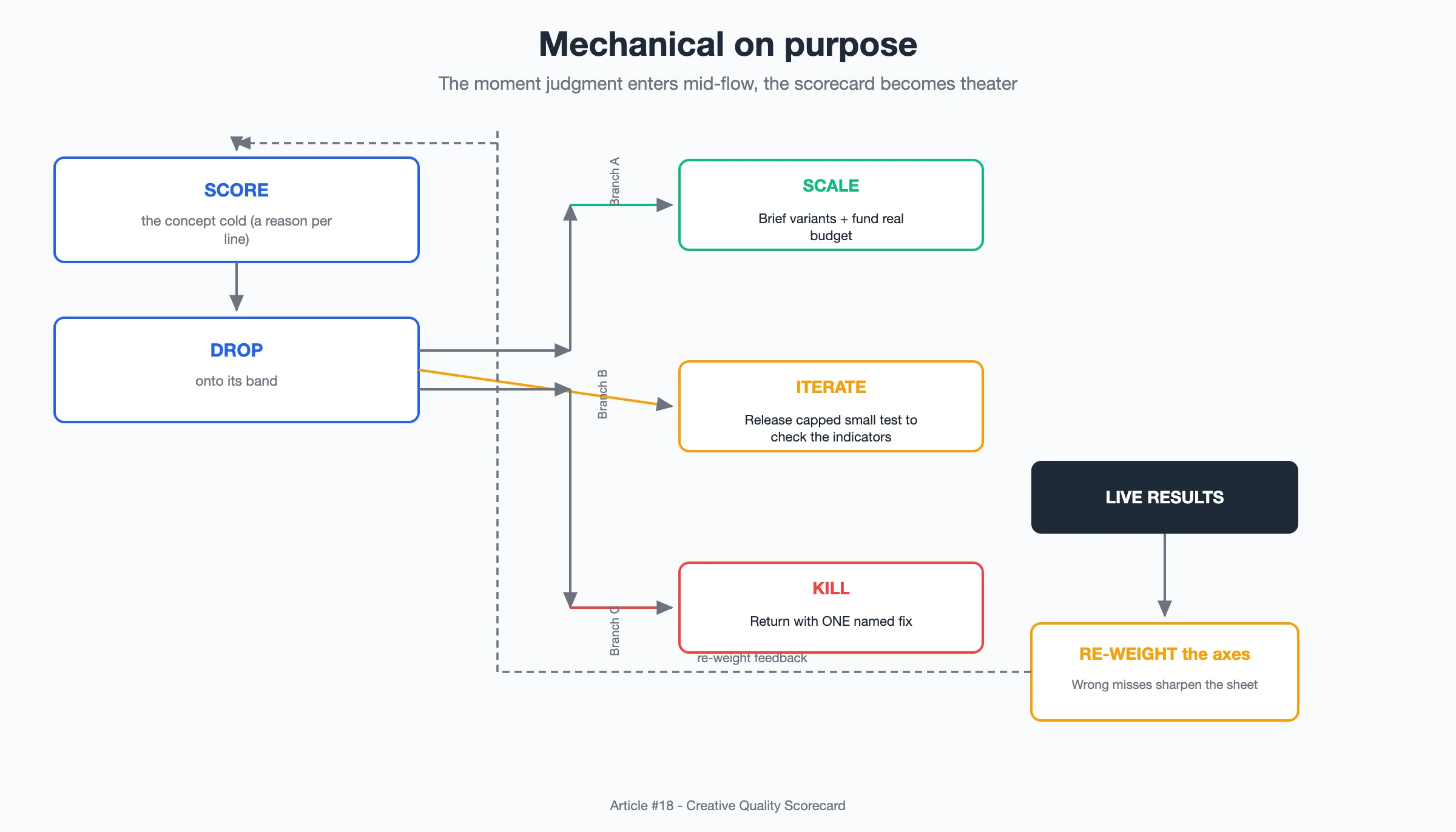
The flow is mechanical on purpose, because the moment I allow judgment mid-flow is the moment the scorecard becomes theater.
- I score the concept cold, with a reason per line, before discussing it with anyone.
- I drop it onto the band it lands in and accept that band.
- Scale routes to a variant brief and real budget. Iterate routes to a small, capped test whose only job is to check whether my indicator guesses held. Kill routes back to the maker with one named fix, not vague disappointment.
- Live results feed the loop. When a concept I scored low performs, or one I scored high flops, I ask which axis was wrong and nudge the weights. The scorecard gets sharper because it's accountable to outcomes it was never allowed to fake.
That feedback link is the difference between a system and a habit. The scores are my predictions; the results are the invoice, and I reconcile the two.
Where The Scorecard Fails Me
I trust it, but I don't over-trust it. It is terrible at genuinely novel formats, because "unprecedented" scores low on familiar proxies and gets binned as weak even when it could be a breakout. It can't feel a fast-shifting cultural moment that the historical benchmarks don't reflect yet. And it is biased toward what I already know how to score, which quietly biases toward making the same ad better instead of making different ads. So I ring-fence a small slice of budget deliberately outside the scorecard for bets it would kill. The sheet decides the majority; it does not get a veto on strangeness, because strangeness is where the outliers live.
The Real Question: Is The Score Predicting The Work Or Just Describing It?
Before I spend a dollar, the honest test is whether my scorecard actually predicted anything. If a high score and a good result are only ever the same story told twice, the number adds nothing I couldn't feel. The value is in the misses: the concept the sheet killed that would have flopped anyway, and the one it flagged that I argued with and lost. I keep the scorecard because it lets me be wrong in a measurable way, and measurable wrongness is the only kind I can improve. Taste guesses. A scorecard guesses on paper, then gets graded. That gap is the entire job.
Sources:
- Industry public benchmarks on short-form video ad metrics (hook/hold/CTR definitions and ranges) – used only for plain-language indicator definitions.
- Baymard Institute and general UX research on legibility and call-to-action clarity – how quickly a viewer parses a proposition.
- CXL Institute articles on creative testing and leading vs lagging indicators – the practice of pre-scored creative evaluation.
- Meta and TikTok business help center guidance on ad delivery and creative best practices – general context on how early engagement behaves.
Disclosure: This piece is written from a practitioner's perspective to share a working method. It is not a customer testimonial, and any numbers are illustrative examples, not guaranteed outcomes.