Attributed Sales vs Incremental Sales: A Budget Decision Guide
A dashboard conversion count is not proof your ads caused it. An attributed order is not the same thing as an order that would disappear without the ad. Here's how to measure true incremental value at any budget level.
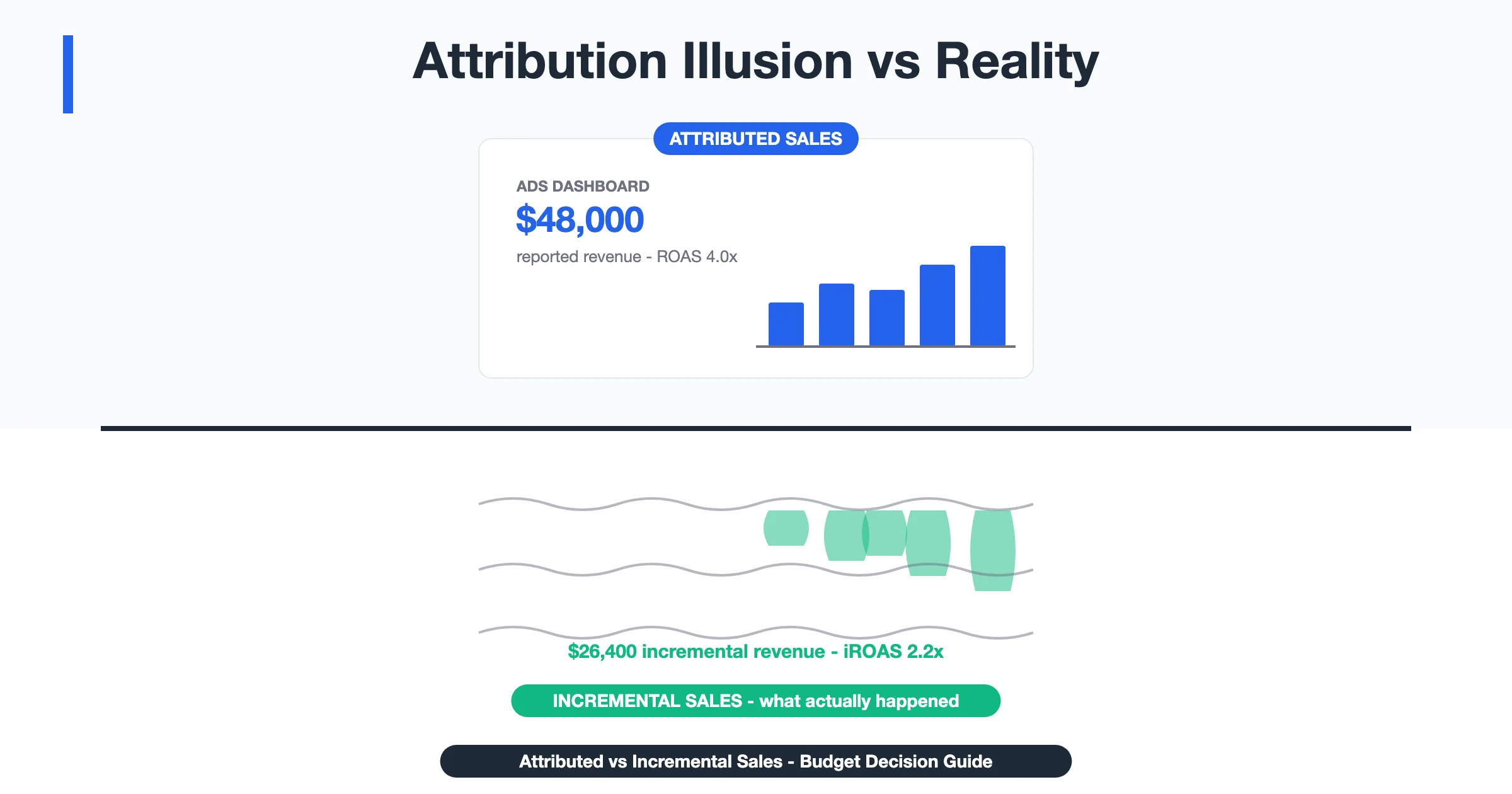
A dashboard conversion count is not proof your ads caused it. An attributed order is not the same thing as an order that would disappear without the ad.
Merchants optimizing for ROAS are discovering a painful truth: the metric they're maximizing may be telling them nothing about whether their campaigns are actually driving incremental value. Meta's attribution model credits ads with conversions based on click-through windows and view-through assumptions. It doesn't measure what would have happened if those customers never saw your ad.
This article explains the difference between attributed and incremental sales, why it matters for budget decisions, and how to choose the right measurement approach for your business stage.
The Attribution Illusion
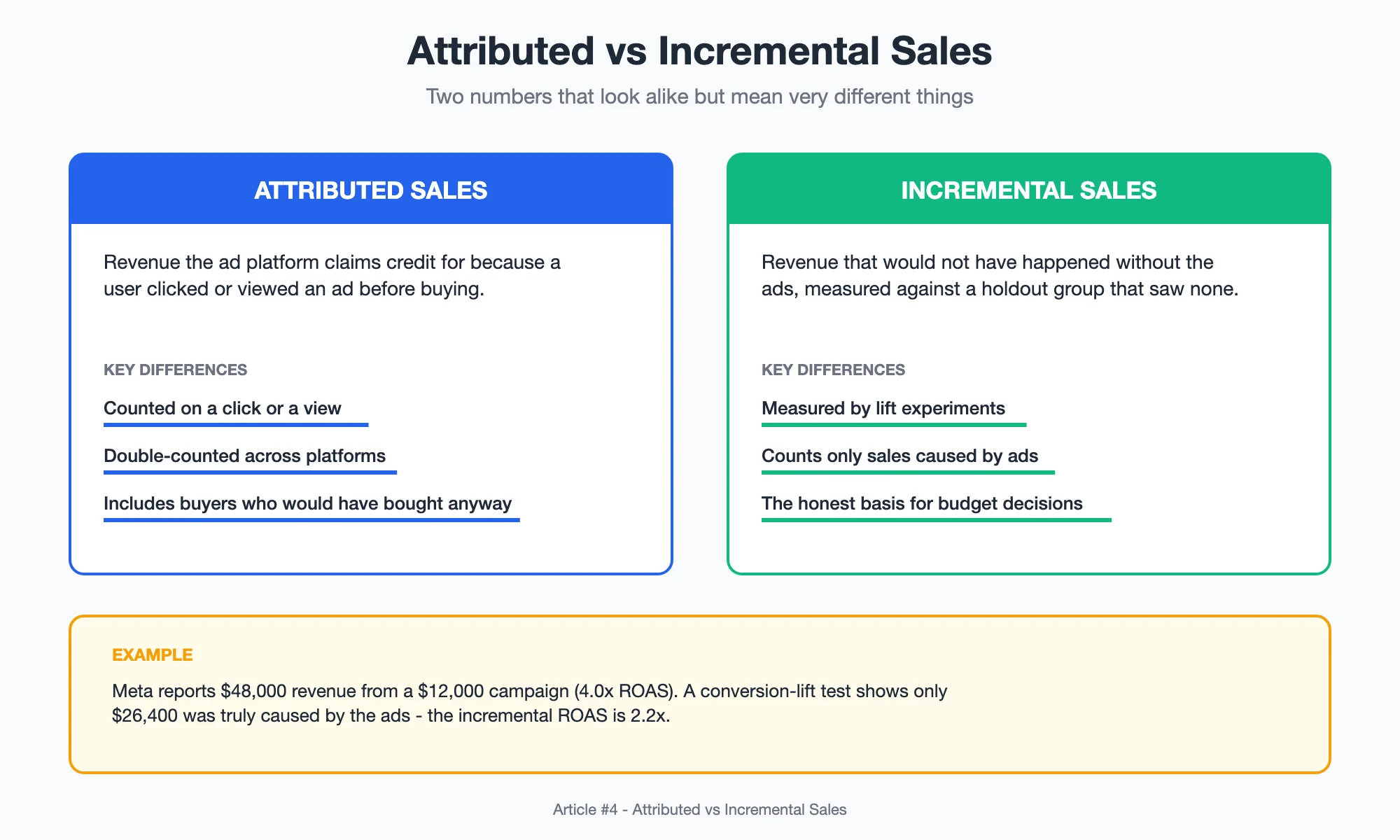
Meta's attribution system works like this: if a user clicks your ad within 7 days (or views it within 1 day) and converts, that sale gets credited to your campaign. This is attribution—assigning credit based on observed touchpoints.
Attributed sales answer: "How many conversions happened after people interacted with our ads?"
What it doesn't answer: "How many of these conversions would have happened anyway?"
That second question is incrementality—measuring the causal effect of your advertising by comparing what happened with ads versus what would have happened without them.
Consider this scenario:
- Your brand has 10,000 monthly returning customers who buy out of habit
- You run Meta ads that generate 2,000 attributed conversions
- A lift study reveals 800 of those customers would have purchased anyway (organic repeat rate unchanged in control group)
- Your true incremental sales: 1,200
- Your true incremental ROAS: 40% lower than reported ROAS
The discrepancy isn't fraud—it's methodology. Attribution measures correlation; incrementality measures causation. Both are real numbers. Only one tells you whether your ad spend is buying new customers or just subsidizing existing ones.
Why Incrementality Matters for Budget Decisions
Before you move more budget into a channel, check what it's taking credit for. An attributed order is not the same thing as an order that would disappear without the ad.
Scenario A: Brand awareness already exists
Your product has strong organic search volume, direct traffic, and email list engagement. Meta ads capture bottom-funnel demand—people searching for your brand name, then clicking your ad before converting.
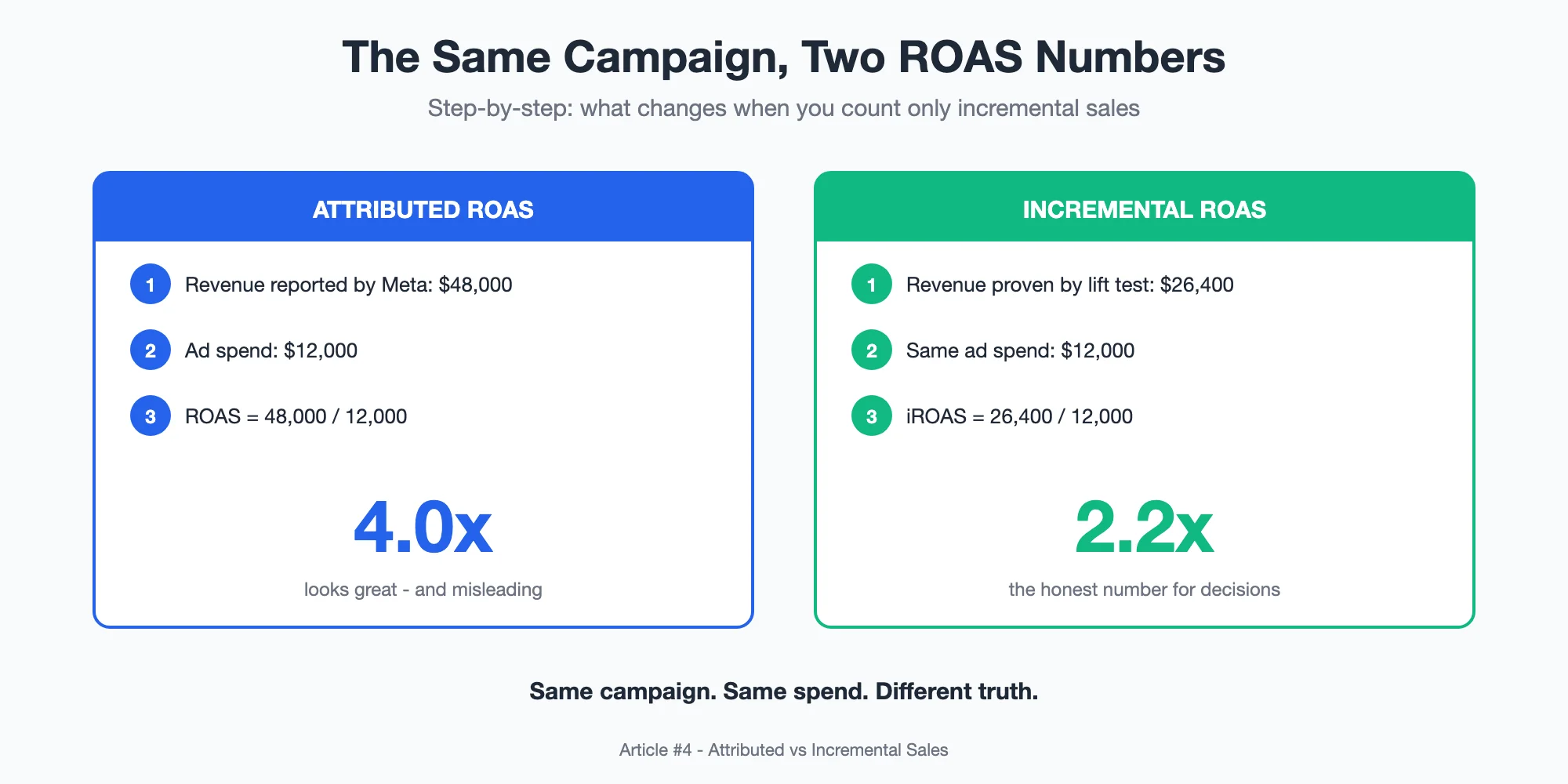
Attribution says: "Great! Your ROAS is 4.5x!"
Incrementality says: "Those customers would have converted through organic search or direct traffic regardless."
Result: You're paying Meta to credit itself with sales that were already happening. Your incremental ROAS might be 1.2x—or negative if you're cannibalizing higher-margin channels.
Scenario B: You're acquiring new customers
Your product category is unfamiliar to most consumers. They discover it through TikTok videos, Instagram feeds, or Facebook discovery placements. These customers have no prior intent to buy.
Attribution says: "Excellent! 3,000 conversions at 2.8x ROAS!"
Incrementality says: "Lift study confirms 2,700 were truly incremental—only 300 would have found you organically."
Result: Your ads are genuinely expanding your customer base. Even at 2.8x attributed ROAS, the business value is higher because you're buying new customers, not redirecting existing ones.
The budget decision:
If Scenario A describes your business, increasing Meta spend may look attractive on paper while eroding profitability. If Scenario B describes you, scaling makes sense even if ROAS appears mediocre compared to search or email.
How to Measure Incrementality Without Breaking the Bank
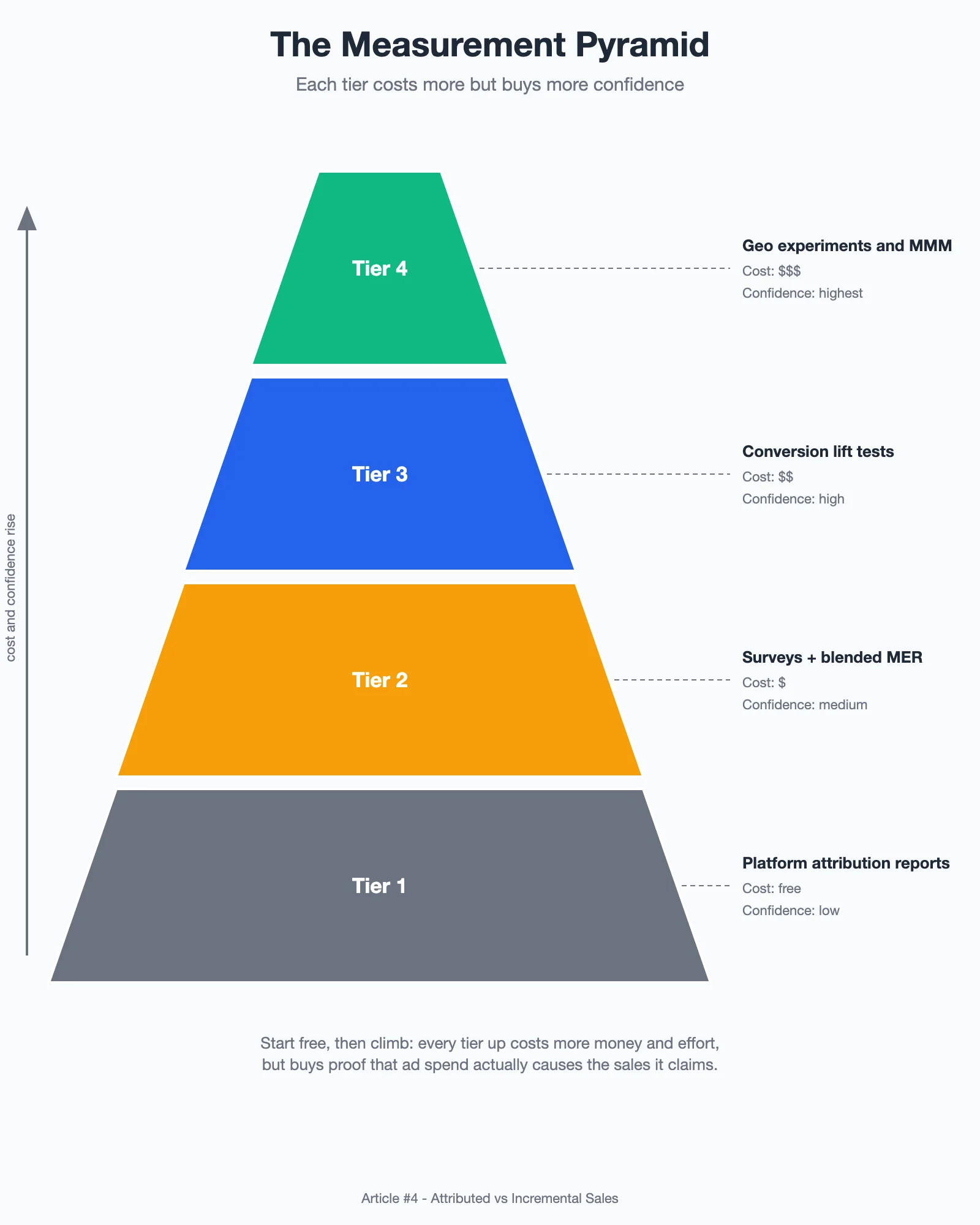
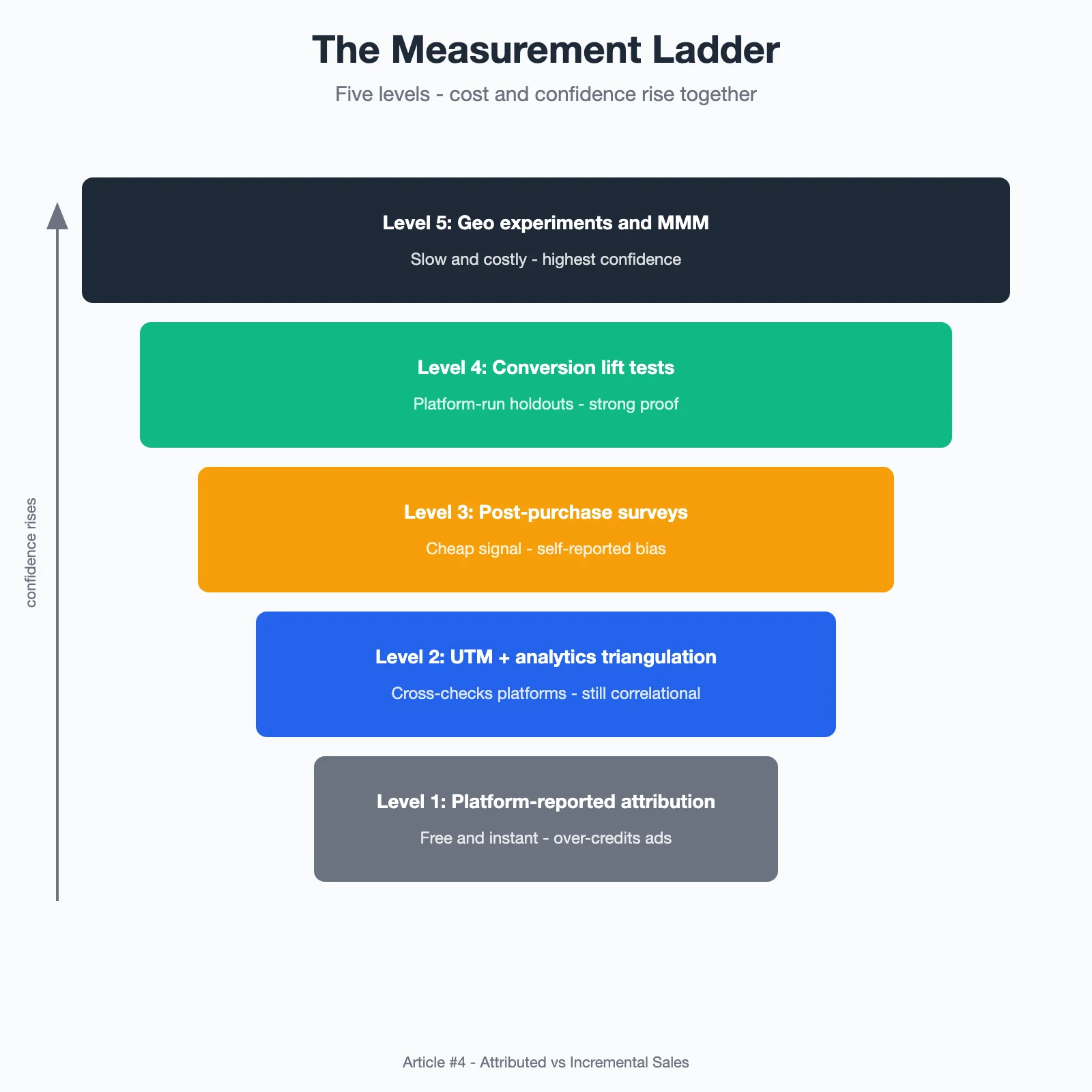
Full lift studies cost $20,000-$50,000 and require 4-6 weeks to execute. Most merchants can't justify that investment upfront. Here's a tiered approach:
Tier 1: Holdout Testing (Free, DIY)
Method: Run two identical campaigns targeting similar audiences. Campaign A runs normally. Campaign B has $0 budget (ads shown to zero people). Compare conversion rates over 30 days.
What it tells you: Rough estimate of incremental lift by measuring organic conversion rate in the "no ads" group versus the "ads" group.
Limitations: Audience similarity assumptions may be flawed; external factors (seasonality, PR events) can confound results; requires significant volume to detect statistically meaningful differences.
Best for: Merchants with 100+ daily conversions testing major budget shifts.
Tier 2: Geo-Based Experiments (Moderate cost)
Method: Split test across geographic markets. Run full ad spend in City A (treatment); reduce or eliminate spend in City B (control). Compare overall business performance, not just attributed conversions.
What it tells you: More reliable incrementality signal than holdout testing; captures cross-channel effects (people seeing ads in treatment cities may talk to friends in control cities, though this dilutes results).
Limitations: Requires multi-location presence; market differences may confound results; takes 60-90 days to accumulate sufficient data.
Best for: Regional brands with physical presence or clear geographic customer clusters.
Tier 3: Platform Lift Studies (High cost, high confidence)
Method: Meta's Conversion Lift or Google's Measurement Partners run randomized controlled trials. Meta randomly assigns users to see ads or not, then measures conversion rate differential.
What it tells you: Gold-standard incrementality measurement; statistically rigorous; isolates ad impact from all other factors.
Limitations: Expensive ($20k+ minimum); requires commitment to study duration; results apply only to the specific campaign tested, not all future ads.
Best for: Enterprise advertisers running major campaigns ($100k+ monthly spend) where measurement precision justifies cost.
Tier 4: Modeling-Based Estimates (Medium cost, medium confidence)
Method: Use marketing mix modeling (MMM) or platform-provided incrementality estimates (Meta's "Estimated Ad Sales," Google's "Measured Conversions"). These use statistical models to infer incremental impact from historical data.
What it tells you: Continuous estimation without dedicated experiments; useful for trend tracking rather than absolute accuracy.
Limitations: Model assumptions may be wrong; less transparent than controlled experiments; requires clean historical data.
Best for: Mid-market merchants ($10k-$100k monthly ad spend) seeking ongoing incrementality visibility.
A Decision Framework for Your Business Stage
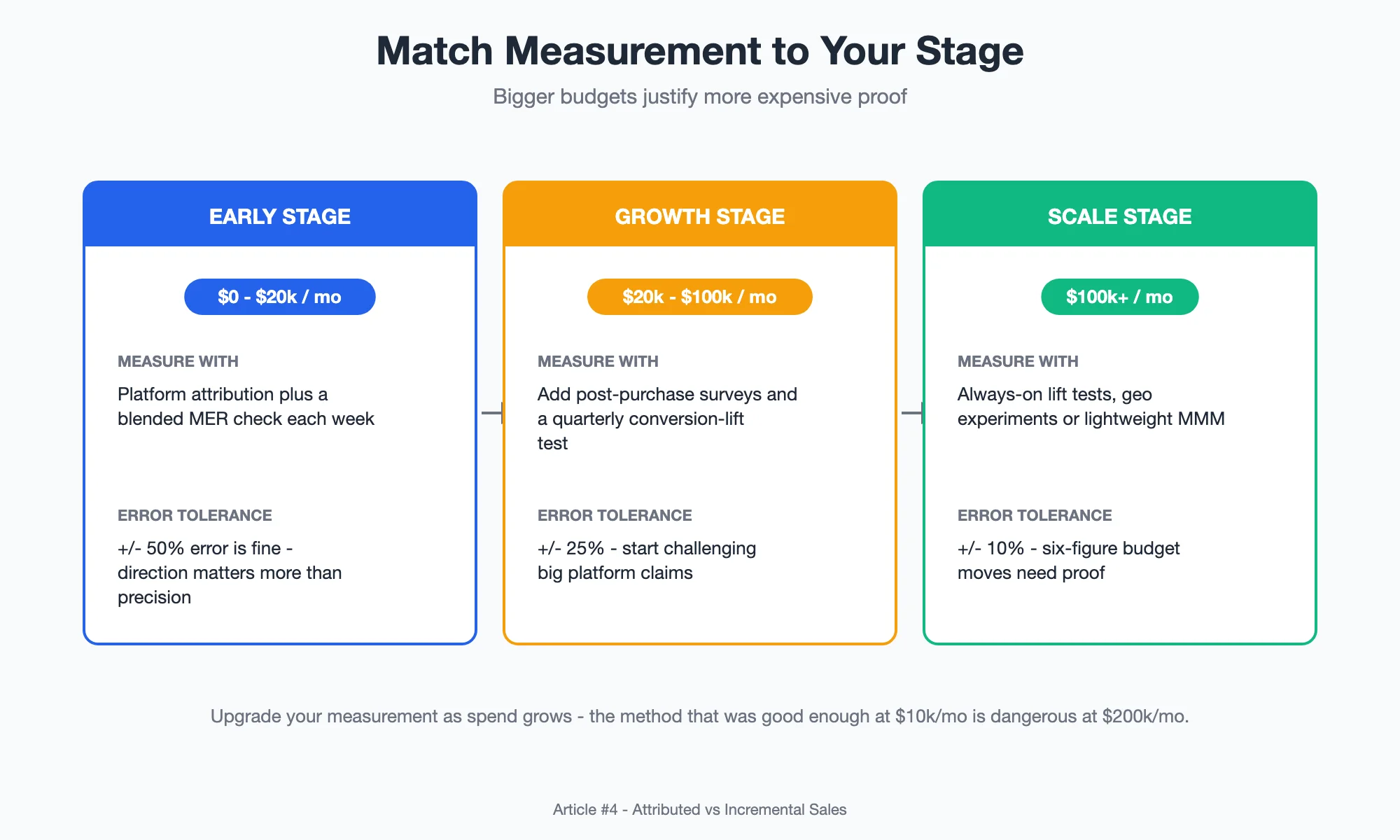
Don't treat incrementality measurement as binary (lift study or nothing). Match your approach to your business maturity:
Early-stage (<$10k monthly ad spend):
- Focus on directional signals, not precision
- Run simple holdout tests on individual campaigns
- Track organic vs. paid customer acquisition ratios over time
- Accept 20-30% measurement error; prioritize speed over accuracy
Growth-stage ($10k-$100k monthly ad spend):
- Implement geo-based experiments quarterly
- Supplement with platform incrementality estimates
- Build internal experimentation capability (dedicated media buyer owns test design)
- Target 10-20% measurement error tolerance
Scale-stage ($100k+ monthly ad spend):
- Commission annual lift studies on major channels
- Maintain continuous MMM or modeled incrementality tracking
- Invest in first-party data infrastructure to improve attribution baseline
- Target <10% measurement error
Your measurement sophistication should match your budget size. Running a $50,000 lift study when you spend $5,000/month on Meta is mathematically irrational. Running no incrementality checks when you spend $500,000/month is negligent.
What Attribution Still Gets Right
Incrementality measurement gets attention, but attribution isn't useless. It serves important functions:
Creative optimization: Attribution tells you which creatives drive conversions within the measured window. Even if those conversions aren't fully incremental, high-performing creative often indicates strong messaging that could work in incrementality-focused campaigns.
Channel comparison: While neither channel's attribution is perfectly accurate, relative ROAS differences between channels often correlate with true performance. Meta may report 3x ROAS while Google reports 5x; even if both are inflated, Google may still be more efficient.
Real-time optimization: Lift studies take weeks to execute. Attribution enables daily adjustments. Use attribution for tactical optimization, incrementality for strategic planning.
Budget pacing: Attribution helps you understand immediate campaign performance and adjust bids or creative mid-flight. Incrementality informs whether you should increase the budget at all.
The key is using each tool for its intended purpose. Don't ask attribution to answer incrementality questions. Don't let imperfect real-time data prevent you from investing in better long-term measurement.
The Real Question: Are You Buying Customers or Credit?
Before increasing any channel budget, ask:
-
What percentage of my conversions come from branded search or repeat customers? If >50%, you're likely capturing existing demand. Incrementality measurement becomes critical.
-
Do I know my organic conversion rate without ads? If you can't estimate this baseline, you can't calculate incremental impact. Start measuring organic trends immediately.
-
Am I comfortable assuming all attributed conversions are real lift? If the answer is no, invest in at least Tier 1 or Tier 4 incrementality estimation.
-
Would I continue spending if ROAS dropped 30% but incremental customer acquisition stayed flat? If yes, you're optimizing for vanity metrics. Realign incentives to incremental outcomes.
-
Can I afford to make measurement errors? Early-stage merchants can tolerate 30% error. Scale-stage merchants cannot. Match your measurement investment accordingly.
Incrementality measurement isn't about perfection. It's about avoiding catastrophic misallocation—scaling channels that look good on paper while actually cannibalizing profitable organic growth.
Sources:
- Meta Incremental Attribution Guide – Platform lift study methodology
- AnalyticaHouse Conversion Lift – Incrementality measurement fundamentals
- Klipfolio Incremental Sales – Definition and calculation framework
- Sovran Meta CPM Benchmarks – Industry performance context