How Much Does an AI Video Really Cost to Make Usable? A Merchant's Cost Model for 2026
A $50 AI-generated ad might waste more budget than a $500 human-made one if it passes quality checks but fails to persuade. Here's how to calculate actual usable-output cost including retries, fixes, and QA.
Suppose AI makes the first draft cheaper. That still leaves the expensive question: is the result accurate enough to run, and does it test a different reason to buy?
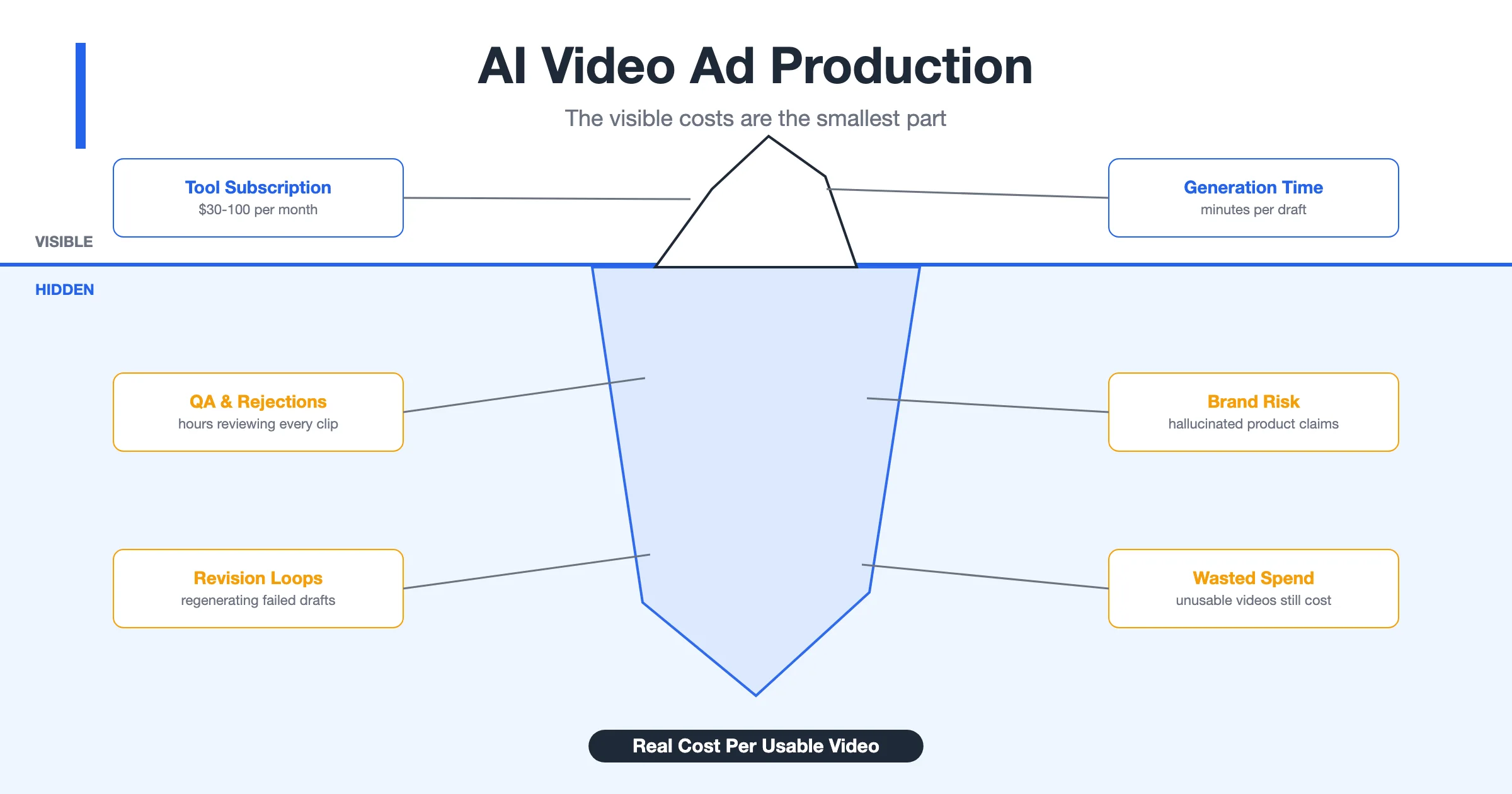
Merchants adopting AI video tools in 2026 are discovering that production cost isn't the real metric. A $50 AI-generated ad might waste more budget than a $500 human-made one if it passes quality checks but fails to persuade. The actual usable-output cost includes retries, accuracy fixes, brand safety reviews, and the opportunity cost of testing mediocre creative.
This article gives you a framework for calculating what an AI video really costs when you need it to perform—not just when you need it to exist.
What "Cost Per Video" Doesn't Tell You
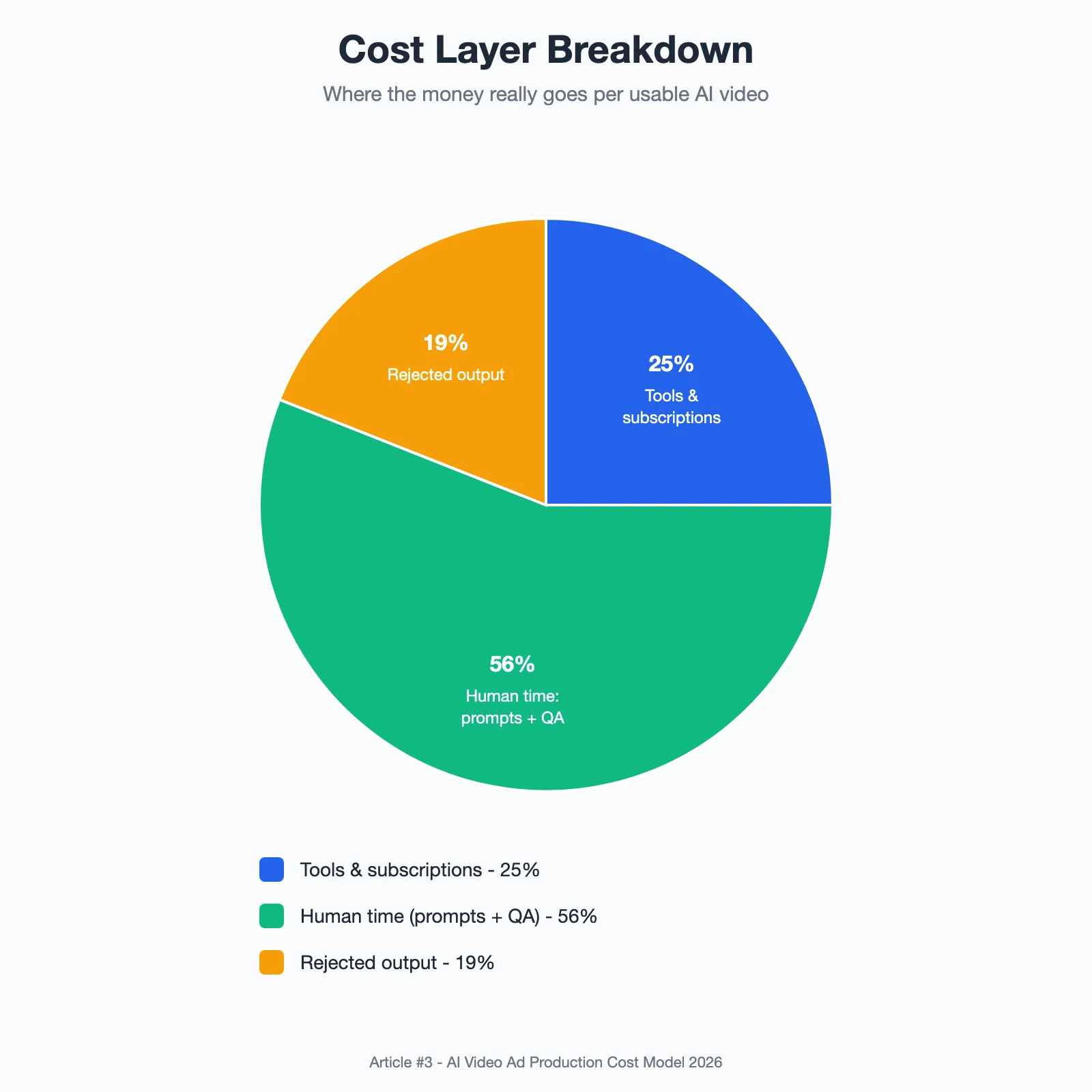
Most AI video tool pricing pages show clean tiers: $30/month for 10 videos, $100/month for 30, $300/month for unlimited. These numbers feel actionable until you discover they measure inputs, not outputs.
The hidden cost layers:
Retry rate: AI models hallucinate details—wrong product colors, distorted text, impossible physics. If 30% of your outputs need manual fixing or complete regeneration, your effective cost per usable video jumps 43%.
Accuracy verification: Can you trust the AI got your product right? Some tools claim "photorealistic rendering," but without visual QA, you're betting on luck. A single wrong product shot in a viral ad can damage brand credibility more than it helps sales.
Brand safety review: Does the AI accidentally include copyrighted music, trademarked logos, or policy-violating content? Manual review time adds labor cost on top of software subscriptions.
Modification overhead: AI outputs rarely ship pristine. Text overlays need repositioning, aspect ratios need cropping, audio needs mixing. Each edit hour is billable time whether you charge clients or allocate internally.
Performance uncertainty: Cheaper doesn't mean worse, but untested AI creative has unknown conversion rates. Running a $20 video that converts at half the rate of a $100 video means you've actually spent more per acquired customer.
The question isn't "how much does AI video cost?" It's "what's my cost per usable, verified, performance-ready video?"
A Working Cost Model for AI Video Production
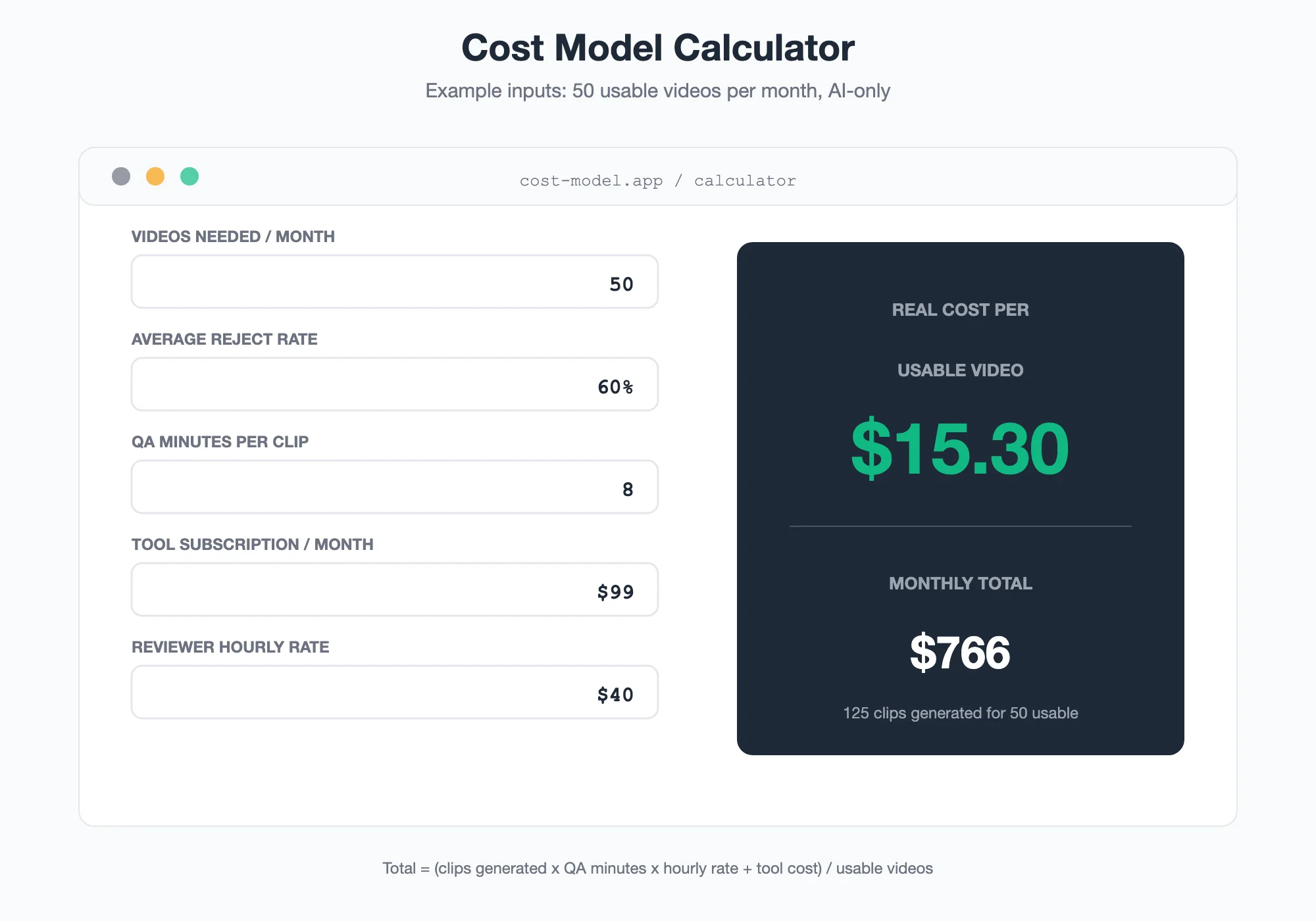
Let's build a model that captures actual economics. Suppose you're producing 20 variations monthly for TikTok before-after ads—a reasonable volume based on Stackmatix recommendations for Advantage+ campaigns.
Direct software costs:
- Mid-tier AI video subscription: $150/month (unlimited exports)
- Stock footage/music add-ons: $50/month
- Total direct cost: $200/month
Labor costs (the variable nobody budgets):
- Prompt engineering and iteration: 2 hours @ $50/hour = $100
- Quality review and selection: 3 hours @ $50/hour = $150
- Post-production fixes (text, aspect ratio, audio): 4 hours @ $50/hour = $200
- Total labor: $450/month
Failure costs:
- Failed generations (30% retry rate): 6 extra videos @ $10 equivalent each = $60
- Brand safety issues caught late: 1 revision cycle = $100
- Total failure cost: $160/month
Total usable-output cost: $810/month for 20 videos = $40.50 per usable video
Compare this to traditional production:
Traditional agency approach:
- Script development: $500
- Shooting (equipment + talent + location): $1,500
- Editing: $800
- Total per video: $2,800
- For 20 videos: $56,000/month
Hybrid human-AI approach:
- Human concept development: $800
- AI generation: $150
- Human refinement: $400
- Total per video: $1,350
- For 20 videos: $27,000/month
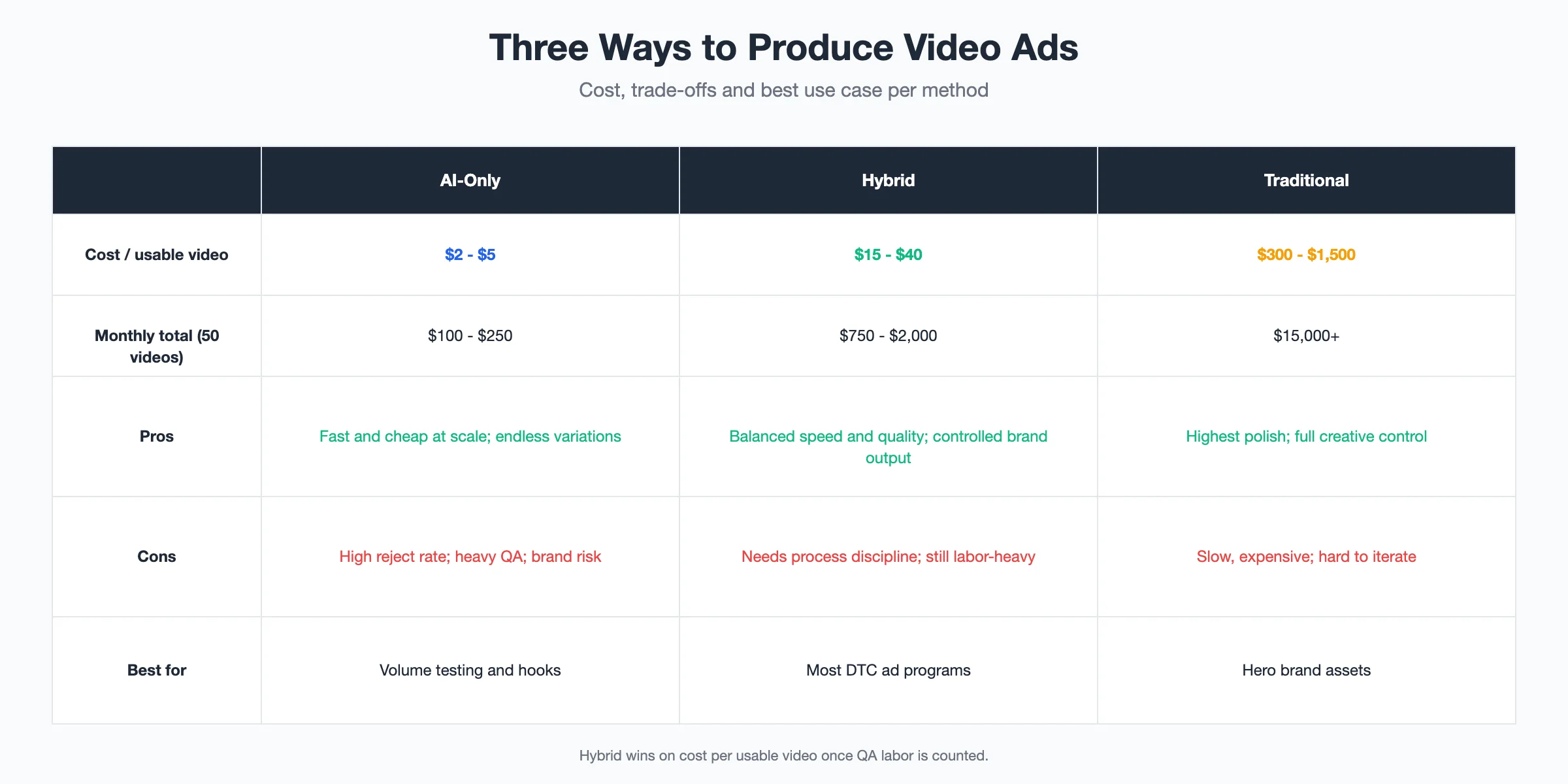
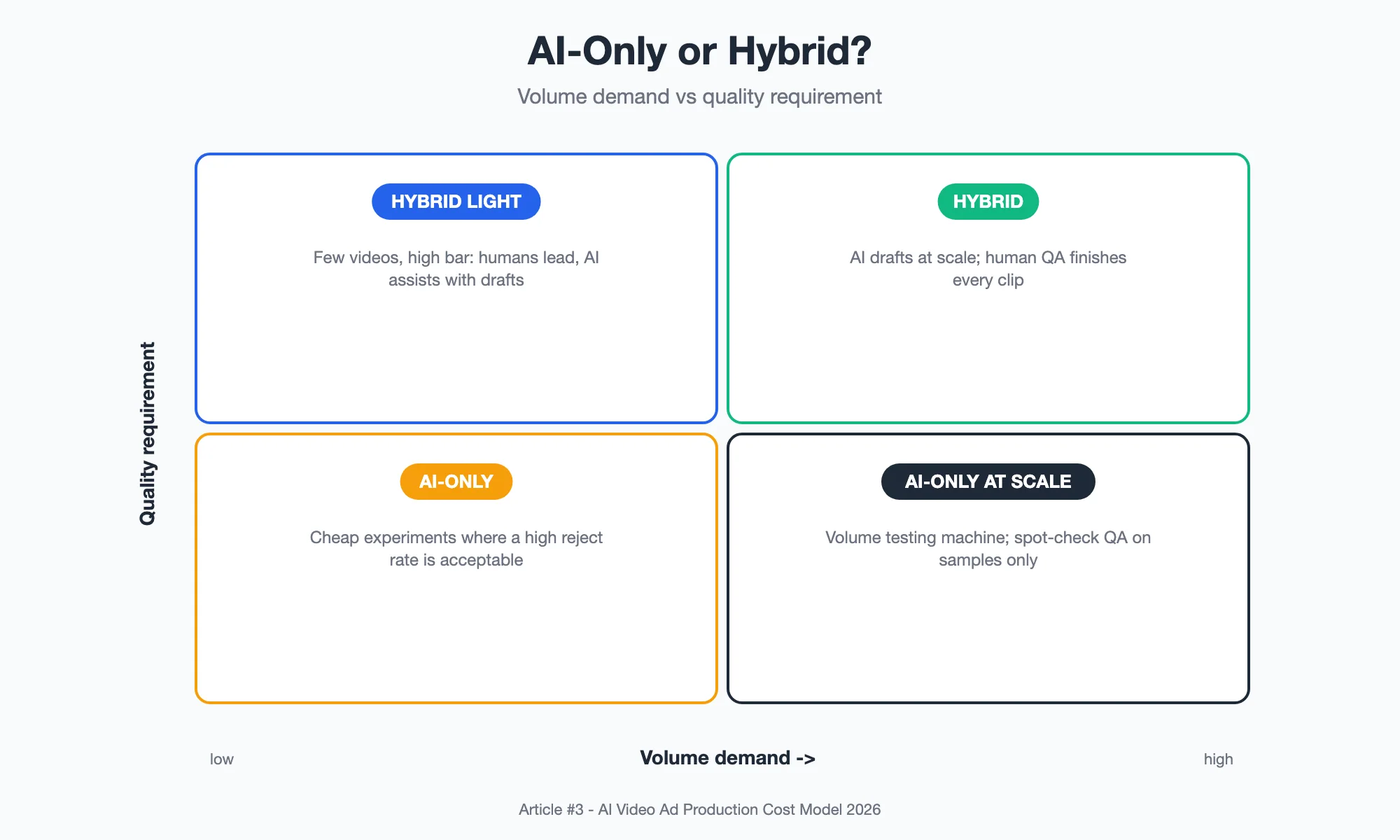
The AI-only model ($810) looks compelling versus traditional ($56,000). But the hybrid model ($27,000) sits in the middle with better quality control. Your choice depends on internal capabilities and risk tolerance.
When AI-Only Makes Sense
AI-only production works best when:
You have high-volume testing needs: Testing 50+ creative variations monthly justifies the retry rate and quality variance. You're buying learning velocity, not perfection.
Your products are visually simple: Cleaning products, basic apparel, standard accessories—these don't require complex product demonstration or nuanced storytelling.
You can tolerate performance variance: Some AI videos will convert poorly. You need statistical power to absorb the noise and find the winners.
You have cheap labor for post-fixes: $40/video becomes $60/video if your team charges $75/hour for editing time. Factor in your actual burn rate.
You're testing new markets: When entering unfamiliar audiences, you need rapid iteration to find what resonates. Perfect creative comes after you've validated the concept.
If most of these apply, AI-only is worth serious consideration. If not, hybrid or traditional may serve you better.
When Hybrid Human-AI Wins
Hybrid production—human concept + AI execution + human refinement—works when:
Brand consistency matters: Your product positioning requires specific tone, messaging, and visual identity that AI alone struggles to maintain across variations.
Product complexity demands accuracy: Electronics, skincare with ingredient claims, fitness equipment with safety considerations—these need human oversight to avoid misleading representations.
You have moderate testing volumes: 10-30 variations monthly justifies human involvement without hitting traditional production costs.
Performance predictability is valuable: You want to reduce variance in conversion rates so media buying decisions aren't guessing games.
Legal/compliance review is required: Supplements, financial products, health claims—all need human verification before publication.
The hybrid model's sweet spot is where AI handles repetitive production tasks while humans manage strategy, quality control, and brand guardrails.
A Practical QA Checklist for AI Videos
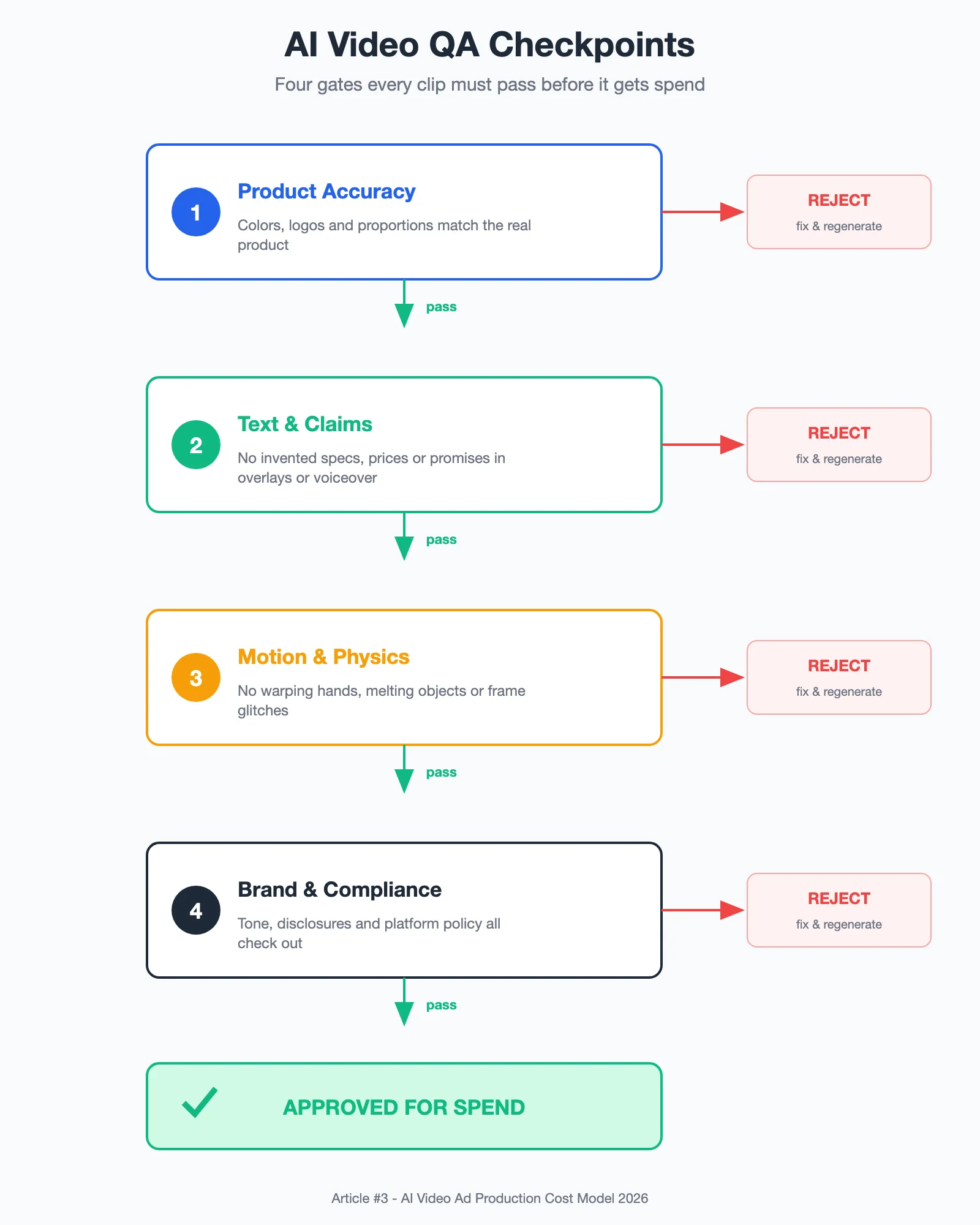
Before running any AI-generated creative, run through this checklist:
Visual accuracy:
- Product color matches reality (not shifted by AI interpolation)
- Text overlays are legible and correctly spelled
- Aspect ratios work for target placements (9:16 for TikTok, 4:5 for Instagram)
- No obvious AI artifacts (warped edges, inconsistent lighting, impossible physics)
Brand compliance:
- Logo placement follows brand guidelines
- Tone of voice matches brand personality
- No unauthorized claims or promises
- Music/license cleared for commercial use
Platform suitability:
- Hook lands within 3 seconds (no slow builds)
- Payoff timing feels native to platform (not overly produced)
- Caption/text supports rather than repeats visual message
- Call-to-action is clear and actionable
Performance indicators:
- Transformation or value proposition is visible without explanation
- Social proof elements present (reviews, metrics, endorsements)
- Emotional resonance exists (humor, aspiration, relief, urgency)
- No defensive or over-explained language
Fail any item above, and the video needs revision before spend. This isn't about perfection—it's about avoiding unnecessary waste.
The Real Question: Are You Optimizing for Cost or Learning?
Here's where merchants make strategic errors: They optimize for cost per video when they should be optimizing for cost per insight.
A $10 AI video that teaches you nothing about your audience is more expensive than a $100 video that reveals a winning creative hypothesis. The metric that matters is:
Cost per validated learning = Total production cost / Number of insights gained
If you produce 20 videos for $810 and learn three things that inform future creative direction, your cost per insight is $270. If you produce 5 videos for $2,000 and learn the same three things, your cost per insight is $667.
But if those 20 AI videos all fail to generate insights because they're too similar or too low-quality to test meaningfully, your cost per insight is infinite.
The framework shifts from "cheapest video possible" to "cheapest way to get reliable learning." Sometimes that's AI-only at scale. Sometimes it's hybrid with tighter quality control. Sometimes it's traditional production for flagship campaigns.
Your answer depends on:
- How many distinct creative hypotheses do you need to test?
- How much variance can you tolerate in conversion rates?
- How quickly do you need to iterate based on results?
- What's the cost of a wrong decision versus the cost of a right one?
There's no universal answer. But there is a calculable one for your specific situation.
Sources:
- Stackmatix Creative Volume Recommendations – 20-50 monthly variations for ASC success
- Darkroom Agency Creative Fatigue Framework – Performance testing methodology
- SitePoint AI Video QA Checks – Quality assurance principles for AI output
- Overseas CMCM A+ Creative Analysis – Meta A+ Creative automation insights