The 5 Ad Formats Still Winning in 2026 (Copy-Paste Formulas)
Five repeatable, cross-platform performance-ad formats with the mechanism behind each and opening lines you can steal today, plus how to check whether your winner is real.

Most "best-performing ad" advice is a screenshot of someone else's winner, posted with no explanation of why it worked or when it would fail for you. This is the opposite. Below are five repeatable performance-ad formats, the mechanism behind each, and the opening line you can lift today. They travel across TikTok, Reels, Shorts, Meta feed, and YouTube pre-roll because they exploit how people actually watch on a phone — not because one algorithm currently happens to reward them.
One honest note before the list. This is a practitioner's playbook, not a benchmark report. There is a single data point I cite and link to; everything else is structure you can steal and then test on your own account. When you do test it, watch out for the measurement trap where platform-reported conversions quietly overstate what your ad actually caused. A format that "wins" in the dashboard may have won nothing. Treat every line here as a hypothesis to prove cheaply, not a rule to obey.
The one framework worth anchoring to is Google's ABCD model of effective video ads, built with Kantar. Its four principles — Attention, Branding, Connection, Direction — and the guidance to "jump in," brand "early and often," "hero the product," and "be exact and tangible" with your call to action, show up inside almost every format below. Google reports that applying the principles drove as much as a 30% lift in short-term sales likelihood, which is a ceiling from one vendor's own study, not a promise for your brand. Use it as a checklist, not a forecast.
1. The pattern-interrupt cold open
In one line: Win the first second with something unexpected, then explain it.
Why it works: On a phone, the viewer decides to keep watching before your value proposition finishes loading. The safest opening — a slow logo sting, a wide establishing shot, a greeting — is exactly the opening the thumb swipes past. Front-loading the interesting frame buys you the next three seconds. This is the "jump in: get to the heart of the story faster" move from the ABCD Attention principle.
Structure: Cold-open on the surprising visual or claim → one line of context → product → proof → ask. The odd thing you open on should be true about the product, not clickbait you later have to walk back.
Steal-this hooks:
- "I didn't expect [specific result] from something this cheap."
- "Everyone does [common task] wrong. Here's the 10-second fix."
- "Stop [belief everyone holds]. It's costing you [concrete loss]."
- "Nobody talks about the [category] problem like this."
- "POV: you finally found a [product type] that doesn't [annoying failure]."
Don't: Open on your brand, a logo animation, or "Hey guys." Don't lead with a hook the rest of the ad can't honor.
2. The watch-it-work demo
In one line: Show the product doing the thing, at the moment it does the thing.
Why it works: Seeing is believing in a way telling never is. For consideration-stage shoppers, watching the mechanism resolve the doubt that reading a benefit line can't. Google's own objective guidance puts "hero the product" and "show how it works" under the consideration goal for exactly this reason. It also happens to be the most honest format: a product that can't survive being watched work is a product you shouldn't be scaling.
Structure: Result-first tease (0.5s) → the hands-on process, uncut → the payoff → one differentiator → ask. Keep the camera close and the action continuous; jump-cuts that hide the actual mechanism erode trust.
Steal-this hooks:
- "Watch what happens when I [action] on this [surface]."
- "30 seconds, no cuts. Can your [product] do this?"
- "This is the [task] that used to take me an hour."
- "From [before state] to [after state] in one go — no editing."
Don't: Fake the demo with a stock clip or a cut at the critical moment. One dodgy frame costs more trust than a hundred polished ones earn.
3. The talking-head proof (founder or customer POV)
In one line: A real person, to camera, making one specific claim they can defend.
Why it works: Faces and voices trigger a social response that text-over-b-roll doesn't, and the ABCD "Connection" principle tells you to feature people and humanize the story. A single spokesperson holding one focused idea outperforms a montage of five half-made points. The format also carries your tone and objections in a way product-only footage can't.
Structure: Direct address + one bold-but-true claim → why they personally trust it → one proof or story → one objection, answered → ask. Shot phone-forward, eye contact, sound-on, subtitled.
Steal-this hooks:
- "I built this because [specific frustration] kept happening."
- "If you're [audience], stop scrolling — this fixes [pain]."
- "Three months in, here's what [product] actually changed."
- "I was skeptical too. Here's what convinced me."
Don't: Read a scripted pitch like a scripted pitch. Don't stuff five benefits into one head — pick the one that sells.
4. The objection-killer
In one line: Name the reason people don't buy, and defuse it on camera.
Why it works: Most ad spend doesn't fail on desire — it fails on a quiet unresolved doubt ("will it fit my skin / my stack / my budget / my kitchen"). The ABCD "Connection" guidance to "focus the message: avoid doing too much" is really about removing friction, and nothing removes friction like saying the doubt out loud before the viewer does. This format converts hesitant-but-interested viewers, which is the cheapest segment to win.
Structure: State the exact objection → address it with evidence or a demo → reframe the risk → low-pressure ask. One ad, one objection. List the top three objections from your support tickets or comment section and film one short per objection.
Steal-this hooks:
- "'But isn't it too [expensive/complicated/small]?'" — then answer it.
- "The #1 thing people ask before buying this, answered."
- "I know what you're thinking. Here's why that's wrong."
- "Return it if [specific worry] turns out true. But it won't."
Don't: Invent an objection nobody has, or dodge the real one. And don't bury the price or a caveat, so a "proven" hook becomes a trust problem.
5. The exact-offer close
In one line: Make the deal concrete and time-bounded, and say the ask plainly.
Why it works: After attention and belief, the deciding factor is often clarity, not persuasion. Google's "Direction" principle and the action guidance — "make the product the ad, be exact and tangible, present the ask after the context is set" — all point the same way: vague CTAs leak the people you already convinced. Specificity ("two for the price of one, this week") beats enthusiasm.
Structure: One-line recap of the value → the exact offer (price, bundle, trial, or deadline) → the risk-reversal → the literal ask ("tap to claim, code CF20"). Put the ask after the context, not before, so it lands on a warm viewer.
Steal-this hooks:
- "Here's the deal: [exact offer] if you [action] before [deadline]."
- "One click gets you [specific outcome]. That's it."
- "First [N] people get [bonus]. Then it's gone."
Don't: Ask twice for two different things. Don't dangle an offer you won't honor — it poisons every retargeting ad that follows.
Stitching one 15-second ad
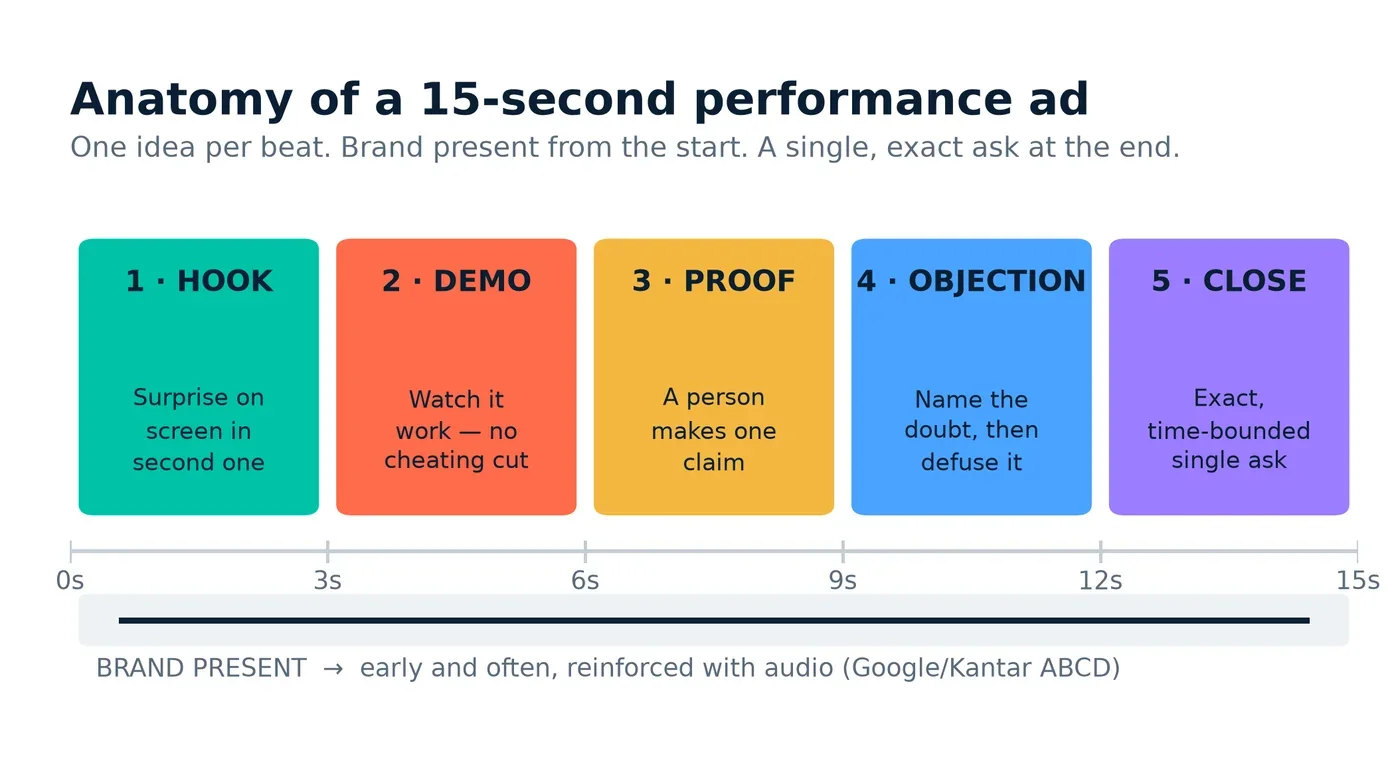
These aren't five competing ideas; they're five beats you can stack. A tight short-form performance ad usually runs hook → demo → talking-head proof → objection → close, roughly one beat every three seconds, with the brand present from the start and the ask at the end. The shape matters more than the polish: sound-on, vertical, subtitled, one idea per beat.
The part that actually decides your results
The format is maybe half the job. The other half is knowing whether the "winner" in your reporting is a winner at all. Attributed conversions and true incremental conversions are different numbers, and picking the format that looks best in an inflated report can send you scaling a loser. The teardown of why this 20-second egg-poacher ad works shows how to read a single creative closely; the CreativeFly workspace guide walks you through generating and testing several variants from one hypothesis in one place. Start from a format above, produce three takes, then let measured lift — not a dashboard smile — pick the one you scale.