You Don't Need a Better AI Video Prompt. You Need a Proven Template.
Most merchants fail at AI video because they're authoring prompts instead of choosing proven structures. A CreativeFly template carries the source campaign's real views, ROAS, and spend — you swap in your product image and model, and generate. Here's why choosing beats authoring.
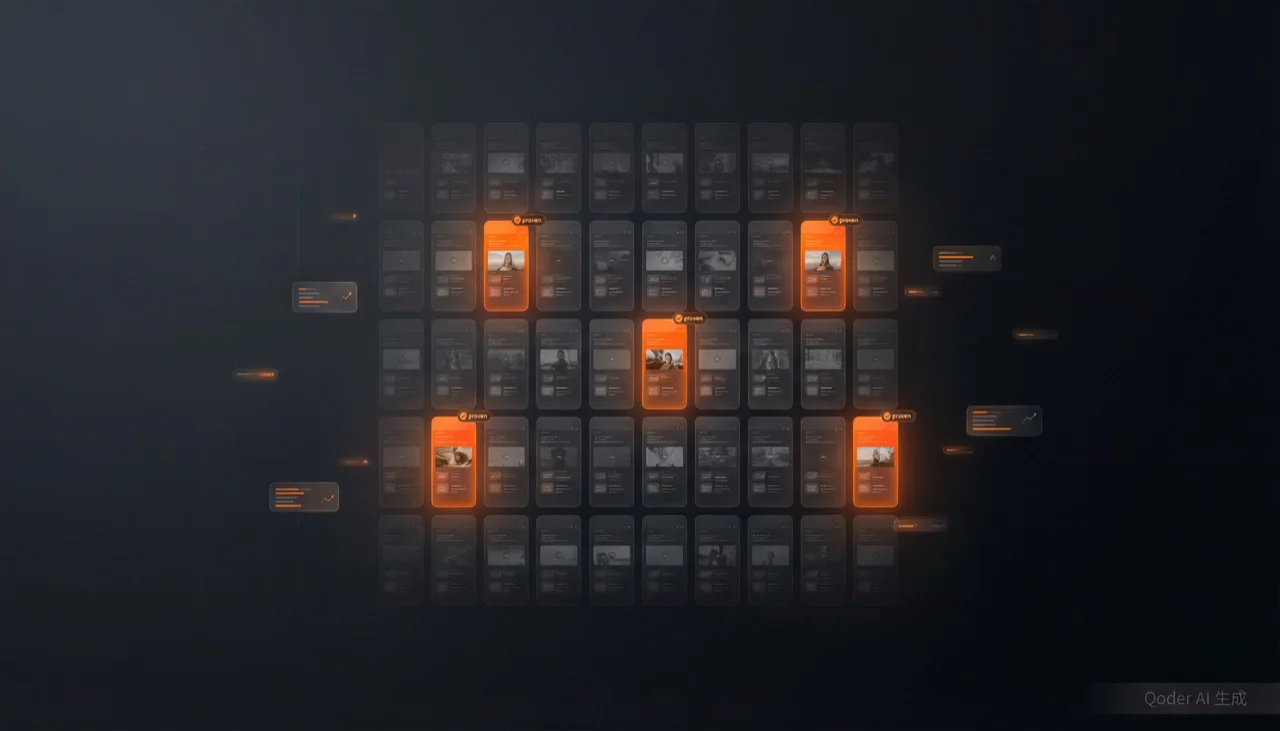
Here's the scene every merchant knows too well. You open an AI video tool, the demo makes it look trivial — type a line, get a scroll-stopping ad — so you write your own. Twenty minutes and a couple hundred credits later you have a clip that is technically a video and completely un-shippable. The product looks fine. Everything around it is flat, generic, and would be dead in the feed within two seconds.
The tool didn't lie. It really is that easy to make a video. It skipped over the part where you have to make an ad that wins an auction. Those are different jobs.
The gap between them is what I'd call the blank-prompt tax — paid in credits, hours, and slowly draining confidence. Most merchants conclude, from their own evidence, that "AI video isn't there yet." It is. They were authoring when they should have been choosing.
The model was never your problem. The blank prompt was.
A high-performing AI video prompt is holding five things in the air at once, and a merchant shouldn't have to learn any of them:
- The hook. What happens in frame one, and whether it lands as a creator recommendation, an unboxing reveal, or a before/after payoff. Wrong opening, nobody's still watching.
- Shot logic and pacing. Camera move, beat length, where the product enters, when the reveal hits. One lazy transition and "premium" becomes "AI slop."
- Consistency. Same face, same hands, same product geometry across every cut. This is the #1 failure — models love to quietly redesign your bottle between shots.
- Brand and compliance. Right pronunciation, no invented claims, nothing that trips ad review. In finance and health especially, one overclaim kills the whole thing.
- The negatives. Everything you have to explicitly forbid: warped text, extra fingers, a new room, a face that drifts into a stranger.
Prompt craft is mostly knowing which of these to enforce so the model doesn't take the lazy path. That's a skill. It should not be your skill.
What a CreativeFly template actually is
Not a Canva frame with a placeholder. A CreativeFly template is the reverse-engineered blueprint of a real ad that already ran and already worked. All the messy craft above — the hook structure, the pacing, the way the product is revealed, the compliance-safe framing — is already baked into the template's own prompt.
What's left for you is the only two things a template can't know: your product image and your model. The workflow is upload → reference → replicate. Pick a template, swap in your product and a person, and the detailed prompt auto-adapts to your inputs and submits the job. An ~11-second Seedance 2.0 clip costs on the order of 79 credits. You're not facing a blank prompt box. You're pointing a proven structure at your SKUs.
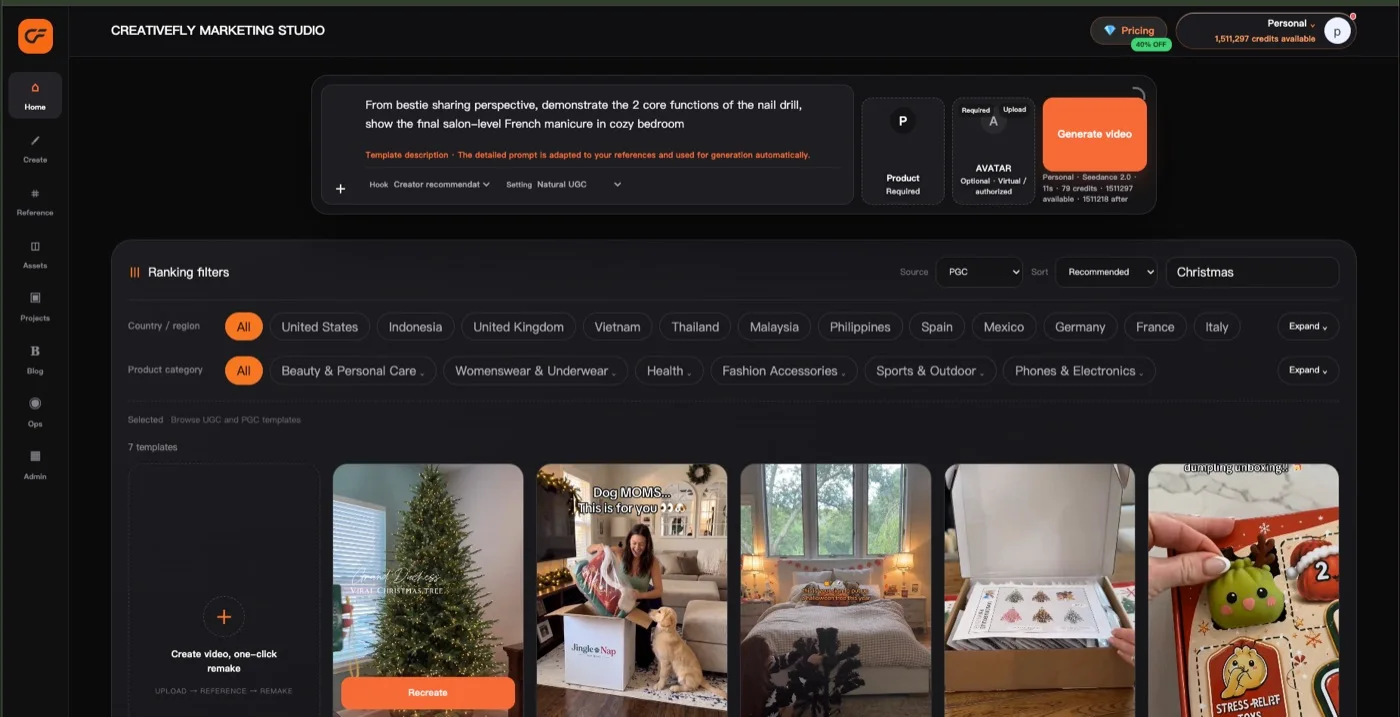
The only two fields that are yours: product image and model. Everything else is already decided by a structure that worked.
Even the creative levers a good prompt would encode are there as plain choices: opening hook (creator recommendation / unboxing reveal / before-after), and visual treatment (real UGC / commercial studio / fast-paced social). You set them by preference instead of discovering them the hard way.
The receipts: templates that ship with the ad's actual numbers
This is the part that turns "nice idea" into an argument. On the PGC board — professionally-produced reference ads, versus the creator-style UGC side — every template carries the performance of the real campaign it was modeled on: view range, ROAS range, total spend. You can check it in ten seconds. Go to the template browser, search "Christmas," flip the source filter to PGC, and the results each show their numbers.
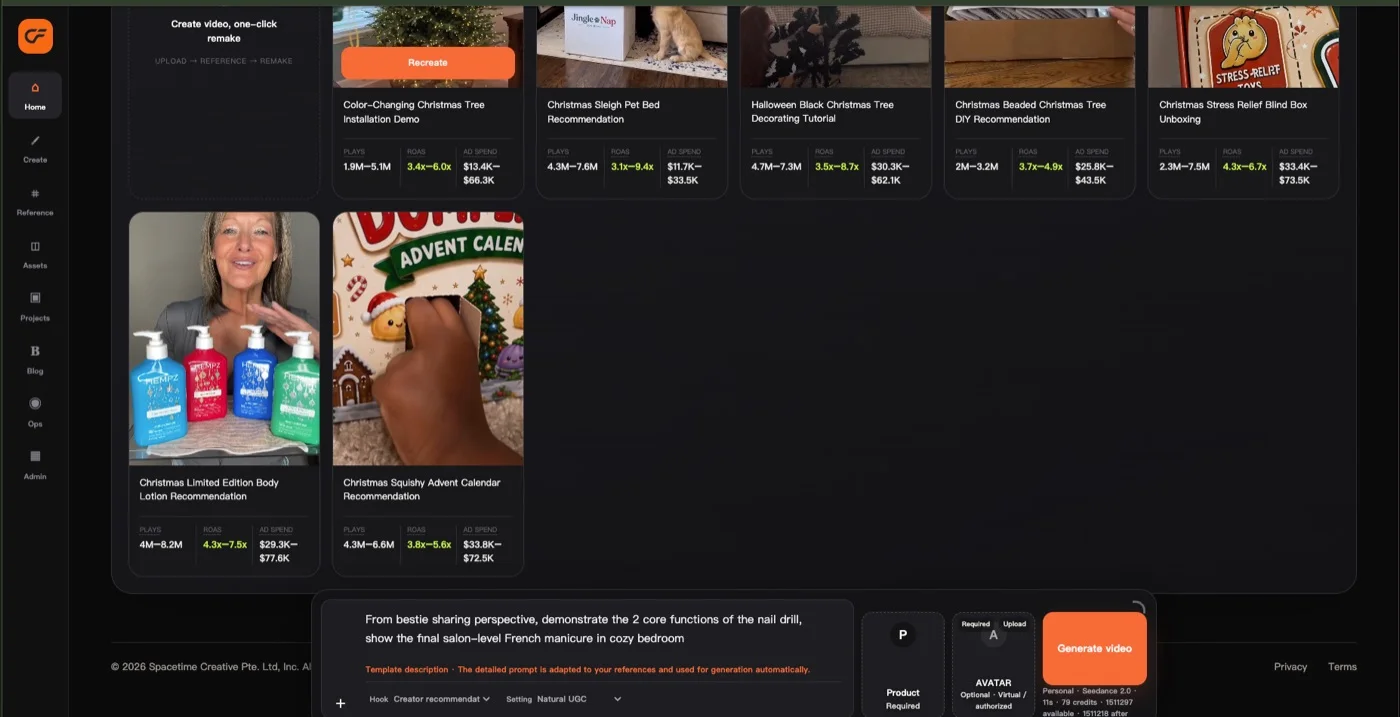
Search "Christmas", flip to PGC, and every card carries its source campaign's views, ROAS, and spend — visible before you spend a single credit.
That's not decoration. The "color-changing Christmas tree install demo" template you'd be cloning came from an ad that pulled roughly 1.9M–5.1M views at 3.4x–6.0x ROAS on $13.4K–$66.3K of spend. The "Christmas sleigh pet bed" template: 4.3M–7.6M views, 3.1x–9.4x ROAS. Sort the whole PGC library by ROAS and the same picture shows up across verticals:
| CreativeFly PGC template | Views | ROAS | Ad spend |
|---|---|---|---|
| Folding phone-case home demo | 5.4M–8.1M | 3.4x–9.3x | $25.6K–$66.6K |
| Hidden vanity home reveal | 2.3M–4.6M | 4.3x–9.6x | $13.4K–$25.4K |
| Handmade leather phone-case demo | 4.1M–7.9M | 5.2x–6.3x | $62.6K–$98.7K |
| Leather folding case 3D showcase | 2.5M–9.6M | 5.3x–6.4x | $18.5K–$79.6K |
| Pink polka-dot folding case | 2.3M–7M | 3.4x–9.7x | $20.5K–$53.9K |
| Christmas limited body lotion | 4M–8.2M | 4.3x–7.5x | $29.3K–$77.6K |
There are 727 PGC templates like this, and 3,103 total once you add the UGC side. The point isn't that one of them guarantees you 9x. The point is the structure you inherit already survived a real auction against real fatigue — and the blank prompt you were about to write has survived nothing except your own optimism.
Why choosing beats authoring every time
Three reasons this moves your success rate, not just your mood:
You start from a working prior, not a coin flip. A blank prompt is one sample from a huge space of plausible-but-mediocre videos. A template is a narrow, pre-tuned slice of that space — the slice someone already paid to prove works. Your first render is far more likely to be usable, which is the whole game on a small budget.
Iteration gets cheap and directional. At ~79 credits a clip, running three templates on one product and keeping the winner isn't a gamble, it's a Tuesday. Three blank-prompt attempts are just three essays you have to write — and you probably can't tell attempt two from attempt three anyway.
The failure modes are pre-handled. Consistency, pacing, compliance — the stuff that quietly sinks merchant-authored prompts — is already solved inside the template. You spend your limited skill where it matters: picking the right template for your product.
Use it well (the 15-minute version)
Filter to your market first. The browser sorts by country/region and product category, so start in your vertical and your ad market — a finance structure that works in Indonesia and a phone-case structure that works in the US are different animals.
Sort by what you're optimizing. The options are recommended, views, ROAS, and longest-running. Want proven efficiency, sort by ROAS. Want creative that survived fatigue over months, sort by longest-running — longevity is the best "not just loud, but durable" filter there is.
Match the hook to what your product can honestly deliver. A before/after template is brilliant for a cleaning gadget and a lie for a commodity accessory.
Bring one clean product shot. The template handles the ad; you handle the product. A sharp, well-lit image of the actual SKU is the single biggest input on whether the output looks like yours.
Run a small set, ship the winner, kill the rest. Two or three templates, same product, compare. Spend credits like a media buyer spends test budget — to find the one that scales.
The fine print, because we'd rather be straight with you
A template doesn't launder a bad product photo or a bad offer. And those ROAS figures are the performance of the source campaign — its market, its product, its landing page, its price. They're proof the structure works, not a forecast for your account. Anyone who's run ads should distrust a tool that promises 9x, so we won't.
What templates genuinely do is delete the part of the job that was never yours — the prompt craft, the consistency wrangling, the compliance landmines — so a merchant with a real product and no prompt engineer can ship ads that look like they came from a team that has one.
Stop paying the tax
You were never meant to author the prompt. You were meant to pick the right proven one and point it at your product.
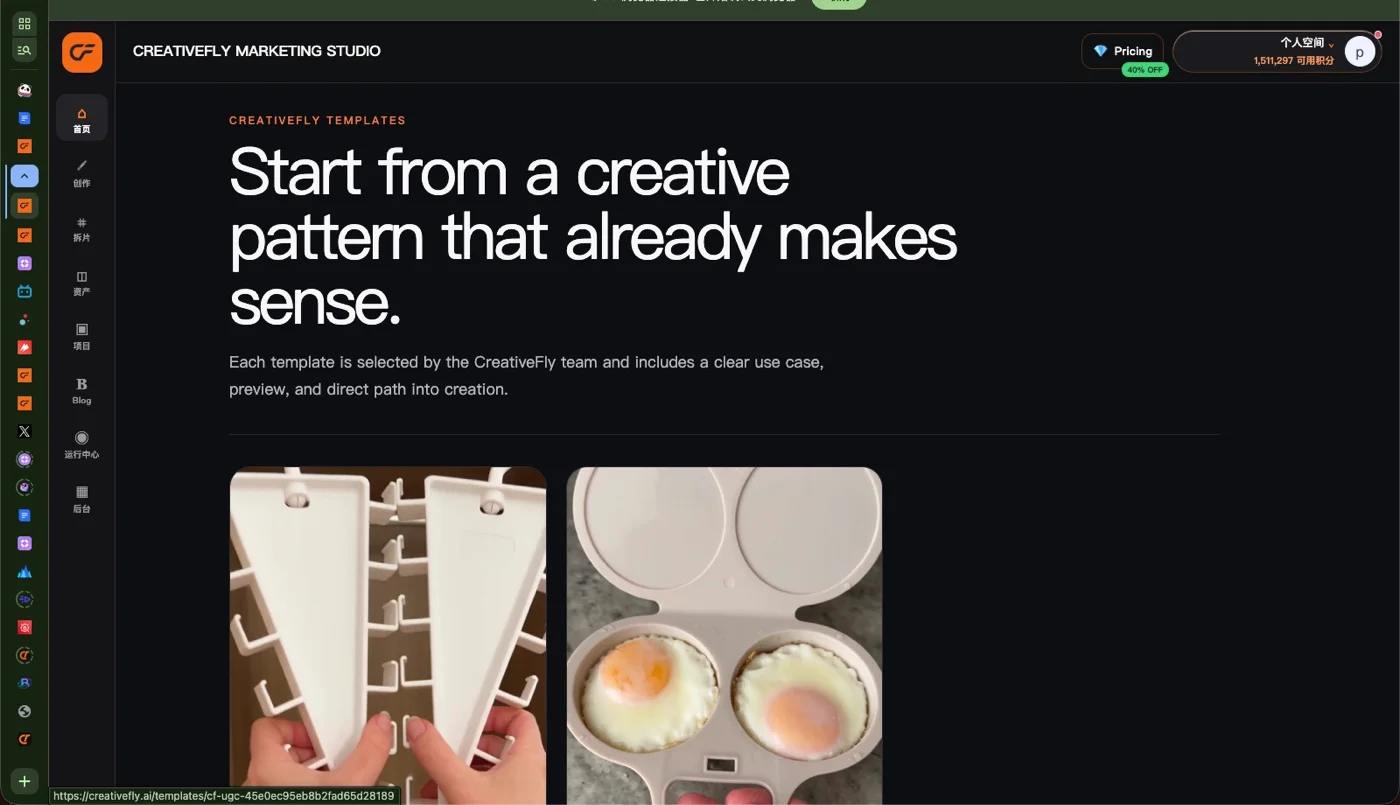
creativefly.ai/templates — every listing is team-reviewed and links straight into creation.
Browse the reviewed library at creativefly.ai/templates, or open the Marketing Studio, search your category, flip to the templates carrying real campaign data, swap in your product and model, and generate. Start from a creative pattern that already makes sense. The blank-prompt tax is optional. Stop paying it.